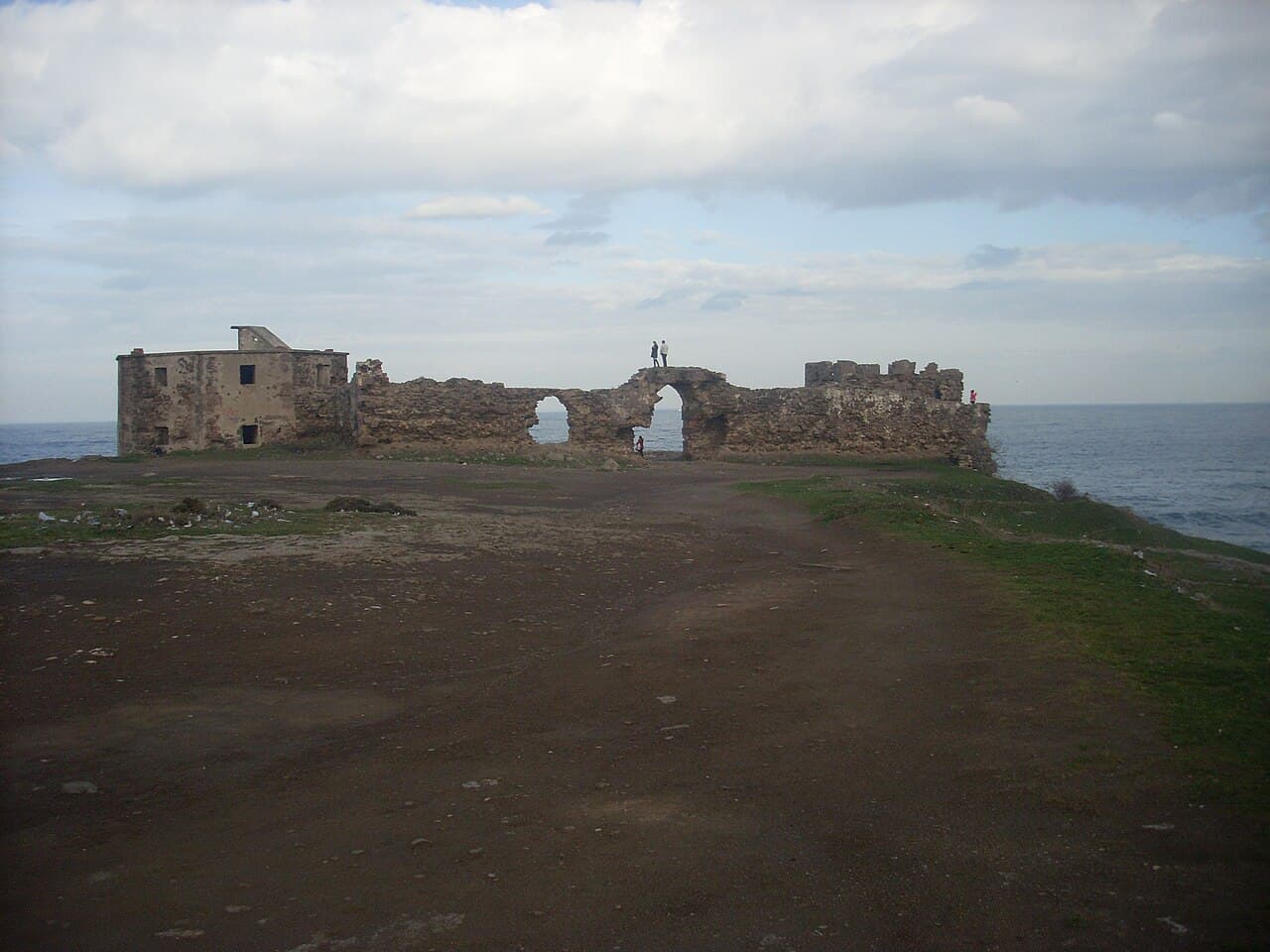
Rumelifeneri Castle
Rumelifeneri Castle, locally known as Rumeli Feneri Kalesi or Topçu Kalesi, stands prominently on the Black Sea coast in the village of Rumelifeneri within Istanbul Province, Turkey. The castle takes its name from the nearby Rumeli Feneri lighthouse, a historic beacon that has long guided maritime traffic entering the Bosphorus Strait from the Black Sea. This fortress represents a significant military installation from the late medieval to early modern Ottoman period, with a complex history reflecting the strategic importance of the Bosphorus as a vital waterway connecting the Black Sea to the Mediterranean.
While the precise origins of Rumelifeneri Castle remain somewhat unclear, it is widely accepted that the existing structure dates primarily to the 18th century. Local tradition and some historical sources suggest that the site may have hosted earlier fortifications, possibly constructed by the Byzantines or Genoese during the 15th century, but definitive evidence for these claims is lacking. The earliest firm Ottoman record of the castle's construction or major rebuilding comes from 1769, when an unnamed Greek engineer in Ottoman service is credited with its design. Subsequent modifications and enhancements were carried out by a series of French military engineers—including Toussaint in 1783, Latiffe-Clavé in 1785, and Monnier in 1794—reflecting ongoing efforts to modernize the fortress in response to evolving military technology and threats.
Historical significance and strategic role
Rumelifeneri Castle occupies a commanding position overlooking the northern entrance to the Bosphorus Strait, a critical maritime chokepoint that has been fiercely contested throughout history. The site, historically known as Panyum Burnu in antiquity and later as Fanariyan Burnu during Byzantine times, was traditionally used as a landmark where fires were lit to guide ships safely through the treacherous waters. This longstanding maritime function is preserved in the castle's name, which translates as "Roman Lighthouse," and in the adjacent village and lighthouse that continue to serve navigational purposes.
Throughout the Ottoman period, Rumelifeneri Castle served primarily as a coastal fortress and artillery battery, tasked with defending the northern Bosphorus entrance against naval incursions from the Black Sea. It housed a garrison of approximately 300 soldiers and included facilities such as troop quarters, ammunition and grain storage, and a mosque, underscoring its role as a fortified military community. The castle's walls underwent repairs ordered by Sultan Murad IV after damage sustained in 1624, indicating the site's longstanding military importance even before the current structure was completed.
Architectural features and layout
Set atop ridges rising about 58 meters above sea level, the castle covers a rectangular footprint measuring approximately 55 by 70 meters, encompassing some 46,000 square meters. Its design incorporates chamfered (beveled) corners on the northeast and northwest sides, a defensive feature intended to improve the field of fire and reduce blind spots along the curtain walls.
The fortress's walls are constructed using a combination of rubble masonry, roughly hewn stones, and bricks, a layered technique typical of Ottoman military architecture in the 18th century. Two octagonal towers anchor the eastern and western walls, providing elevated positions for artillery and observation. The western tower underwent significant modifications in the 20th century, including the installation of concrete flooring and reinforced walls, reflecting its continued military use into the modern era.
The main entrance is situated on the southwest side, marked by a robust arched gate constructed from heavy stone blocks designed to withstand assault. Inside the castle, no elaborate interior decorations or chambers survive, as the structure primarily served a utilitarian military function.
The lighthouse and maritime heritage
Adjacent to the castle stands the Rumeli Feneri lighthouse, a 30-meter-tall beacon historically powered by kerosene and later acetylene gas. The lighthouse's light reaches up to 18 nautical miles, continuing the site's centuries-old tradition of aiding navigation at the Bosphorus entrance. This maritime heritage complements the castle's defensive role, linking the fortress to the broader history of seafaring and trade in the region.
Later history and preservation
Following the decline of the Ottoman Empire and the establishment of the Turkish Republic, Rumelifeneri Castle retained some military significance and was used as a strategic outpost during the 20th century. However, much of the fortress fell into disuse and disrepair over time, with many structural elements deteriorating or lost.
Today, Rumelifeneri Castle remains in a state of ruin, with its walls and towers still standing as evocative reminders of its former military might. The site is freely accessible to the public and has become a popular destination for locals, especially on weekends, who come to enjoy the scenic views of the Black Sea and the dramatic waves crashing against the rocky shore below the fortress.
Since 2008, the castle and its surroundings have been legally protected as a First Degree Natural Site, ensuring conservation efforts and safeguarding its cultural and historical significance for future generations. Its combination of strategic location, architectural features, and maritime heritage make Rumelifeneri Castle a noteworthy example of Ottoman coastal fortifications.
Visitor information and experience
Visitors to Rumelifeneri Castle can explore the exterior walls and towers, gaining insight into 18th-century Ottoman military architecture and coastal defense strategies. The site offers panoramic views of the Bosphorus Strait and the Black Sea, making it a favored spot for photography and relaxation. While the interior is largely inaccessible due to its ruined condition, the castle's setting and historical context provide a compelling experience for history enthusiasts and casual tourists alike.
The castle's proximity to Istanbul makes it an accessible day trip destination, combining cultural heritage with natural beauty. Visitors are advised to wear sturdy footwear due to uneven terrain and to check local conditions before visiting, as the site is outdoors and exposed to the elements.
Frequently asked questions (FAQ)
- What is Rumelifeneri Castle known for?
- Rumelifeneri Castle is a historic fortress located at the northern entrance of the Bosphorus Strait in Turkey. Built in the 15th century, it played a significant role in controlling maritime traffic and safeguarding the area against potential invasions.
- When was Rumelifeneri Castle constructed?
- The construction of Rumelifeneri Castle began in 1452, commissioned by Sultan Mehmed II as part of his strategic preparations for the conquest of Constantinople. It has since stood as a testament to the military architecture of the Ottoman era.
- Can I visit Rumelifeneri Castle?
- Yes, visitors are welcome to explore Rumelifeneri Castle and its scenic surroundings. There are no strict entry requirements, but be sure to respect the site's historical significance during your visit.
- What are the opening hours for Rumelifeneri Castle?
- Rumelifeneri Castle is generally open to visitors daily from 9 AM to 7 PM, allowing ample time to explore its grounds and enjoy the views. However, hours may vary seasonally, so it's advisable to check ahead before your visit.
- Is there an entrance fee to visit Rumelifeneri Castle?
- There is typically a small entrance fee to access Rumelifeneri Castle, making it an affordable outing for history enthusiasts and tourists. This fee helps with the maintenance and preservation of the castle.
- What is the best time to visit Rumelifeneri Castle?
- The best time to visit Rumelifeneri Castle is during the spring and fall when the weather is mild and the views are particularly stunning. Summer can be hot, while winter may bring chilly winds, especially near the Bosphorus.
- Are there any nearby attractions to Rumelifeneri Castle?
- Yes, nearby attractions include the charming village of Rumelifeneri itself, along with scenic walking trails along the Bosphorus. Visitors can also enjoy local restaurants and cafes offering traditional Turkish cuisine.
- How do I get to Rumelifeneri Castle?
- To reach Rumelifeneri Castle, you can take public transportation from central Istanbul to Sarıyer and then use a taxi or local bus to get to the castle. The scenic drive along the coast adds to the overall experience of visiting this historic site.
Photo gallery

Information
Website
Visit websiteSources & official resources
Verify the information above using these authoritative references.
Loading map...
Visitor reviews
No reviews yet. Been here? Write the first review and help other travelers!
Write the first reviewVisited this castle? Share your experience
Your review helps other travelers and adds first-hand knowledge to our encyclopedia.



