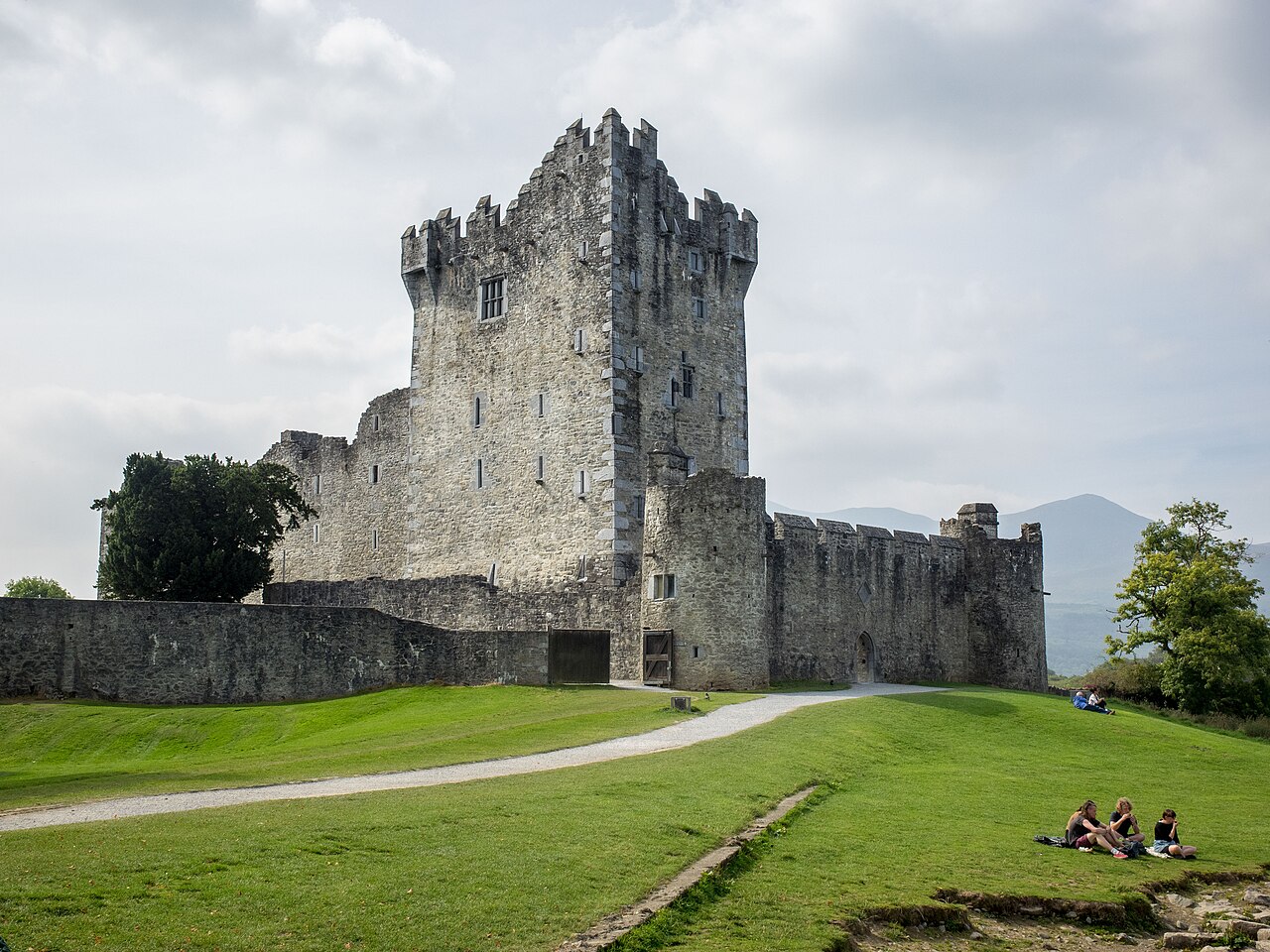
Ross Castle
Ross Castle, also known as O'Donoghue Castle, is a striking 15th-century tower house situated on the scenic shore of Lough Leane within Killarney National Park in County Kerry, Ireland. This castle stands as a significant example of late medieval Irish defensive architecture and is closely linked to the history and culture of the O'Donoghue Mor clan, its original builders and inhabitants.
Constructed in the late 15th century, Ross Castle was designed as a formidable rectangular tower house surrounded by a protective bawn—a defensive courtyard wall—with round towers at each corner. This layout reflects the typical architectural style of Irish tower houses of the period, combining residential comfort with strong defensive capabilities.
The castle's strategic location on Ross Island allowed control over the surrounding lands and the lake, playing a crucial role in regional power dynamics. The O'Donoghue Mor clan used the castle as their chief seat, maintaining authority over the local territory.
Historical significance and ownership transitions
During the turbulent 16th century, Ross Castle witnessed significant changes in ownership and function. In the 1580s, amid the Second Desmond Rebellion, control passed to the MacCarthy Mor clan. Subsequently, in 1588, the castle was mortgaged to Sir Valentine Browne, an English official, marking the beginning of Anglo-Irish influence in the area.
The castle's role in the Irish Confederate Wars (1641–1652) is particularly notable. It was one of the last strongholds to resist Oliver Cromwell's forces. Defended by Donough MacCarthy, Lord Muskerry, the castle withstood a siege by a Cromwellian army led by Edmund Ludlow. The siege ended only after the attackers deployed artillery from boats on Lough Leane, fulfilling a local prophecy that the castle would remain impregnable until attacked from the water.
After the wars, the Browne family retained ownership by proving their non-involvement in the rebellion. Around 1688, they constructed a nearby mansion, which led to the partial demolition of the castle's western bawn wall. However, their support for King James II during the Williamite War resulted in their exile.
Subsequently, Ross Castle was converted into a military barracks. This conversion involved the demolition of the Browne mansion and much of the bawn, with new extensions and bastions added to the tower house. The castle served as a garrison until 1825, after which it fell into ruin.
Architectural features and defensive elements
Ross Castle exemplifies the classic features of a medieval Irish tower house. The central keep is a tall, rectangular stone structure with square bartizans—small overhanging turrets—on two opposite corners, enhancing its defensive capabilities and providing vantage points for surveillance.
The surrounding bawn is a square defensive wall with round towers at each corner, designed to protect the courtyard and provide additional fortification. The main entrance is fortified with a yett, an iron grill secured by a chain from the inside, and a murder-hole above the doorway allowed defenders to attack invaders who breached the outer gate.
The inner door consists of two layers of thick Irish oak boards arranged perpendicularly and reinforced with heavy beams embedded in the stone walls, providing formidable resistance against forced entry.
Windows on the lower floors are narrow vertical slits, facilitating defense by allowing archers and later firearm users to shoot while minimizing vulnerability. Upper-floor windows are larger to admit light, considered safer due to their height above ground level.
Two machicolations project from the parapet above the front door and the rear wall, enabling defenders to drop stones or boiling substances on attackers attempting to scale the walls. The roof parapet is crenellated, with alternating merlons and crenels providing cover for defenders.
Interior layout and living quarters
The castle's interior is organized vertically across multiple floors. The first floor served as storage space, while the second floor housed guards and attendants, who slept on straw without furniture. The third floor contained kitchen facilities and living quarters for attendants.
The fourth floor was reserved for the chieftain's family, featuring an arched stone roof that supported the heavy stone floor of the fifth story. The fifth floor functioned as the great hall, used for dining, entertaining, and as a last refuge during attacks, with a fire-resistant stone floor.
Cultural significance and legends
Ross Castle is steeped in local legend and folklore. One enduring tale tells of the O'Donoghue chieftain who mysteriously disappeared by leaping or being drawn into the waters of Lough Leane from the castle's top chamber, along with his horse, table, and library. According to legend, he now resides in an underwater palace at the bottom of the lake, watching over the land and its people.
This legend contributes to the castle's cultural importance, linking the physical structure with the natural landscape and the mystical heritage of the region.
Modern preservation and visitor experience
After falling into ruin in the 19th century, Ross Castle was taken into state care in 1970. Since then, it has undergone partial restoration to preserve its architectural integrity and historical value. The castle is now a popular tourist attraction within Killarney National Park.
The castle grounds are freely accessible to visitors, offering scenic views of Lough Leane and the surrounding parkland. Access to the tower house interior is available only through guided tours, which provide detailed insights into the castle's history, architecture, and legends. These tours require a ticket fee and are an essential part of the visitor experience.
Nearby attractions include Castlelough Castle, adding to the area's rich concentration of historical sites.
Visitor information
- Opening hours: Typically open during daylight hours; guided tours available seasonally.
- Ticket prices: Entrance to the grounds is free; guided tours of the interior require a fee.
- Accessibility: The castle's medieval structure includes narrow stairways and uneven floors; visitors should be prepared for limited accessibility.
- Best time to visit: Spring through early autumn offers the most favorable weather and park activities.
Frequently asked questions (FAQ)
- How do I visit Ross Castle and what are the opening hours?
- Ross Castle grounds are freely accessible year-round, but the tower house interior is open only through guided tours, usually available seasonally during daylight hours. It's best to check local visitor information for current opening times before planning your visit.
- What is the historical significance of Ross Castle?
- Ross Castle is a prime example of a late medieval Irish tower house, historically significant as the stronghold of the O'Donoghue Mor clan and a key site during the Irish Confederate Wars, notably resisting Cromwellian forces until 1652.
- Can I explore the interior of Ross Castle?
- Yes, visitors can explore the interior of Ross Castle, but only via guided tours that provide detailed historical and architectural insights. These tours require a ticket and are the best way to experience the castle's rich heritage.
- Why is Ross Castle associated with legends?
- Ross Castle is linked to the legend of the O'Donoghue chieftain who vanished into Lough Leane from the castle's top chamber. This folklore adds a mystical dimension to the castle, enhancing its cultural significance in the region.
- Is Ross Castle accessible for visitors with mobility issues?
- Due to its medieval design, Ross Castle has narrow stairways and uneven floors, which may limit accessibility for visitors with mobility challenges. It's advisable to inquire in advance about accommodations.
Information
Current owner
State museum
Website
Visit websiteAddress
Ross Rd, United Kingdom of Great Britain and Northern Ireland
Sources & official resources
Verify the information above using these authoritative references.
Loading map...
Visitor reviews
No reviews yet. Been here? Write the first review and help other travelers!
Write the first reviewVisited this castle? Share your experience
Your review helps other travelers and adds first-hand knowledge to our encyclopedia.