Rodoni Castle
Rodoni Castle, also known locally as Kalaja e Rodonit or Kalaja e Skënderbeut (Skanderbeg Castle), is a significant late medieval bastioned fortress located on the Cape of Rodon in the county of Dürres, Albania. This fortress stands near the tip of the cape, commanding a strategic position overlooking the Adriatic Sea. Its historical importance is closely tied to the Albanian national hero Gjergj Kastrioti Skanderbeg, who played a pivotal role in resisting the Ottoman Empire's expansion in the 15th century.
Historical context and construction
Following the victory of the League of Lezhë at the First Siege of Krujë in 1450, the Albanian confederation sought to strengthen its defensive network against the advancing Ottoman forces. Skanderbeg personally selected the Cape of Rodon as the site for a new fortification, recognizing its strategic maritime and land significance. Construction of Rodoni Castle commenced around 1450 and was largely completed by 1452. The castle's walls extended approximately 400 meters, enclosing a bastioned design that allowed for improved defense against artillery and infantry assaults.
In 1463, the fortress was further reinforced to bolster its defenses amid ongoing Ottoman threats. Rodoni Castle served as a crucial military and logistical base for the League of Lezhë, providing a coastal stronghold that complemented inland fortifications such as Krujë Castle.
Role during the Ottoman sieges
During the Second Siege of Krujë in 1466, Rodoni Castle gained prominence as a refuge and naval base. Skanderbeg used the castle as a departure point to sail to Italy, seeking military aid from the Pope and the King of Naples. Although the support received was limited, he later secured assistance from the Venetian Republic, which helped the League repel the Ottoman siege in 1467.
Despite these efforts, Ottoman forces managed to destroy Rodoni Castle in 1467, marking a significant setback for Albanian resistance. The castle's destruction was part of the Ottoman strategy to eliminate coastal fortifications that could support anti-Ottoman operations.
Venetian reconstruction and later history
In the summer of 1500, the Republic of Venice initiated efforts to rebuild Rodoni Castle, recognizing its strategic importance in controlling the Adriatic coast. However, this reconstruction was short-lived, as the Ottomans captured the nearby city of Dürres the same year, diminishing the castle's military relevance. After this period, Rodoni Castle ceased to be mentioned in historical records and was not utilized by the Ottomans.
Architectural features and current condition
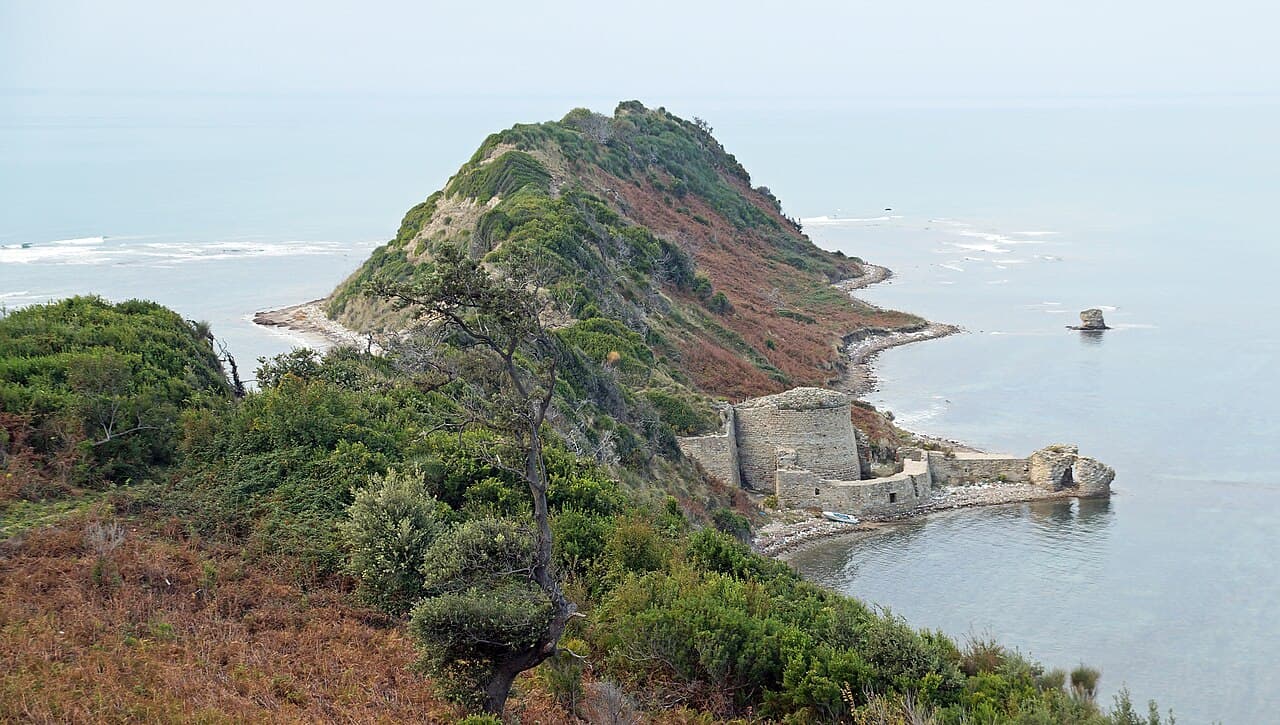
Today, the remains of Rodoni Castle consist primarily of the eastern walls and several towers still standing on the cape. Coastal erosion has claimed much of the original structure, especially the walls that once closed off the neck of the cape, which likely extended to the western side but are now lost to the sea. A solitary masonry stump located north of the ruins in the water is believed to have been a watchtower, possibly used for signaling and communication with Krujë Castle.
The castle's bastioned design reflects the evolving military architecture of the late medieval period, incorporating angled walls and towers to better withstand artillery fire. Its position on a narrow cape provided natural defensive advantages, with sea on multiple sides limiting approaches by land.
Access and visitor experience
Rodoni Castle is freely accessible to visitors and lies within a protected nature reserve. Reaching the site requires a 25-minute walk along a sandy path from the nearest road, adding to the sense of seclusion and preservation. Along the path, visitors can also see remnants of a coastal battery consisting of four gun bunkers dating from Albania's communist era (1960s-1980s), which add a layer of modern military history to the site.
The combination of historical ruins, natural coastal landscapes, and the castle's connection to Skanderbeg make Rodoni Castle a point of interest for history enthusiasts and nature lovers alike. Its ruins offer a tangible link to the turbulent period of Albanian resistance against the Ottoman Empire and the shifting control of the Adriatic coastline during the late medieval and early Renaissance periods.
Frequently asked questions (FAQ)
- How do I get to Rodoni Castle?
- Rodoni Castle is located on the Cape of Rodon and can be reached by a 25-minute walk along a sandy path from the nearest road. The path passes through a nature reserve, so comfortable walking shoes are recommended.
- What is the historical significance of Rodoni Castle?
- Rodoni Castle was built by Skanderbeg in the mid-15th century as a bastioned fortress to defend against the Ottoman Empire. It played a key role during the sieges of Krujë and was a strategic coastal stronghold for the League of Lezhë.
- Can I visit Rodoni Castle for free?
- Yes, Rodoni Castle is freely accessible to visitors. There is no entrance fee, making it an attractive destination for those interested in history and nature.
- What remains of Rodoni Castle can I see today?
- Visitors can see the eastern walls and towers of Rodoni Castle, along with a solitary masonry stump in the water believed to be a former watchtower. Coastal erosion has submerged much of the original structure.
- Is Rodoni Castle suitable for a family visit?
- Yes, Rodoni Castle is suitable for families, but keep in mind the 25-minute walk over sandy terrain to reach the site. The natural surroundings and ruins offer an educational and scenic experience for visitors of all ages.
Photo gallery

Information
Loading map...
Visitor reviews
No reviews yet. Been here? Write the first review and help other travelers!
Write the first reviewVisited this castle? Share your experience
Your review helps other travelers and adds first-hand knowledge to our encyclopedia.