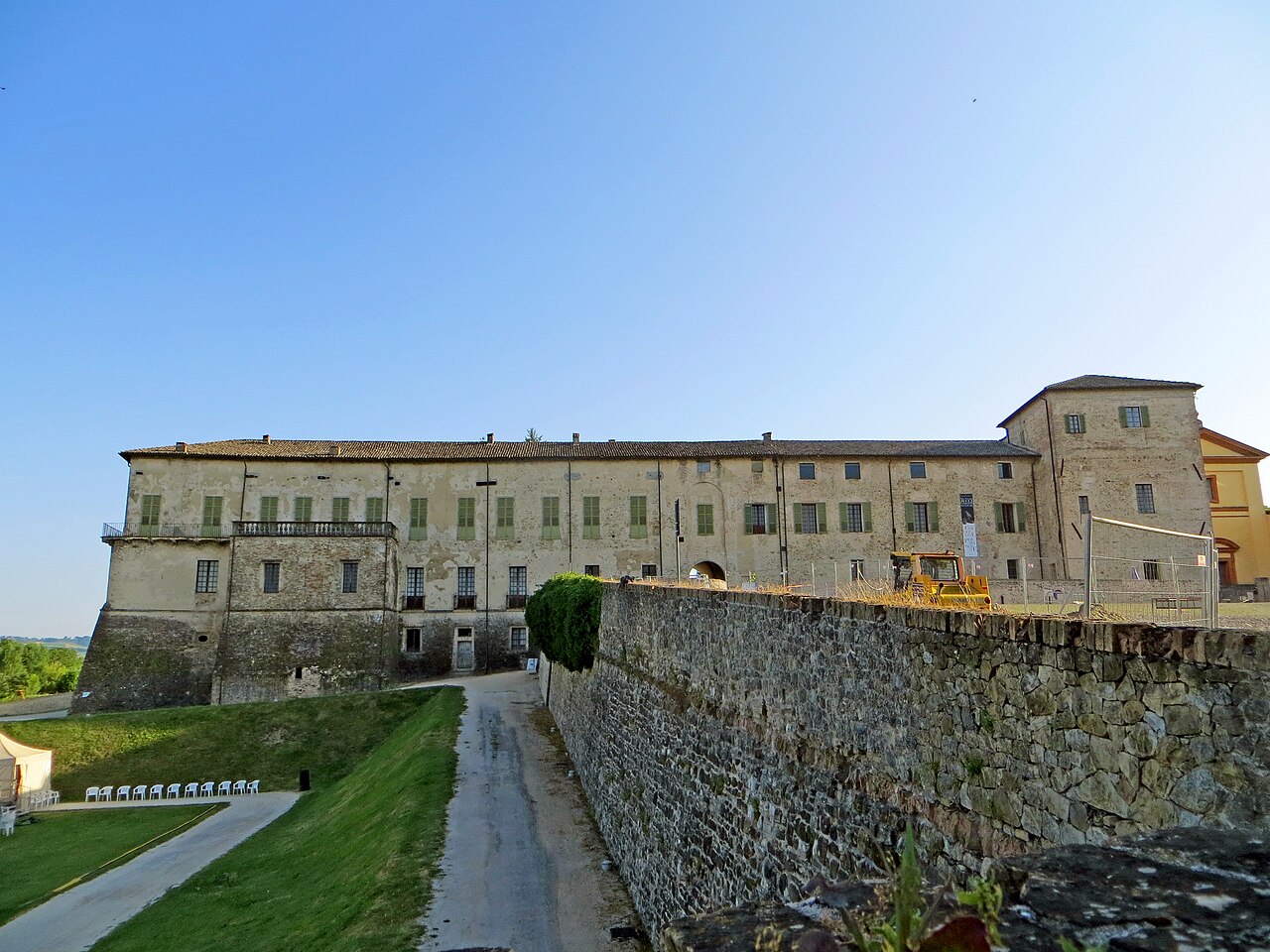
Rocca Meli Lupi
Rocca Meli Lupi stands as a remarkable example of a medieval hill castle that evolved into a splendid Baroque noble residence in Soragna, Italy. Its origins date back to 985 AD, when Marquis Adalbert I of Milan established the fortress under the authority of the Holy Roman Empire, following a land grant from Emperor Otto I. This enduring stronghold has witnessed over a millennium of Italian history, reflecting the shifting tides of power, architectural trends, and noble prestige.
The castle's initial purpose was defensive, serving as a fortified seat for the local ruling families. It was closely associated with the Pallavicino family, who were confirmed as lords of the area by Emperor Frederick Barbarossa in 1189. After surviving raids and partial destruction, the castle passed through marriage to the Lupi family by the end of the 12th century. The Lupi undertook extensive rebuilding, renaming it Castrum Novum to distinguish it from the earlier Pallavicini fortress. The castle played a significant role in the Guelf and Ghibelline conflicts of the 13th and 14th centuries, enduring sieges and occupations that underscored its strategic importance.
Transition to the Meli-Lupi principality
In 1513, the castle entered the possession of the Meli family through marriage, creating the Meli-Lupi lineage under Giampaolo I Meli. This union marked the beginning of a new era, with the castle becoming a symbol of noble power and cultural refinement. The Meli-Lupi family faced contested claims and military threats, including disputes with Bonifacio Aldighieri and surviving an assault during the 1551 War of Parma. Despite these challenges, the castle remained a resilient stronghold and noble residence.
Over the 16th and 17th centuries, Rocca Meli Lupi gradually transformed from a military fortress into an elegant Baroque residence. In 1709, Emperor Joseph I elevated the marquisate to the rank of a principality, granting it the right to mint its own coins. Although the principality was abolished in 1805 during Napoleonic reforms, the castle remained in the hands of the Meli-Lupi descendants, preserving an unbroken family legacy.
Architectural features and layout
The castle exhibits a symmetrical square layout centered around a large courtyard, surrounded by sturdy brick walls. Each corner is fortified with a quadrangular tower, reflecting typical medieval defensive architecture. The main façade features a narrower entrance tower added during the 17th-century Baroque conversion. A deep dry moat encircles the castle on three sides, enhancing its defense without the need for water.
Access is granted via a substantial masonry bridge built in the 1600s, replacing an earlier drawbridge. This bridge is flanked by two imposing stone lions on tall pedestals, serving both defensive and symbolic roles. The façade is divided into five sections by three towers, rising three floors plus a basement. The central tower includes a wide round-arched doorway, a recessed balcony, and a large Meli-Lupi coat of arms beneath a classical triangular pediment.
The chapel and neo-Gothic fort
At the castle's northwest rear corner, a long building links the fortress to the Baroque Chapel of Santa Croce, constructed in 1606 as a family place of worship and burial. The chapel’s ceiling was frescoed by Giacomo Mercoli in 1697, complemented by a marble altar by Pietro Oliva and paintings by Giovanni Bolla and others. Adjacent lies the Fortino Neogotico, a small neo-Gothic fortification beside a romantic artificial lake with grottoes designed to mimic natural stalactites and stalagmites.
Interior decoration and artistic heritage
The castle's interiors showcase a rich tapestry of artistic styles spanning the Renaissance to the Baroque periods. The Sala delle Grottesche features grotesque frescoes by Cesare Baglione around 1580, depicting hybrid creatures and symbolic motifs. The Sala di Nicolò dell’Abate contains large mythological frescoes painted circa 1543, narrating the heroic deeds of Hercules amid yellow walls with frescoed lunettes.
The Bridal Chamber dates from the early 19th century, furnished with a carved wooden canopy bed commissioned for a noble wedding and adorned with gilded stucco and Genoese furnishings from the 17th and 18th centuries. The castle also includes a grand corridor decorated with grotesque frescoes, housing a 17th-century French tapestry illustrating fairs and exotic beasts, Empire-style furnishings, terracotta vases, and wrought iron gates by Giulio Pellegrinelli.
The Red Salon is notable for its deep red walls, Baroque sofas, six large oval landscape paintings from the early 1500s by il Brescianino, and portraits of historical family members. It also contains an elegant gilded wood mirror from the late 1600s and displays exotic 18th-century Japanese vases on gilded pedestals.
The Galleria degli Antenati (Ancestors’ Gallery) exhibits a billiard table from the 1700s and numerous portraits of the Meli-Lupi family, including the famed Cassandra Marinoni, known as “Donna Cenerina.” A large square room designed by Carlo Virginio Draghi and decorated by the Bibiena brothers glorifies the family’s military service for the Holy Roman Empire and Venice against the Ottoman Turks through stucco and fresco cycles featuring imperial eagles, the Venetian Lion of Saint Mark, and classical mythology.
Extending from this room, a 62-meter-long gallery connects to the chapel and neo-Gothic fort, decorated with Baroque stuccoes and frescoes by the Bibiena family, late 18th-century frescoes by Giovanni Motta, and Apollo-themed frescoes within the fort. Twelve sculpted herms representing celebrated poets from various ancient cultures line this gallery.
Military artifacts and staircases
The castle preserves an impressive collection of 16th- and 17th-century weaponry in its Arms Room, including stone-lock rifles, halberds, swords, sabers, helmets, a 17th-century Spanish flag, family banners, and a historic iron cannon. These artifacts provide valuable insight into the castle’s martial past and the evolution of arms over centuries.
The Honor Staircase, built in the late 17th century by Carlo Virginio Draghi, features frescoed walls from the same period, an Art Nouveau ceiling added in 1927 by Giuseppe Riva, a balustrade carved from red Verona marble, and seven white stone cherubs atop decorated pillars.
Gardens and landscape design
The castle gardens reflect centuries of evolving landscape design. Originally a moat, the area was transformed into an Italian-style garden in 1542, expanded in the 1600s with statuary niches. By the late 18th century, the grounds were enlarged and converted into an English landscape garden in 1833 by architect Luigi Voghera. This naturalistic park features a lake, a neo-Gothic Fortino with Ghibelline battlements, and the “Island of Love” with artificial grottoes.
A grand double-ramp stairway connects the garden to the castle, bordered by six 18th-century statues representing major rivers and the seasons. Additional garden features include a neoclassical café building, an ancient black walnut tree, a greenhouse with arcades, a rose garden adorned with Baroque statues such as the “Pastore d’Arcadia,” and alleys lined with benches and Venetian-style sculptures of classical deities. These elements exemplify the refined tastes and cultural heritage of the castle’s noble inhabitants.
Today, Rocca Meli Lupi remains a testament to Italy’s rich medieval and Baroque history, offering visitors a unique glimpse into the architectural evolution, artistic achievements, and noble lineage that have shaped this iconic hill castle over more than a thousand years.
Frequently asked questions (FAQ)
- How do I get to Rocca Meli Lupi?
- Rocca Meli Lupi is located in the charming town of Soragna, Italy. You can reach it easily by car, as it is situated just off the A1 motorway, and there are also local bus services available from nearby cities.
- What are the opening hours of Rocca Meli Lupi?
- The castle is typically open to visitors from Tuesday to Sunday, with hours varying by season. It’s best to check the official website for the most current opening times before your visit.
- When was Rocca Meli Lupi built?
- Rocca Meli Lupi dates back to the 14th century, showcasing a rich history as a noble residence. Over the centuries, it has undergone various renovations, enriching its architectural significance.
- Can I take photographs inside Rocca Meli Lupi?
- Yes, photography is allowed in most areas of the castle, although some specific exhibitions may have restrictions. Be sure to respect any signage regarding photography to ensure a pleasant experience for all visitors.
- Why is Rocca Meli Lupi historically significant?
- Rocca Meli Lupi is an important historical site as it reflects the feudal architecture and lifestyle of the Italian nobility. The castle has witnessed significant events in regional history, making it a key point of interest for history enthusiasts.
- Is it possible to access Rocca Meli Lupi with a wheelchair?
- Yes, Rocca Meli Lupi is equipped with facilities to assist visitors with mobility challenges. However, some areas may have limited accessibility due to historical architecture, so it's advisable to check in advance.
- What is the ticket price for visiting Rocca Meli Lupi?
- Ticket prices for Rocca Meli Lupi are generally affordable, with discounts available for students and seniors. Prices may vary for special events or guided tours, so checking the official website for the latest information is recommended.
- When is the best time to visit Rocca Meli Lupi?
- The best time to visit Rocca Meli Lupi is during the spring and fall when the weather is mild and pleasant. Additionally, these seasons tend to have fewer crowds, allowing for a more enjoyable experience exploring the castle.
- What nearby attractions can I visit while in Soragna?
- While in Soragna, you can explore the beautiful surrounding countryside and other historical sites such as the nearby Palazzo dei Meli Lupi. The town also offers quaint shops and local eateries that enhance your visit.
Information
Website
Visit websiteSources & official resources
Verify the information above using these authoritative references.
Loading map...
Visitor reviews
No reviews yet. Been here? Write the first review and help other travelers!
Write the first reviewVisited this castle? Share your experience
Your review helps other travelers and adds first-hand knowledge to our encyclopedia.