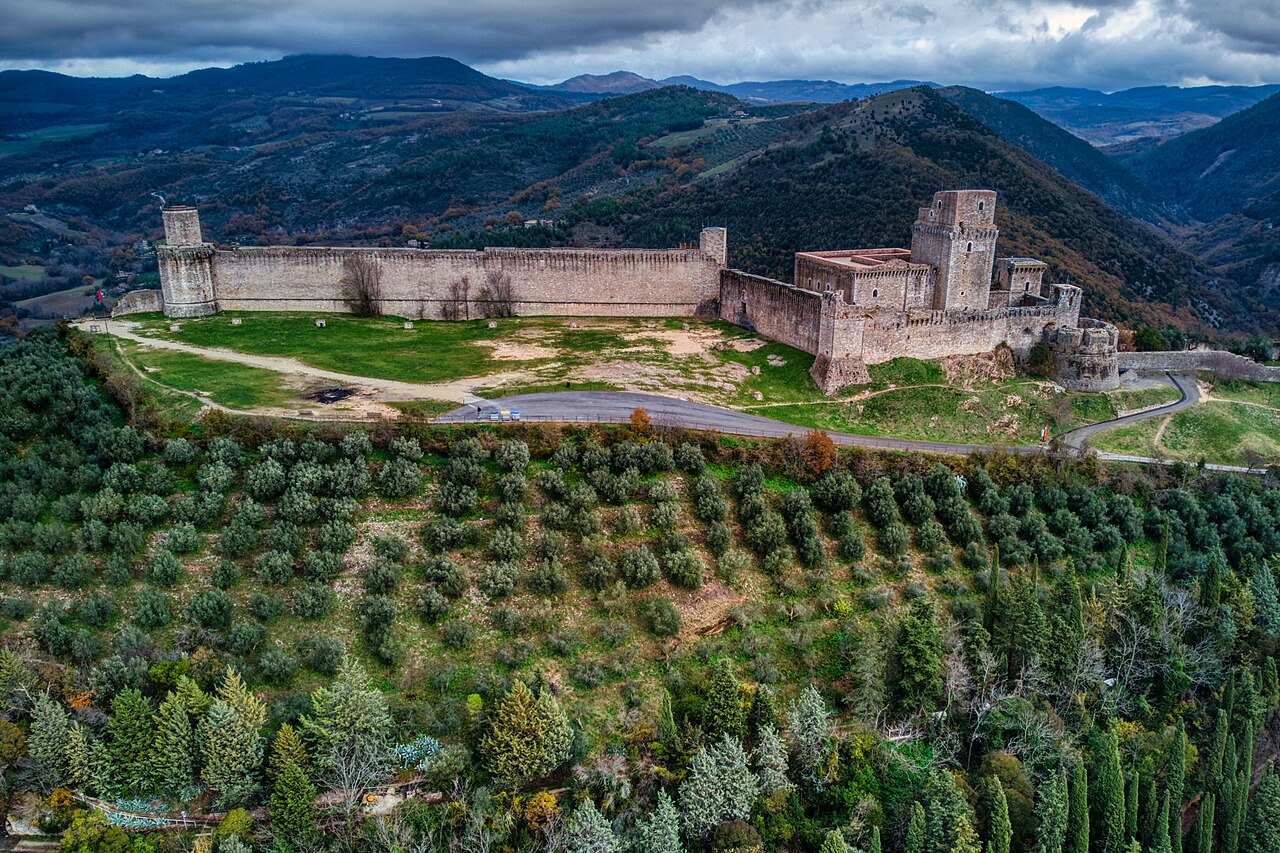
Rocca Flea
Rocca Flea is a remarkable hill castle located in Gualdo Tadino, within the region of Umbria, Italy. Its strategic position atop a prominent hill has made it a commanding presence over the surrounding landscape for centuries. The fortress embodies a rich historical narrative that spans from its early medieval origins through the Renaissance and into modern times, reflecting the evolving military, residential, and cultural functions it has served.
The castle's earliest foundations date back to the early medieval period, originally established by the Lombards in the 8th or 9th centuries. Initially known as Arx Major Terre Gualdi, the site included a sanctuary dedicated to Saint Michael the Archangel, illustrating the intertwining of religious and military significance from its inception. Documentary evidence from the 12th century confirms the fortress's existence, which was substantially rebuilt in 1242 under the auspices of Emperor Frederick II. This reconstruction closely followed the town's rebuilding in 1237, indicating a concerted effort to strengthen regional defenses during a turbulent period in central Italy's history.
Medieval fortifications and architectural evolution
In the mid-14th century, during the period of Perugine domination, the fortress underwent significant modifications, notably the addition of a central keep known as the Cassero in 1350. This massive tower served as the core defensive structure, designed to provide both military protection and command over the surrounding territory. The Cassero's robust construction exemplifies the high medieval military architecture typical of the era, emphasizing verticality and defensibility.
Later in the 14th century, further renovations were undertaken by the condottiero Biordo Michelotti, a prominent military leader whose influence extended across central Italy. Michelotti's interventions likely included enhancements to the fortress's walls and internal structures, adapting the Rocca Flea to the evolving demands of warfare and residence.
Integration of religious and military elements
One of the unique features of Rocca Flea is the preservation of the Lombard sanctuary dedicated to Saint Michael within the fortress's fabric. This integration of a sacred space inside a military complex is a testament to the site's layered history and cultural importance. It reflects the medieval practice of combining spiritual protection with physical defense, a common theme in hilltop fortifications of the period.
Renaissance transformation and later uses
By the early 16th century, the fortress's military role diminished as it transitioned into a Renaissance patrician residence. Between 1515 and 1533, Cardinal Antonio Maria Ciocchi del Monte made the Rocca his residence, marking a shift towards comfort and status rather than purely defensive purposes. This transformation included architectural adaptations to suit noble living, although detailed records of these Renaissance modifications are limited.
In the 19th century, the Rocca Flea underwent another functional change when it was converted into a prison, initially serving as a female penitentiary and later as a district prison from 1888. This period marked a departure from its aristocratic and military past, reflecting broader social changes in Italy during the post-unification era.
Modern preservation and cultural significance
Since 1999, Rocca Flea has been repurposed as the Museo Civico di Gualdo Tadino, a civic museum dedicated to preserving and showcasing the local heritage. The museum's collections span a wide chronological range, including archaeological artifacts from prehistoric times through the early Middle Ages, highlighting the long human presence in the region.
A significant focus of the museum is the display of regional ceramic art, particularly lustrous ceramics for which Gualdo Tadino is renowned. These exhibits celebrate the town's centuries-old tradition in pottery, linking the Rocca's historical role with contemporary cultural identity.
The museum also houses paintings by notable local artists such as Matteo da Gualdo and Sano di Pietro, preserving artistic legacies that contribute to the cultural richness of Umbria. The fortress's halls and chambers have been adapted for exhibition purposes, allowing visitors to experience the architectural grandeur alongside the artistic and historical displays.
Architectural features and current condition
The Rocca Flea remains well-preserved, with key elements like the Cassero keep and surrounding structures maintained through careful restoration. The castle's layout reflects centuries of architectural evolution, from its high medieval defensive origins to its Renaissance residential adaptations. Visitors can explore accessible halls on the ground and first floors, gaining insight into both the fortress's military past and its cultural present.
The fortress's enduring presence on the hilltop continues to dominate the skyline of Gualdo Tadino, serving as a tangible link to the region's complex history. Its combination of military, religious, residential, and cultural functions over time makes Rocca Flea an exemplary case of adaptive reuse and heritage preservation in Italy.
Frequently asked questions (FAQ)
- How do I get to Rocca Flea?
- Rocca Flea is located in Gualdo Tadino, Italy, and can be easily accessed by car or public transport. If you are traveling by train, the nearest station is in Gualdo Tadino, from where you can take a short taxi ride to the castle.
- What is the historical significance of Rocca Flea?
- Rocca Flea dates back to the 12th century and served as a vital fortress for the local nobility. Its strategic location on a hilltop allowed it to control the surrounding areas and protect against invasions.
- When was Rocca Flea built?
- Rocca Flea was constructed in the late 11th century, with significant expansions and renovations occurring throughout the 12th and 13th centuries. This rich history is reflected in its impressive architectural features and fortifications.
- Can I take a guided tour of Rocca Flea?
- Yes, guided tours of Rocca Flea are available and provide a deeper insight into its history and architectural significance. These tours are often conducted by knowledgeable guides who can share fascinating stories and details about the castle.
- Why is Rocca Flea considered an architectural gem?
- Rocca Flea is recognized for its well-preserved medieval architecture, featuring robust walls, towers, and a stunning panoramic view of the surrounding landscape. Its design reflects the military and residential needs of the time, showcasing the ingenuity of medieval builders.
- Is it possible to visit Rocca Flea with children?
- Absolutely, Rocca Flea is a family-friendly destination with ample space for children to explore. The castle’s fascinating history and beautiful surroundings make it an educational and enjoyable experience for visitors of all ages.
- What are the opening hours for Rocca Flea?
- Rocca Flea is typically open to visitors from Tuesday to Sunday, with hours varying by season. It is recommended to check the official website for the most current opening hours before your visit.
- What is the ticket price for entering Rocca Flea?
- Ticket prices for Rocca Flea are generally affordable, with discounts available for students and seniors. It's advisable to check the official website for the latest pricing information and any special offers.
- When is the best time to visit Rocca Flea?
- The best time to visit Rocca Flea is during the spring and fall months when the weather is mild and pleasant. This allows for a comfortable exploration of the castle and its beautiful surroundings.
- Are there any nearby attractions to explore after visiting Rocca Flea?
- Yes, after visiting Rocca Flea, you can explore nearby attractions such as the historic town of Gualdo Tadino and the scenic Mount Cucco Regional Park. These locations offer additional opportunities for hiking, dining, and cultural experiences.
Information
Website
Visit websiteSources & official resources
Verify the information above using these authoritative references.
Loading map...
Visitor reviews
No reviews yet. Been here? Write the first review and help other travelers!
Write the first reviewVisited this castle? Share your experience
Your review helps other travelers and adds first-hand knowledge to our encyclopedia.