Revište Castle Ruins — Slovakia castle

Revište Castle Ruins

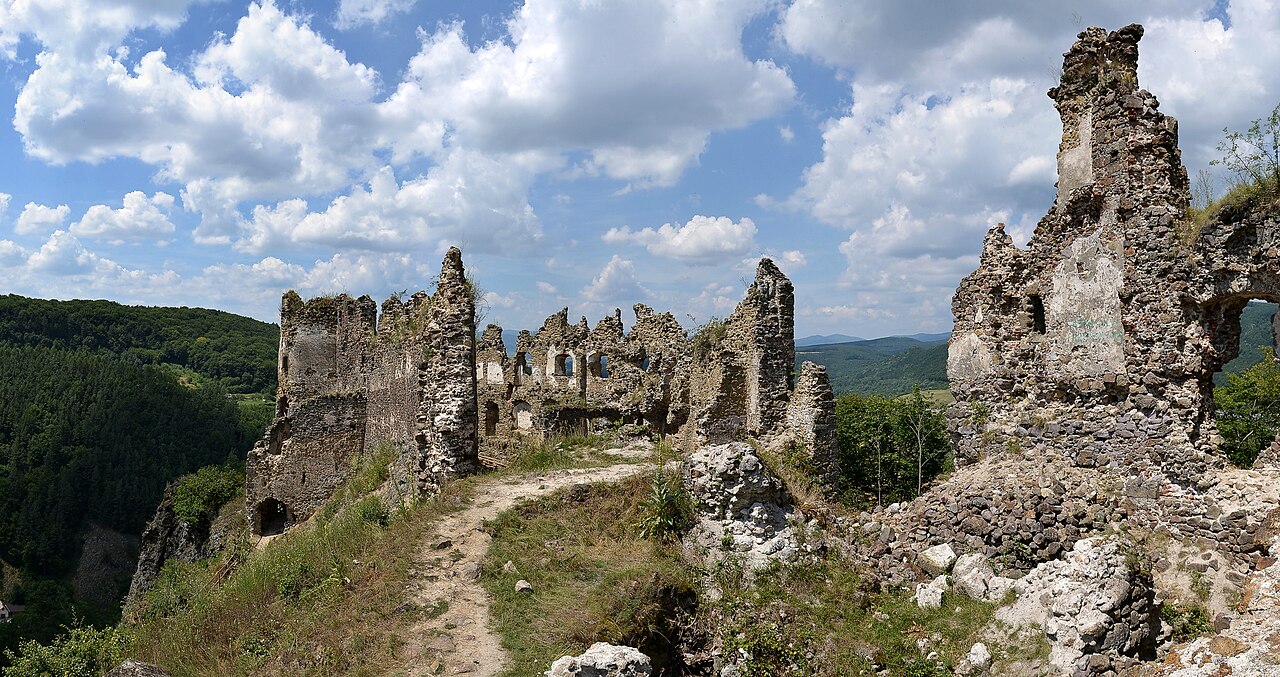
Revište Castle ruins near Žarnovica, Slovakia
Žarnovica, Slovakia
High Medieval (11th–13th c.)
Ruins

The Revište Castle ruins stand prominently on a steep rocky outcrop approximately 100 meters above the floodplain of the Hron River, near the village of Revištské Podzámčie in Žarnovica, Slovakia. This hill castle was constructed in the 13th century during the High Medieval period as a strategic fortification to protect central Slovakian mining towns and the vital trade routes running along the river. Its location provided commanding views over the surrounding landscape and control over the important passageways used by merchants and travelers.

Historical significance and ownership

Revište Castle was built under the auspices of the Kingdom of Hungary, which ruled the region at the time. Its construction paralleled that of nearby Šášov Castle, situated just 18 kilometers across the Hron River, both serving as defensive bulwarks guarding the approaches to prosperous mining centers such as Banská Štiavnica and Kremnica. The castle first appears in written records in 1265, confirming its early importance, with further mentions in 1331 indicating its continued role in regional defense.

Throughout the 14th century, Revište underwent significant development and functioned as a royal stronghold. Over the centuries, ownership of the castle changed hands multiple times, most notably becoming the seat of the influential Dóczy noble family for nearly two centuries. The castle's history reflects the turbulent political and religious conflicts of Central Europe, including its seizure in the 1440s by supporters of the Hussite military leader Ján Jiskra of Brandýs.

In 1467, the castle was reclaimed by King Matthias Corvinus, who used it as part of a political exchange involving Šášov Castle. Subsequently, the fortress was granted to prominent ecclesiastical figures such as Ján Vitéz, Archbishop of Esztergom, and later to Bishop Urban Dóczy of Veľká Lúča, reflecting its importance within both secular and religious power structures.

The castle remained under Dóczy family control until 1647, when its last lord, Žigmund Dóczy, was killed during Ottoman incursions. The fortress suffered devastating damage around 1678 during the rebellion led by the magnate Imrich Thököly, whose mercenaries captured and ruined the castle. Although some repairs were made afterward, Revište's military relevance declined, and by the late 18th century, it was repurposed as barracks before being abandoned and gradually falling into ruin by the 19th century.

Architectural features and layout

Revište Castle's design is notably adapted to its hilltop rocky promontory, resulting in an irregular footprint shaped by the natural terrain. The core of the castle consisted of an inner keep surrounded by defensive walls enclosing a courtyard that housed a palace and residential buildings. This arrangement provided a fortified center for habitation and defense.

Access between the lower and upper courtyards was secured by a circular bastion, which likely functioned as an artillery tower or lookout point, enhancing the castle's defensive capabilities. During the Renaissance period, additional fortifications were added, including a southern outer bailey—an enclosed courtyard used for stabling horses, troop accommodation, and other logistical purposes.

Today, the ruins reveal fragmented perimeter walls that outline the castle's former boundaries amid dense forest. Portions of the residential quarters remain visible, though much of the structure has succumbed to the ravages of time. The absence of decorative stonework or inscriptions suggests that the castle's primary function was military and residential rather than ornamental.

Preservation and visitor experience

Currently classified as ruins, Revište Castle is a significant cultural heritage site offering valuable insights into medieval fortification techniques and noble residence in Slovakia. Efforts to stabilize and conserve the remaining structures have been ongoing in recent decades, aiming to prevent further deterioration while allowing visitors to explore the evocative remnants of this historic fortress.

The castle's elevated position provides spectacular views of the surrounding landscape and the Hron River valley. The meadow below, popular with canoeists as a camping site, adds to the site's natural appeal. Visitors can appreciate the layered history embodied in the stone ruins and the castle's strategic role in protecting trade and mining interests in central Slovakia.

Historical context in the region

Revište Castle's strategic location along the Hron River corridor was crucial during the medieval period, as it controlled access to some of the most important mining towns in the Kingdom of Hungary. The castle's history reflects broader regional dynamics, including the Hussite wars, Ottoman incursions, and the shifting allegiances of noble families and ecclesiastical authorities.

Architectural evolution

The castle's architectural evolution from its original Gothic core to the later Renaissance fortifications illustrates the adaptation of medieval castles to changing military technologies and political circumstances. The addition of artillery bastions and outer baileys during the Renaissance period was a response to the increasing use of gunpowder weaponry and the need for more complex defensive structures.

Cultural significance

As a monument, Revište Castle embodies the medieval heritage of Slovakia and the historical interplay between military defense, noble power, and religious influence. Its ruins serve as a tangible link to the past, offering educational opportunities and fostering appreciation for the region's rich history.

Frequently asked questions (FAQ)

How do I get to Revište Castle ruins?
Revište Castle ruins are located near the village of Revištské Podzámčie, close to Žarnovica in the Banská Bystrica Region of Slovakia. Visitors can reach the site by car or local transport, followed by a hike up the hill to the ruins.
What is the historical significance of Revište Castle?
Revište Castle was built in the 13th century to protect key mining towns and trade routes in central Slovakia. It played a role in regional conflicts including the Hussite wars and Ottoman incursions, reflecting the area's turbulent medieval history.
Can I explore the ruins of Revište Castle?
Yes, visitors can explore the ruins, which include remnants of defensive walls, a circular bastion, and residential buildings. The site offers panoramic views of the Hron River valley and surrounding landscape.
When is the best time to visit Revište Castle ruins?
The best time to visit is during late spring to early autumn when the weather is favorable for hiking and outdoor exploration. The castle's elevated position offers scenic views especially in clear weather.
Are there any facilities or guided tours available at Revište Castle?
Facilities at the site are limited due to its ruined state. There are no official guided tours, but local tourist information centers in Žarnovica can provide historical context and directions.

Photo gallery

Revište Castle Ruins
Click to view

Photo by Patrik Kunec•CC BY-SA 4.0

1 photo • Click any image to view in full screen

Information

Hill Castle

Current owner

Municipality

Sources & official resources

Verify the information above using these authoritative references.

Loading map...

Visitor reviews

No reviews yet. Been here? Write the first review and help other travelers!

Write the first review

Visited this castle? Share your experience

Your review helps other travelers and adds first-hand knowledge to our encyclopedia.
Write a review

(5/5)

0/2000 characters

Your review will be visible after admin approval

Nearby castles

9.5 km
Pustý hrad (Sklené Teplice) — Slovakia castle

Pustý hrad (Sklené Teplice)

, Slovakia

Pustý hrad, located near the village of Sklené Teplice in Slovakia, is a notable example of a 13th-century hill castle from the High Medieval period. The castle's name, which translates to "Deserted Castle," reflects its current state as a ruined fortress, yet it remains an important historical and architectural landmark in the region. Perched strategically on a hill, Pustý hrad was originally constructed to oversee and protect the surrounding territory, taking advantage of its elevated position to control trade routes and provide defense against invaders. Historical background and significance The castle dates back to the 13th century, a time when many fortifications were built across the Kingdom of Hungary, which included present-day Slovakia. This era was marked by frequent conflicts and territorial disputes, necessitating strong defensive structures. Pustý hrad served as a military stronghold and a residence for local nobility. Over the centuries, the castle witnessed various ownership changes and played a role in regional power struggles. Despite its strategic importance, Pustý hrad was eventually abandoned, likely due to shifts in military technology and political changes that rendered hilltop fortresses less effective. Its abandonment led to its gradual decay, leaving behind the ruins visible today. Architectural features and layout The castle exemplifies typical High Medieval hill castle architecture, characterized by robust defensive walls, towers, and a compact layout adapted to the hill's topography. The remains include sections of the curtain walls that once enclosed the castle's inner ward, as well as foundations of towers that provided vantage points for surveillance and defense. The castle's design reflects the military architectural principles of the 13th century, emphasizing strong fortifications with limited access points to deter attackers. The use of local stone materials contributed to the castle's durability. Although much of the superstructure has collapsed, archaeological studies have helped reconstruct the original layout and understand its defensive mechanisms. Current condition and preservation efforts Today, Pustý hrad stands as a ruin, with significant portions of its walls and towers lost to time. The site is accessible to visitors interested in medieval history and castle architecture. Preservation efforts focus on stabilizing the remaining structures to prevent further deterioration while allowing safe public access. Interpretive signage and guided tours provide educational context, explaining the castle's historical role and architectural features. The surrounding landscape offers scenic views of the Slovak countryside, enhancing the visitor experience. Visiting information and cultural importance Pustý hrad is a popular destination for hikers and history enthusiasts. Its location near Sklené Teplice makes it accessible for day trips from nearby towns. Visitors can explore the ruins, enjoy panoramic views, and learn about medieval fortifications in Slovakia. The castle contributes to the cultural heritage of the region, representing medieval defensive architecture and the historical development of Slovak territories during the High Medieval period. It also serves as a reminder of the region's turbulent past and the evolution of military strategy.

High Medieval (11th–13th c.)
Details
14.6 km
Sásov Castle Ruins — Slovakia castle

Sásov Castle Ruins

Žiar nad Hronom, Slovakia

The Sásov Castle ruins stand prominently above the Hron River near the town of Žiar nad Hronom in Slovakia, offering a striking glimpse into the region's medieval past. Constructed in the 13th century, the castle was strategically positioned to guard vital trade routes and oversee the valuable mining districts around Banská Štiavnica. Its role as a toll collection point and military stronghold reflects the economic and defensive priorities of the High Medieval period. According to local legend, the castle was originally built by the lord of Zvolen Castle for his court joker, who had saved his life during a hunting expedition. While this story adds a colorful dimension to the castle's origins, historical records emphasize its practical function in controlling the convergence of routes leading through the Hron valley and neighboring regions like Kremnica and Turiec. Historical significance and ownership The first documented mention of Šášov Castle dates to 1253, linking it to royal estates and notable figures such as Vincent and Peter de Vancha, relatives of the Archbishop Štefan of Esztergom. Over the centuries, the castle's ownership changed hands multiple times, reflecting the shifting political landscape of the Kingdom of Hungary and later Habsburg rule. In the early 14th century, the castle became part of the estate managed by the chamber count of Banská Štiavnica, underscoring its administrative importance. King Sigismund granted the castle to the noble Szécsényi brothers in 1387, followed by transfers to Queen Barbara in 1424 and military leader Ján Jiskra in 1447. The castle was later bestowed upon the Dóczy family by Queen Beatrix in 1490, who undertook significant Renaissance-style renovations and maintained control until the mid-17th century. Subsequent ownership passed to Gašpar Lipai in 1650. During the Tököli uprising of 1677, rebel forces captured and looted the castle, marking the decline of its military role. The castle was eventually recaptured by imperial troops under General Sigbert Heister in 1708, who ordered it set on fire, leading to its gradual abandonment and ruin. Architectural features and layout Šášov Castle is classified as a hill castle, perched on a steep cliff approximately 340 meters above sea level on the left bank of the Hron River. Its elongated layout is divided into an upper castle and a fortified outer courtyard, reflecting typical medieval defensive planning. Upper castle and defensive structures The castle's core was a Gothic palace located at the highest point, serving as the main residential and administrative building. This palace was fortified with a triangular tower that enhanced its defense. Surrounding the upper courtyard was a large round bastion protecting the main entrance, a key feature in the castle's fortifications. Outer courtyard and additional defenses The outer courtyard contained residential buildings arranged along its perimeter and was defended by a round guard tower at its far end. Renaissance-era modifications introduced multiple bastions and reinforced walls designed to withstand evolving siege tactics, transforming the castle into a more modern fortress. Fortified approach and archaeological remains The approach to the castle was controlled by a fortified outer bailey with a small bastion, traces of which have mostly eroded. Archaeological evidence also reveals a small fortress on the ridge above the main complex, likely serving as an advanced defensive position. Foundations near the mountain massif indicate additional structures, suggesting a wider fortified settlement. Decline, preservation, and cultural importance Following its destruction in the early 18th century, Šášov Castle fell into ruin, with only partial walls and structural remnants surviving. The castle's decline reflects broader historical conflicts, including the Rebellion of Estates and the Tököli uprising, which shaped the region's political and military history. Modern preservation efforts began in the early 21st century, notably with the founding of the Association for the Rescue of Šášov Castle in 2003. Subsequent funding from Slovakia's Ministry of Culture enabled conservation and stabilization work to protect the ruins and promote public awareness of the castle's heritage. Today, the ruins of Šášov Castle serve as a significant cultural landmark and tourist destination. Visitors can explore the remains of its Gothic and Renaissance architecture, appreciate its strategic location overlooking the Hron River valley, and learn about the castle's role in guarding medieval trade routes and regional mining wealth.

High Medieval (11th–13th c.)
Details
14.6 km
Kammerhof w Bańskiej Szczawnicy — Slovakia castle

Kammerhof w Bańskiej Szczawnicy

Bańska Szczawnica, Slovakia

Kammerhof Castle is a notable hill castle located in the town of Bańska Szczawnica in Slovakia. This castle occupies a strategic position that historically allowed it to oversee and control the surrounding area, a common feature of many medieval hill castles. Although the exact date of its construction is not fully documented, it is believed to have origins in the High Medieval period, reflecting the architectural and defensive needs of that era. Historical context and significance The castle played a significant role in the regional defense system, particularly due to Bańska Szczawnica's importance as a mining town. The town was known for its rich deposits of precious metals, and Kammerhof Castle was integral in protecting these valuable resources and the local population from external threats. Over the centuries, the castle witnessed various historical events, including conflicts and changes in ownership, which contributed to its architectural evolution. Architectural features and layout Kammerhof Castle exemplifies typical hill castle architecture, designed to utilize the natural elevation for defense. The castle's layout likely included a central keep or donjon, surrounded by defensive walls and possibly a moat or other fortifications adapted to the terrain. The construction materials predominantly consisted of local stone, which provided durability and resistance against sieges. The castle's defensive structures would have included battlements, arrow slits, and possibly towers positioned to maximize visibility and defense coverage. The internal buildings served various functions, such as residential quarters, storage rooms, and administrative offices related to the management of the mining operations. Preservation and current condition Today, Kammerhof Castle stands in a state that reflects its long history. While it may not be fully intact, the castle is considered partially preserved or in ruins, with some sections of walls and foundational structures still visible. Efforts to maintain and protect the site have been undertaken to preserve its cultural and historical value for visitors and researchers alike. Visiting Kammerhof Castle The castle is accessible to the public, offering an opportunity to explore a piece of Slovakia's medieval heritage. Visitors can appreciate the castle's strategic location and the panoramic views it provides of Bańska Szczawnica and the surrounding landscape. Interpretive signage and guided tours may be available to enhance the visitor experience by providing historical context and architectural insights. Nearby attractions Bańska Szczawnica itself is a town rich in history, with other notable landmarks and museums dedicated to its mining past. Visitors to Kammerhof Castle often combine their visit with exploring the town's historic center, local museums, and natural surroundings, making it a comprehensive cultural excursion. Architectural style and influences The castle's design reflects the practical and defensive architectural styles common in the High Medieval period. Its features align with the Romanesque and early Gothic styles prevalent in Central European castle construction during that time. The robust stone walls, narrow windows, and fortified towers are characteristic elements that served both defensive purposes and symbolized feudal authority. Legacy and cultural importance Kammerhof Castle remains an important symbol of the region's medieval history and its mining heritage. It represents the intersection of military, economic, and administrative functions that castles embodied in medieval society. The preservation of Kammerhof Castle contributes to understanding the development of defensive architecture and the historical landscape of Slovakia.

High Medieval (11th–13th c.)
Details