Rawa Mazowiecka
Rawa Mazowiecka Castle stands as a significant example of a Gothic bastioned fortress in the historic region of Masovia, Poland. Its origins trace back to the early 12th century, with the first mentions of a stronghold at Rawa Mazowiecka dating from 1249 during the rule of Duke Konrad I of Masovia. The castle evolved through centuries of political change, military conflict, and architectural development, ultimately becoming a prominent defensive and administrative center in the region.
The castle's strategic location at the confluence of the Rawka and Rylka rivers allowed it to control key trade and military routes in the lowland plains of Masovia. Originally a wooden and earth fortification, it was replaced by a substantial brick and stone structure in the late 14th century, credited primarily to Siemowit IV, Duke of Masovia. This reconstruction marked the transition of Rawa Mazowiecka Castle into a formidable Gothic bastioned fortress, designed to withstand the evolving threats of medieval warfare, including the introduction of artillery.
Historical context and origins
The fragmentation of Poland in 1138 by Bolesław III Wrymouth led to the creation of separate duchies, including the Duchy of Masovia. Around 1202, Konrad I of Masovia became the ruler of Masovia and Kuyavia. His reign was marked by military campaigns against the Prussian tribes and neighboring Polish dukes. It was during his rule that the first documented mention of a fortified settlement at Rawa Mazowiecka appeared in 1249. This early stronghold served as the seat of a castellan and a defensive outpost guarding the duchy's borders.
In the following centuries, Masovia underwent further territorial divisions, resulting in the emergence of the independent Duchy of Rawa. Although briefly reunited under Siemowit III in 1370, the duchy was again divided seven years later between his sons. The younger son, Siemowit IV, inherited the Rawa lands and is credited with commissioning the construction of the stone castle in Rawa Mazowiecka. While the 15th-century chronicler Jan Długosz attributed the castle's foundation to King Casimir III the Great, modern scholarship favors Siemowit IV as the primary builder.
Architectural features and layout
Construction likely began in the late 14th century, with the castle erected on an artificially raised mound formed between the two rivers. The fortress was designed on an irregular quadrilateral plan close to a square, measuring approximately 66 by 64 meters. Its perimeter was enclosed by brick walls on a stone foundation, nearly 10 meters high and 3 meters thick, providing formidable defense.
Main defensive tower
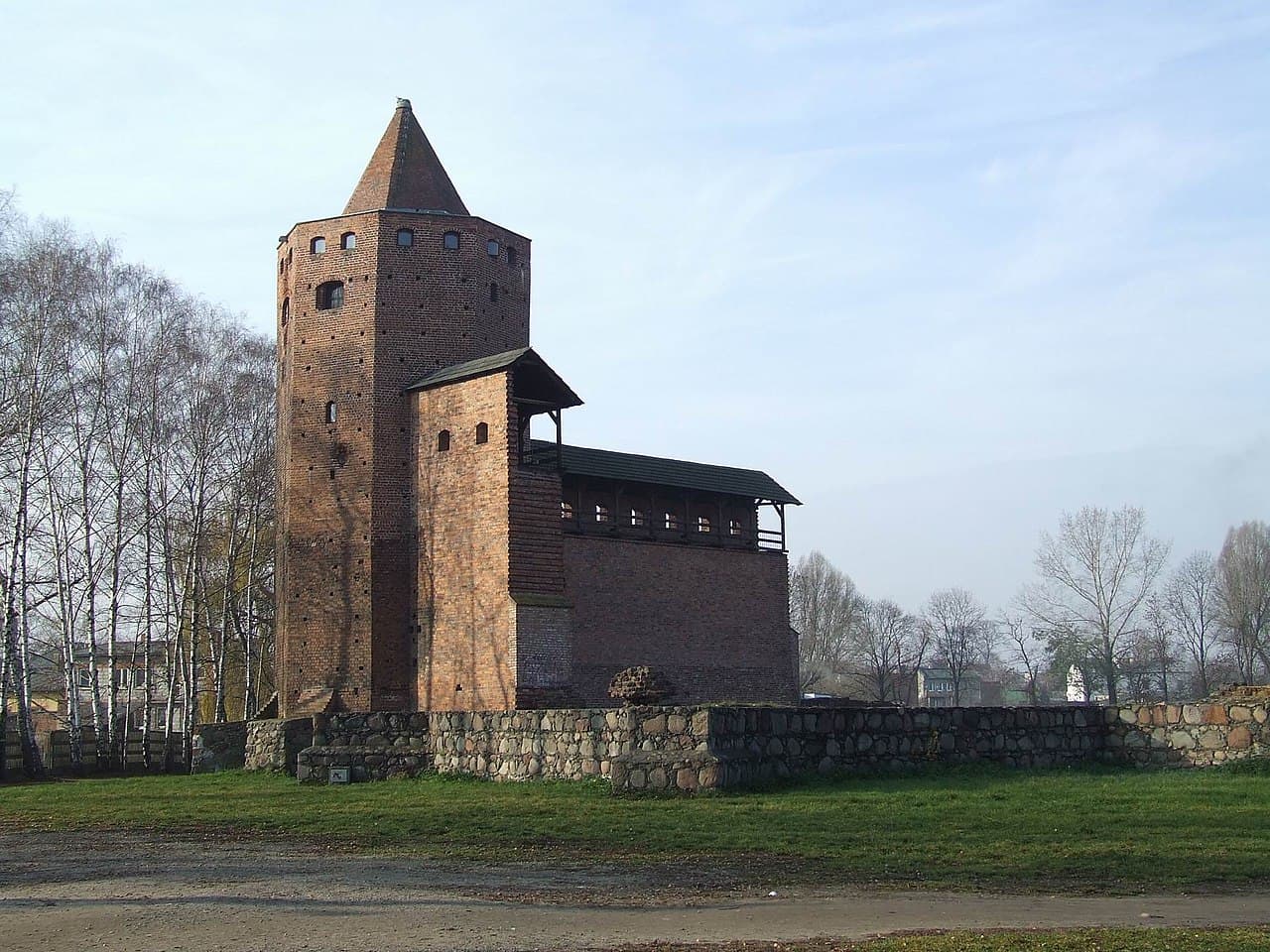
The castle's most prominent feature was a massive octagonal tower positioned at the southwest corner. Supported by buttresses and rising over 20 meters, this tower served as the primary stronghold and lookout. Originally, access to the tower was through a walkway atop the curtain walls, emphasizing its defensive role.
Gatehouse and entrance
The southern curtain wall featured the main gate, a three-story gate tower equipped with a drawbridge spanning a defensive moat. This gatehouse was designed to control access tightly and withstand sieges.
Residential and auxiliary buildings
The northern wall housed a large two-story stone building that functioned as the ducal residence and likely included a castle chapel. The rest of the courtyard contained wooden service buildings supporting the castle's garrison. A recently discovered square foundation in the southeast corner suggests the possible existence of a second defensive tower, although its exact purpose remains uncertain.
Later history and military significance
After the death of the last Duke of Rawa, Władysław II in 1462, the duchy was incorporated into the Kingdom of Poland. The castle was repurposed by the Polish Sejm as a treasury for revenues from royal estates, known as the "kwarciane," which funded the royal army. In 1507, a significant fire damaged the castle, prompting reconstruction efforts that included strengthening the main tower to accommodate firearms and expanding the gatehouse defenses.
Throughout the 16th century, the castle's military importance declined due to the rise of artillery and changing warfare tactics. It transitioned into a prison, holding notable captives such as Christoph, Duke of Mecklenburg, and the Cossack leader Ivan Pidkova, who was executed there in 1578. Other prisoners included Charles Gyllenhielm, the illegitimate son of King Charles X of Sweden, detained in 1602.
The castle suffered greatly during the Swedish Deluge (1655-1660), when invading forces looted and burned it, leaving it in ruins. Attempts at restoration in the late 17th and 18th centuries were limited, and the fortress gradually lost its strategic role.
Decline and preservation efforts
Following the Partitions of Poland, Rawa Mazowiecka fell under Prussian control. The castle was ordered to be dismantled in the late 18th century, with much of its masonry repurposed for local construction. By the early 19th century, only the main tower remained standing. This tower was struck by lightning in 1859, damaging its upper sections.
Post-World War II archaeological excavations uncovered the foundations of the gate tower, the ducal palace, and curtain walls. Restoration work in the mid-20th century reconstructed the main tower and parts of the surrounding walls, preserving the site as a ruin open to visitors. Today, the castle remains a valuable cultural monument illustrating the medieval and early modern history of Masovia.
Visitor experience and cultural significance
Visitors to Rawa Mazowiecka Castle can explore the restored main tower and walk along reconstructed sections of the curtain walls. The castle's footprint is marked by exposed foundations, providing insight into its original layout and scale. Interpretive signage and guided tours offer historical context about the castle's role in regional defense, administration, and imprisonment.
The castle is a poignant symbol of Masovian heritage, reflecting the region's turbulent history from medieval fragmentation through the rise and fall of duchies to incorporation into the Polish Crown. Its architectural remains stand as a testament to Gothic military design adapted to the challenges of artillery warfare.
Frequently asked questions (FAQ)
- When was Rawa Mazowiecka Castle originally built?
- Rawa Mazowiecka Castle was originally established as a fortified settlement around 1138, with the current stone castle constructed in the late 14th century under Duke Siemowit IV.
- What architectural style characterizes Rawa Mazowiecka Castle?
- The castle is primarily Gothic in style, featuring thick brick walls, an octagonal defensive tower, and a three-story gatehouse typical of medieval bastioned fortresses.
- Can visitors access the castle today?
- Yes, visitors can explore the restored main tower and reconstructed curtain walls. The site is open daily from 10:00 to 16:00, and admission is free.
- What historical events affected the castle?
- The castle played roles in regional defense, served as a treasury and prison, and was damaged during the Swedish Deluge in the mid-17th century before falling into ruin after the Partitions of Poland.
- How was the castle used during the 16th century?
- In the 16th century, Rawa Mazowiecka Castle functioned as a prison for notable captives and housed the treasury for the "kwarciane" army, reflecting its administrative and military significance.
Photo gallery

Information
Opening hours
10:00-16:00, daily
Ticket prices
Free
Current owner
Municipality of Rawa Mazowiecka
Website
Visit websiteSources & official resources
Verify the information above using these authoritative references.
Loading map...
Visitor reviews
No reviews yet. Been here? Write the first review and help other travelers!
Write the first reviewVisited this castle? Share your experience
Your review helps other travelers and adds first-hand knowledge to our encyclopedia.