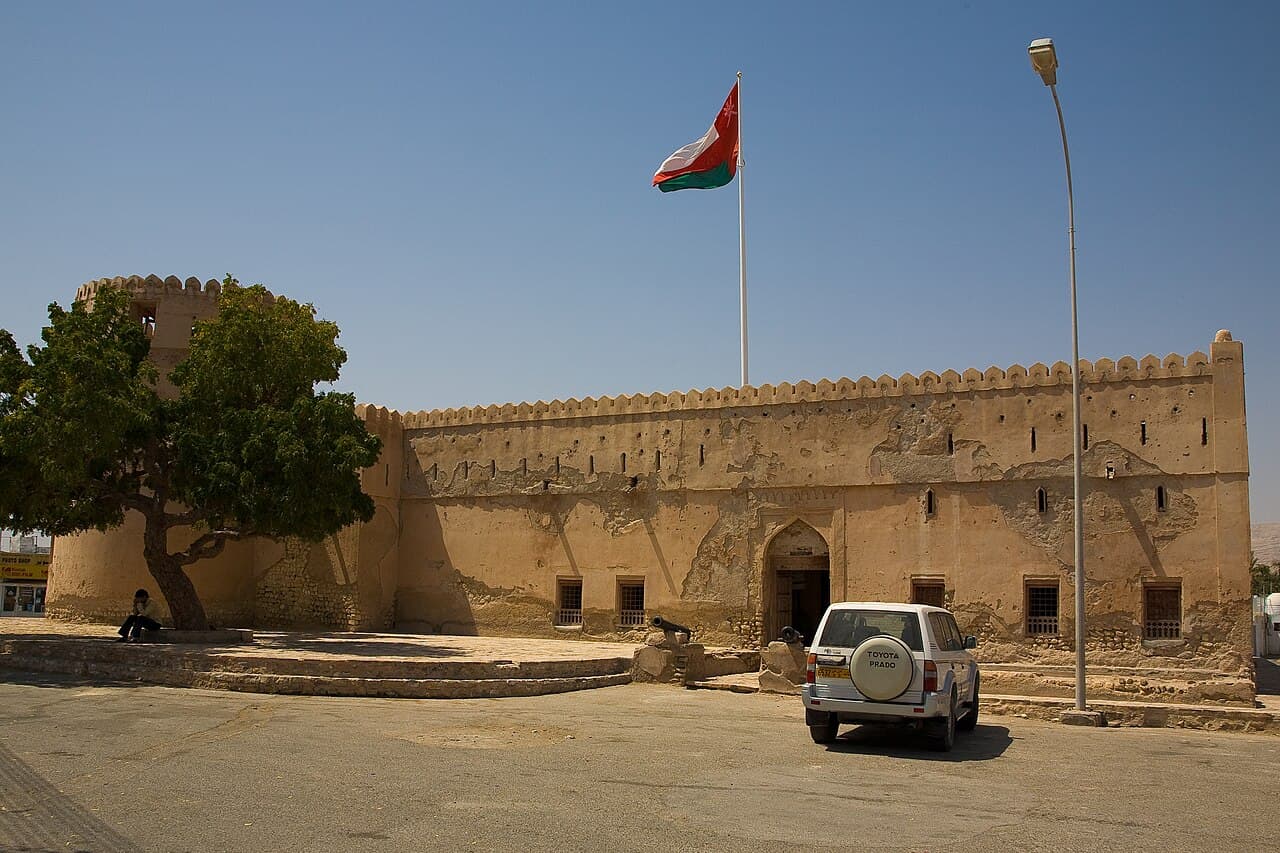
Quriyat Castle — Oman castle

Quriyat Castle

Quriyat Castle: 19th-century bastioned fortress in Oman
Quriyat, Oman
Modern (19th–20th c.)
Well Preserved

Quriyat Castle stands in the coastal town of Quriyat, located in the Muscat Governorate of Oman. This 19th-century bastioned fortress was constructed as a fortified residence for the local wali (governor) and his family, as well as a place to host the Sultan during his visits. Its strategic position along the Arabian Sea coast reflects its historical role in the defense and administration of the region.

Historical background and earlier fortifications

Before the current Quriyat Castle was built, the site or town housed an earlier Arab fortification. This original fort was seized by the Portuguese in 1507 during their expansion into the Arabian Peninsula. The Portuguese rebuilt the fort and named it Fortaleza de Curiate. This fortification was an important military outpost controlling maritime routes and local trade.

In the 1640s, the fort was captured from the Portuguese by the Ya'rubid dynasty, a powerful Omani ruling family that played a key role in expelling European colonizers from the region. It is not definitively known if the current castle occupies the exact location of this earlier fort, but the continuity of fortifications in Quriyat highlights the town's longstanding strategic significance.

Construction and architectural features of the current castle

The present Quriyat Castle was built in the early 19th century by Sayyid Hamad bin Said Al Busaidi, the wali of Quriyat at the time, during the reign of Sayyid Saïd bin Sultan al-Busaidi, the Sultan of Oman. The castle was intended as a fortified residence for the wali and his family and as a secure accommodation for the Sultan during his visits to the town.

The castle's design features a square ground plan with a notable round tower positioned at its southeastern corner. This tower likely served both defensive and residential functions, providing a vantage point over the surrounding area and the nearby coastline. The castle's walls are robust and built in a bastioned style typical of coastal fortifications designed to resist artillery and provide overlapping fields of fire.

While the castle is primarily a military structure, its residential purpose is evident in the internal layout, which would have included living quarters, administrative rooms, and spaces for the wali's family and guests.

Other fortifications in Quriyat and regional significance

Quriyat is home to a small network of fortifications that underscore its historical importance as a coastal defense point. Alongside Quriyat Castle, there are two other notable towers: Al Sirah Tower located at the harbor, and Al Kharmooh Tower at the southern end of the town. These structures collectively formed a defensive system protecting the town and its maritime approaches.

The presence of multiple fortifications in Quriyat reflects the town's role in safeguarding trade routes and local settlements from seaborne threats during the 19th century and earlier periods.

Visiting Quriyat Castle today

Today, Quriyat Castle is accessible to visitors for a modest entrance fee. The castle is well-preserved and offers a glimpse into the military architecture and residential life of Omani governors during the early modern period. Its location in a quiet seaside town makes it an attractive destination for travelers interested in history, architecture, and coastal landscapes.

Visitors can explore the castle's bastioned walls, the distinctive round tower, and the surrounding area, which includes the town's other historic towers. The castle and its environs provide an authentic experience of Oman's coastal heritage and fortification traditions.

Frequently asked questions (FAQ)

How do I visit Quriyat Castle?
Quriyat Castle is open to visitors for a small entrance fee. It is located on Al Hesn Street in the town of Quriyat, Oman. Visitors can explore the castle's bastioned walls and round tower during opening hours, which are typically during daylight.
What is the historical significance of Quriyat Castle?
Quriyat Castle was built in the early 19th century as the residence of the local wali and to accommodate the Sultan during visits. It stands on a site with earlier Portuguese and Arab fortifications, reflecting the region's strategic coastal importance.
Can I visit other fortifications near Quriyat Castle?
Yes, Quriyat has two other historic towers: Al Sirah Tower at the harbor and Al Kharmooh Tower at the southern end of town. Together with Quriyat Castle, they form a network of coastal defenses worth exploring.
When was Quriyat Castle built?
The current Quriyat Castle was constructed in the early 19th century by Sayyid Hamad bin Said Al Busaidi during the reign of Sultan Sayyid Saïd bin Sultan al-Busaidi.
Why does Quriyat Castle have a round tower?
The round tower at the southeastern corner of Quriyat Castle served both defensive and residential purposes, providing a vantage point for surveillance and protection against attackers.

Photo gallery

Quriyat Castle
Click to view

Photo by Andries Oudshoorn•CC BY-SA 2.0

1 photo • Click any image to view in full screen

Information

Bastioned Fortress

Address

Al Hesn Street, Oman

Loading map...

Visitor reviews

No reviews yet. Been here? Write the first review and help other travelers!

Write the first review

Visited this castle? Share your experience

Your review helps other travelers and adds first-hand knowledge to our encyclopedia.

Write a review

(5/5)

0/2000 characters

Your review will be visible after admin approval

Nearby castles

0.9 km

Al Kharmooh Tower

Quriyat, Oman

Al Kharmooh Tower is a distinctive historic watchtower located in the coastal town of Quriyat in the Muscat Governorate of Oman. This tower is notable for its unusual triangular shape, a rare architectural feature not commonly found in Omani fortifications, making it a unique example of defensive architecture in the region. Location and strategic importance The tower is situated on a small rock outcrop rising from a sand dune, which provided a natural vantage point for surveillance. Its position suggests that it functioned primarily as a watchtower and a forward defense post for the once fortified town of Quriyat. The town itself was historically protected by a series of fortifications, with Al Kharmooh Tower forming part of a defensive network that included Al Sirah Tower on the coast and Quriyat Castle at the town center. Architectural features and design Unlike many other towers in Oman that tend to be circular or square in plan, Al Kharmooh Tower's triangular design is highly unusual. This shape may have been chosen to maximize defensive coverage and reduce blind spots, allowing defenders to monitor multiple directions effectively. The tower's construction atop a rock provided additional height and stability, enhancing its role as a lookout point. The tower's walls are built from local stone and traditional materials common in Omani military architecture, designed to withstand attacks and the harsh coastal climate. While detailed records of its construction date are unavailable, its style and strategic use align it broadly with the late medieval to early modern period fortifications typical of the region. Historical context and role Quriyat was historically a walled town, and Al Kharmooh Tower played a key role in the town's defensive system. Watchtowers such as this were essential for early warning against seaborne threats and inland incursions. The tower's proximity to the coast and its elevated position allowed for effective monitoring of maritime activity and potential enemy movements. Alongside Al Sirah Tower and Quriyat Castle, Al Kharmooh Tower contributed to a layered defense strategy, protecting the local population and trade routes. The fortifications reflect the town's historical significance as a coastal settlement with strategic importance in controlling access to the Gulf of Oman. Current condition and accessibility Today, Al Kharmooh Tower remains freely accessible to visitors, offering a glimpse into the region's military heritage. Although not extensively restored, the tower is partially preserved, retaining much of its original form and structural integrity. Its unique shape and setting make it a notable point of interest for those exploring Oman's coastal fortifications. The tower's accessibility allows for direct engagement with the site, providing opportunities for photography and study of traditional Omani defensive architecture. Visitors to Quriyat can also explore the nearby Al Sirah Tower and Quriyat Castle, which together present a comprehensive picture of the town's historic defenses. Significance and cultural heritage Al Kharmooh Tower stands as an important cultural heritage site within Oman, illustrating the adaptation of military architecture to local geography and strategic needs. Its triangular form distinguishes it from other towers, highlighting regional variations in design and construction techniques. As part of the broader network of Omani fortifications, the tower contributes to understanding the historical defense mechanisms employed along the Arabian Peninsula's coastline. It also offers insight into the social and political history of Quriyat, reflecting the town's role in regional security and trade. Visitor information Visitors interested in exploring Al Kharmooh Tower should note that it is open to the public without an entrance fee. The best time to visit is during the cooler months to avoid the intense heat common in the region. While there are no formal guided tours, the site is accessible for self-guided exploration. Nearby attractions include the coastal scenery of Quriyat and the other historic fortifications, providing a broader context for understanding the area's historical landscape.

Details
1.3 km

Al Sirah Tower

Quriyat, Oman

Al Sirah Tower, also spelled as Serah, is a notable historical fortification located in the coastal town of Quriyat in the Muscat Governorate of Oman. This tower stands prominently on a rocky islet at the entrance to Quriyat harbor, providing a strategic vantage point over the surrounding waters. Its position marks it as a critical element in the town's historic defensive network. Historical background and significance The tower is also known as the Imam Nasir bin Murshid Fort, named after the influential imam who ruled Oman from 1624 to 1649. Imam Nasir bin Murshid is credited with uniting Oman and expelling the Portuguese from several coastal strongholds during the early to mid-17th century. The capture of the Fort of Curiate (modern-day Quriyat) from Portuguese control in the 1640s was a significant event in this campaign, and the tower is closely associated with these military efforts. Although the tower's exact construction date is not precisely documented, its association with Imam Nasir bin Murshid and the historical context strongly suggest it was built or significantly reinforced in the 17th century. This period corresponds with the broader resurgence of Omani fortifications as part of the struggle to reclaim sovereignty from European colonial powers. Architectural features and design Al Sirah Tower is characterized by its distinctive D-shaped design, a form commonly used in coastal watchtowers and small forts throughout Oman and the Arabian Peninsula. This shape provided a solid defensive front facing the sea while allowing defenders to monitor and control maritime approaches effectively. The tower's construction utilizes local stone and traditional masonry techniques, adapted to withstand the harsh coastal climate and potential sieges. Its walls are thick and robust, designed to resist cannon fire and other artillery that were increasingly common in the 17th century. Serving primarily as a watchtower, Al Sirah was part of a triad of fortifications protecting Quriyat. Alongside the tower, the town also features the Quriyat Castle centrally located within the town and Al Kharmooh Tower at the southern end. Together, these structures formed an integrated defensive system to safeguard the harbor and local population from naval threats. Location and accessibility The tower's placement on a rocky islet at the harbor mouth made it a natural sentinel point, overseeing all incoming vessels. This strategic location enhanced its role in early warning and defense against potential invaders or pirates. Currently, Al Sirah Tower is not easily accessible year-round. It can be reached on foot only during low tide when the water recedes enough to expose a natural pathway. At other times, the tower remains surrounded by water, limiting access and preserving its isolated defensive position. Preservation and current condition While detailed information about the current condition of Al Sirah Tower is limited, it remains an important cultural and historical landmark within Quriyat. Its preservation contributes to understanding Oman's coastal defense strategies during the Renaissance period and the era of Portuguese-Omani conflicts. The tower's remote location and tidal accessibility have helped protect it from extensive modern alterations, although this also means it is less frequently visited and studied compared to other fortifications in the region. Related fortifications in Quriyat Quriyat's defensive network includes the centrally located Quriyat Castle, which served as the main stronghold, and Al Kharmooh Tower, positioned at the southern edge of the town. These fortifications complemented Al Sirah Tower's maritime surveillance role, creating a layered defense system against seaborne threats. Quriyat Castle Located in the heart of the town, Quriyat Castle was the administrative and military center, overseeing local governance and defense coordination. Al Kharmooh Tower Situated at the southern end of Quriyat, this tower functioned similarly to Al Sirah, monitoring approaches from the sea and supporting the town's overall security. Visiting information Visitors interested in exploring Al Sirah Tower should plan their visit around the tidal schedule, as access on foot is only possible during low tide. The tower's remote location and limited accessibility mean it is less frequented by tourists, offering a more secluded historical experience. Due to its condition and location, there are no established visitor facilities or guided tours specifically for Al Sirah Tower, so visitors should prepare accordingly and exercise caution when approaching the site.

Renaissance (15th–17th c.)
Details
10.8 km

Hayl Al Ghaf Tower

Hayl Al Ghaf, Oman

Hayl Al Ghaf Tower is a modest yet historically significant 19th-century defensive tower located in the village of Hayl Al Ghaf within the Muscat Governorate of Oman. This tower stands as an example of traditional fortification architecture common in the region during the late 19th century, a period marked by local tribal conflicts and the need for watchful defense structures. Architectural features and structure The tower is characterized by its round shape, a common design choice for defensive towers in Oman, which helps to deflect projectiles and provides a panoramic vantage point for surveillance. It is believed to have three floors, built upon a solid base that ensures stability and durability against natural and human threats. The tower's entrance is notably positioned on the first floor, accessible via a small doorway, a strategic feature designed to enhance defense by limiting direct ground-level access. The construction materials likely include local stone and mortar, traditional to Omani fortifications, providing both strength and insulation against the harsh desert climate. The tower's interior would have served multiple purposes, including lookout, refuge, and storage. Historical context and significance While detailed historical records of Hayl Al Ghaf Tower are scarce, towers of this type were commonly used in Oman during the 19th century to protect villages and control strategic routes. Their presence reflects the socio-political landscape of the era, where tribal dynamics and the need for local defense shaped the architectural landscape. Such towers were integral to the network of fortifications that dotted the Omani countryside, serving as early warning posts against raids and as symbols of local authority and resilience. Current condition and accessibility Today, Hayl Al Ghaf Tower remains inaccessible to the public, standing quietly within its village setting. Despite its simple appearance, the tower holds cultural and architectural value as a preserved example of traditional Omani defensive structures. Its well-preserved state allows for appreciation of its original form and design, although it has not been developed as a tourist site. Location and surroundings Situated in the village of Hayl Al Ghaf, the tower is part of the broader landscape of the Muscat Governorate, an area known for its historical forts and towers. The village setting offers a glimpse into rural life in Oman, with the tower serving as a landmark within this quiet community. Visitor information and practical details Due to its inaccessibility, visitors cannot enter the tower, but it can be viewed from the outside. The site does not have formal visiting hours or ticketing, reflecting its status as a lesser-known heritage site rather than a developed tourist attraction. Frequently asked questions What is the historical importance of Hayl Al Ghaf Tower? It represents traditional 19th-century Omani defensive architecture used for village protection and surveillance. Can visitors enter Hayl Al Ghaf Tower? No, the tower is currently inaccessible to the public and can only be viewed externally. Where is Hayl Al Ghaf Tower located? It is located in the village of Hayl Al Ghaf within the Muscat Governorate of Oman. What architectural style does the tower represent? It reflects traditional Omani fortification design with a round shape and elevated entrance for defense. Is there any restoration work ongoing at the tower? There is no public information about restoration; the tower appears to be in a well-preserved state without active restoration.

Modern (19th–20th c.)
Details

