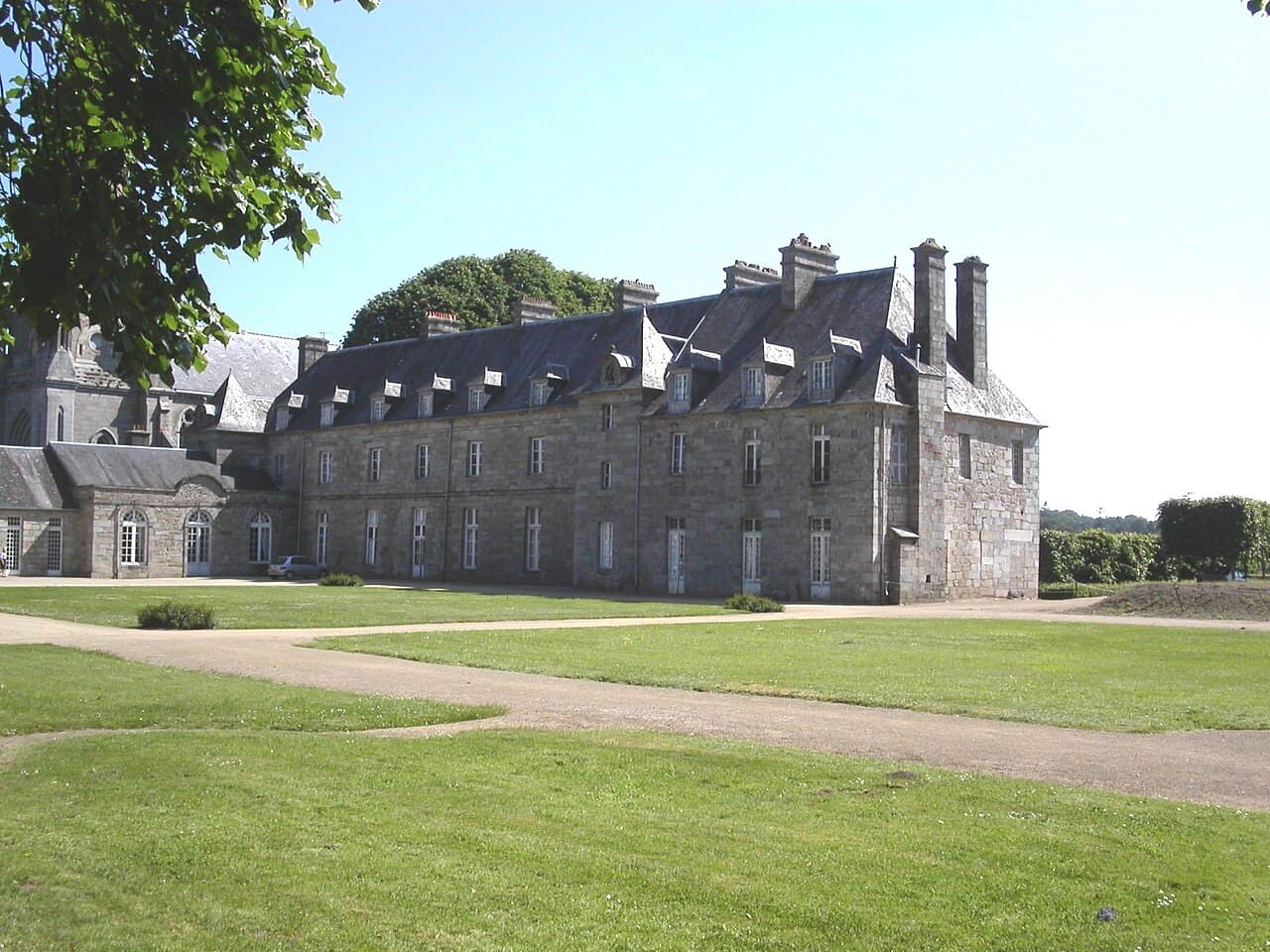
Quintin Castle
Quintin Castle, also known locally as Château de Quintin, is a remarkable historic site located in the town of Quintin in the Côte-d'Armor department of Brittany, France. This castle complex reflects a layered history spanning from the 12th century through the 18th century, showcasing architectural and historical developments shaped by regional conflicts, religious strife, and noble ownership.
The origins of Quintin Castle date back to the late 12th century, when a fortified manor was likely constructed by Alain de Penthièvre. This early structure, mentioned as castellum novum in 1202, served as a defensive stronghold and noble residence. The castle was first explicitly referenced in 1204, marking its significance in the medieval landscape of Brittany.
The medieval fortress and its evolution
In the mid-13th century, around 1249, Geoffrey I of Penthièvre, also known as Geoffrey I Boterel, replaced the initial manor with a more substantial castle. This medieval fortress featured a moat, four fortified gates, curtain walls, and multiple towers, embodying typical defensive architecture of the High Medieval period. The castle’s fortifications underscored its strategic importance in the region.
Despite its strength, the castle suffered severe damage during the French Wars of Religion in the late 16th century, particularly at the hands of the troops of Philippe Emmanuel, Duke of Mercœur. The conflict left the castle in ruins, marking the end of its medieval military function.
17th-century reconstruction and religious tensions
In 1602, the ruined castle was inherited by Henri I, Duke de La Trémoille, who sold it in 1633 to the Marquis de La Moussaye. The La Moussaye family, being fervent Protestants, faced significant opposition from the Catholic local clergy and authorities. This religious tension led to strict conditions imposed on them, including restrictions on construction, residency duration, and religious practice.
Eventually, in 1643, with permission from Anne of Austria, construction of a new castle began. The La Moussaye built foundations, stables, and notably a faceted corner tower. However, due to ongoing religious conflicts and local resistance, construction proceeded slowly and ceased entirely by 1666. Financial difficulties forced the La Moussaye family to sell the unfinished castle to Guy-Aldonce de Durfort, Marshal de Lorge, in 1681.
The 17th-century faceted corner tower and stables
The faceted corner tower from this period remains a significant architectural feature. Its design reflects the transition from medieval fortifications to more residential and symbolic structures. The stables initially built by La Moussaye were later converted into a manor house by the Durfort family during the 18th century.
18th-century manor and later history
Throughout the 18th century, the castle complex evolved into a more comfortable residence. The Durfort family, who adopted the name Lorge, rebuilt the stables into a manor, reflecting the architectural tastes of the period. However, by the late 18th century, the castle was largely abandoned as a noble residence and was occupied only by an intendant and some officers.
In 1775, the castle passed into the hands of the Choiseul family through marriage. During the French Revolution, the castle’s 17th-century tower served as a prison, and its cellars were used for manufacturing saltpeter, an important component for gunpowder.
Architectural features and current condition
Today, the visible remains of Quintin Castle primarily include the 17th-century faceted corner tower and the 18th-century manor house that was converted from the original stables. The subterranean basement galleries beneath the tower are notable features currently undergoing slow restoration to enable public visits.
The castle is classified as a high medieval site with later additions from the post-medieval period, embodying a mix of defensive medieval architecture and residential manor elements. Its condition is considered partially preserved and partially restored, reflecting its complex history and ongoing conservation efforts.
Gardens and visitor experience
Visitors to Quintin Castle can explore its well-maintained gardens and the 18th-century manor. Although the castle remains private property, it is open to the public for a small fee. The full historic castle complex is not yet entirely accessible, but restoration aims to enhance visitor experiences in the future.
Historical significance and cultural heritage
Quintin Castle stands as a testament to the turbulent history of Brittany, reflecting the region’s medieval military architecture, the impact of the French Wars of Religion, and the evolution of noble residences through the centuries. Its story intertwines with prominent historical figures such as Geoffrey I Boterel, Henri I, Duke de La Trémoille, and Guy-Aldonce de Durfort.
The castle’s layered history, from a fortified manor to a Renaissance-style residence and revolutionary prison, provides valuable insights into the social, religious, and political dynamics of the region. Its preservation and ongoing restoration efforts contribute to the cultural heritage of Brittany and offer a rich experience for historians, architects, and visitors alike.
Architectural style and typology
While originally a high medieval fortress with defensive features such as moats, curtain walls, and towers, the later construction phases introduced elements characteristic of post-medieval manor houses. The castle does not fit neatly into a single architectural style but represents a mixed typology reflecting its historical transformations.
Frequently asked questions (FAQ)
- When was Quintin Castle originally built?
- Quintin Castle's origins date back to the late 12th century, with the first fortified manor likely constructed by Alain de Penthièvre. The first actual castle was built around 1249 by Geoffrey I of Penthièvre.
- Can I visit Quintin Castle and its gardens?
- Yes, Quintin Castle is open to visitors for a small fee. While the full castle complex is not entirely accessible, the gardens and the 18th-century manor house are visitable.
- What architectural styles are represented at Quintin Castle?
- Quintin Castle features a mix of architectural styles, including high medieval defensive structures and post-medieval manor house elements from the 17th and 18th centuries.
- What role did Quintin Castle play during the French Wars of Religion?
- During the French Wars of Religion in the late 16th century, Quintin Castle was severely damaged by the troops of Philippe Emmanuel, Duke of Mercœur, reflecting the region's religious conflicts.
- Is Quintin Castle accessible for visitors with limited mobility?
- As the castle is a historic site with partial restorations and some underground galleries, accessibility may be limited. Visitors are advised to check with the site management for specific accommodations.
Photo gallery

Photo by Brieg•Public domain
Information
Current owner
Private owner
Website
Visit websiteAddress
Impasse de la Pompe, Quintin, France
Sources & official resources
Verify the information above using these authoritative references.
Loading map...
Visitor reviews
No reviews yet. Been here? Write the first review and help other travelers!
Write the first reviewVisited this castle? Share your experience
Your review helps other travelers and adds first-hand knowledge to our encyclopedia.



