Puerta de la Macarena (Seville)
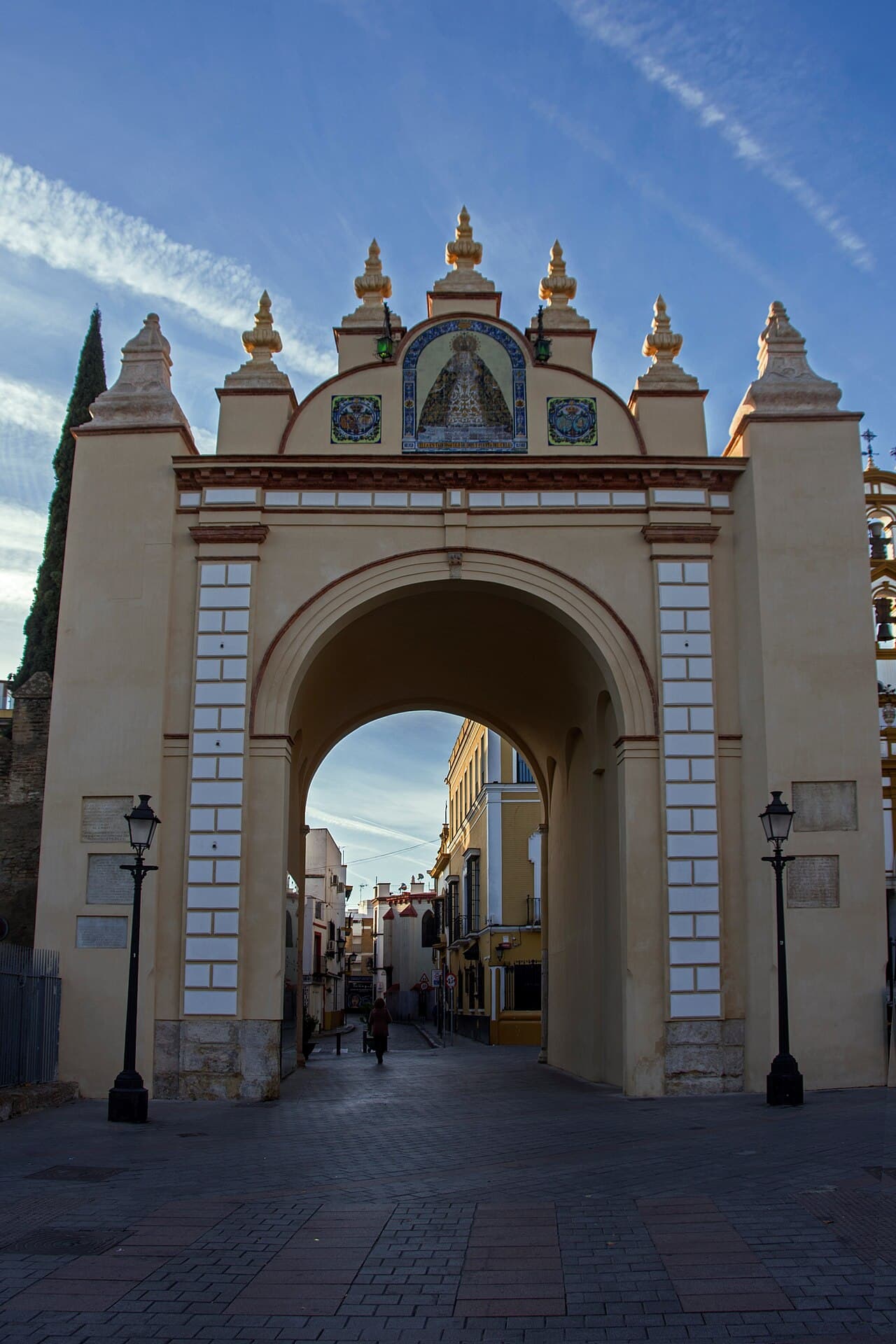
The Puerta de la Macarena (Arabic: Bab-al-Makrin), also known as Arco de la Macarena, is a significant historic city gate located in Seville, Andalusia, Spain. It stands as one of the only three surviving gates from the original medieval city walls of Seville, alongside the Postigo del Aceite and the Puerta de Córdoba. Positioned on Calle Resolana within the barrio de San Gil of the Casco Antiguo district, this gate faces the renowned Basílica de La Macarena, home to the iconic image of the Our Lady of la Esperanza Macarena, a central figure in Seville's Holy Week celebrations.
Historical and architectural significance
The Puerta de la Macarena serves as the northernmost entrance to the historic walled enclosure of Seville. It is the largest gate among the remaining city gates and is connected to the Puerta de Córdoba by a preserved section of the original city walls featuring seven defensive towers. These fortifications originally trace back to the Roman period, with the first walls constructed under Julius Caesar, replacing earlier Carthaginian defenses.
The gate itself was constructed during the 12th century under the direction of the Almoravid sultan Ali ibn Yusuf as part of a significant expansion of Seville's defenses. This period corresponds to the High Medieval era, during which Islamic architectural styles predominated in Andalusia. The original gate featured typical Islamic military architecture, including bastioned fortress elements designed to protect the city from northern threats.
Remodeling and stylistic evolution
Between 1723 and 1795, the Puerta de la Macarena underwent extensive remodeling that transformed its appearance from its original Islamic design to a classicist style. This renovation replaced many of the gate's original architectural elements with features characteristic of 18th-century European classicism, including symmetrical forms, decorative pilasters, and a more monumental facade. Despite these changes, the gate retained its defensive function and historical importance.
Symbolic role in royal ceremonies
The Puerta de la Macarena historically served as a ceremonial entrance for monarchs visiting Seville for the first time. In front of the gate stood an altar where kings performed a symbolic homage, after which they were presented with the keys to the city. This tradition underscored the gate's role as a symbol of royal authority and municipal loyalty.
Notable monarchs who participated in this ceremony include Alfonso XI of Castile (1327), Isabella I of Castile (1477), Ferdinand II of Aragon (1508), Charles V, Holy Roman Emperor, and Isabella of Portugal (1526), and Philip IV (1624). These events highlight the gate's importance in the political and social history of Seville.
Artistic features and cultural heritage
The gate is crowned by a ceramic altarpiece created by the painter Manuel Rodríguez. This artwork depicts the Virgin of Hope of Macarena and was inaugurated in 1923 by Infanta Maria de la Esperanza of Bourbon–Two Sicilies. The altarpiece adds a religious and cultural dimension to the gate, linking it to the strong Catholic traditions of the city.
In recognition of its historical and cultural value, the remains of the walled city of Seville, including the Puerta de la Macarena, were declared a Bien de Interés Cultural in 1985. This designation helps protect the gate and surrounding fortifications as important heritage sites.
Architectural features and preservation
The Puerta de la Macarena is classified as a bastioned fortress, characterized by its robust defensive walls and bastions designed to withstand attacks. The gate's structure includes thick masonry walls, battlements, and defensive towers that emphasize its military purpose. The surviving section of the city walls connected to the gate preserves seven towers, offering valuable insights into medieval urban fortifications.
Today, the gate is well preserved and remains a prominent landmark in Seville. Its location within the historic center makes it accessible to visitors interested in exploring the city's medieval past and architectural heritage.
Location and urban context
Situated in the Casco Antiguo, the oldest part of Seville, the Puerta de la Macarena is integrated into a vibrant urban landscape. The gate's proximity to the Basílica de La Macarena and other historic sites enhances its significance as a cultural and tourist attraction.
Visiting information
The gate is publicly accessible and can be viewed year-round. While there is no entrance fee to see the gate itself, visitors often combine their visit with nearby attractions such as the basilica and the historic district. The best time to visit is during the spring, especially around Holy Week, when the Virgin of Hope of Macarena is prominently celebrated.
Frequently asked questions (FAQ)
- What is the historical significance of Puerta de la Macarena?
- Puerta de la Macarena is one of the three remaining gates of Seville's medieval walls, originally built in the 12th century during the Almoravid expansion. It served as a key defensive structure and ceremonial entrance for monarchs.
- When was Puerta de la Macarena built and remodeled?
- The gate was constructed in the 12th century under Sultan Ali ibn Yusuf and extensively remodeled between 1723 and 1795 to adopt a classicist style.
- Can visitors access Puerta de la Macarena year-round?
- Yes, the gate is publicly accessible throughout the year with no entrance fee, making it easy for visitors to explore this historic landmark.
- What architectural style characterizes Puerta de la Macarena?
- Originally built with Islamic military architectural elements, the gate was remodeled in the 18th century to reflect a classicist style, blending defensive features with elegant design.
- Why is Puerta de la Macarena important during Seville's Holy Week?
- The gate faces the Basílica de La Macarena, home to the Virgin of Hope of Macarena, a central figure in Holy Week processions, linking the gate to the city's religious traditions.
Photo gallery

Information
Loading map...
Visitor reviews
No reviews yet. Been here? Write the first review and help other travelers!
Write the first reviewVisited this castle? Share your experience
Your review helps other travelers and adds first-hand knowledge to our encyclopedia.