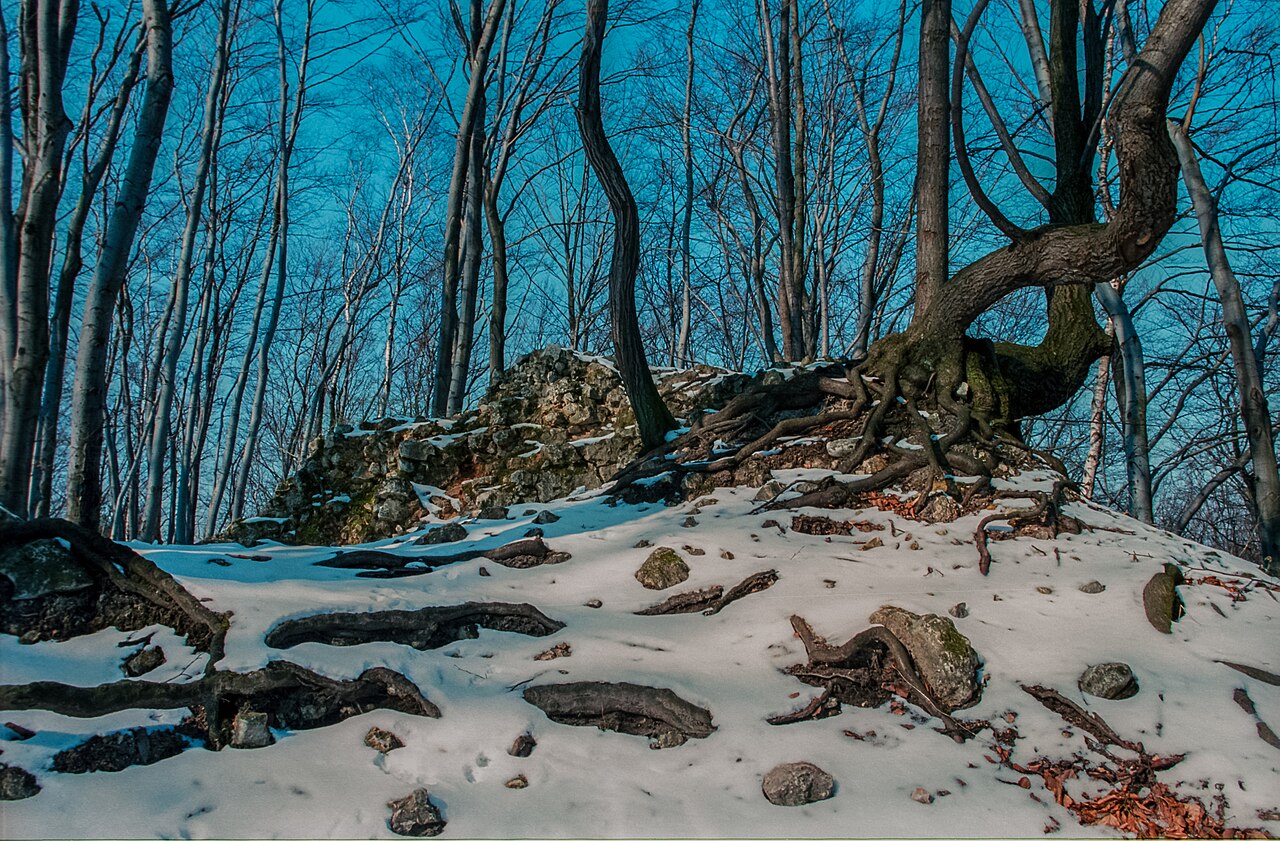
Przewodziszowice
Przewodziszowice castle stands as a striking example of a late medieval hill castle perched atop a nearly twenty-meter-high limestone rock formation in southern Poland. Despite the scarcity of direct historical records, this jurassic stronghold captures the imagination with its dramatic location and the legends surrounding its past. The castle's origins remain uncertain, with some historians debating whether it was founded under the auspices of King Casimir the Great or the Silesian Duke Władysław Opolski. What is certain is that the castle was constructed in the second half of the 14th century as a strategic fortification within the Kraków-Częstochowa Upland, a region known for its rocky terrain and numerous medieval castles.
Architectural layout and structural features
The castle complex was divided into two main parts: the upper castle and the lower bailey. The upper castle occupied the summit of the rock, covering an area of approximately 1650 square meters. It was encircled by a high defensive wall made of rough-hewn limestone blocks, following the edge of the rock. This wall, which still survives in substantial fragments today, reached heights of up to 10 meters and thicknesses of nearly 1.8 meters. On the southeastern side, the wall was reinforced by a natural slope, enhancing its defensive capabilities.
At the base of the rock lay the economic lower bailey, which was protected by an earthen rampart or a low wall and a moat. This outer enclosure would have housed auxiliary buildings necessary for the castle's operation, such as stables, workshops, and storage facilities. Unfortunately, no archaeological excavations have been conducted at Przewodziszowice, limiting precise knowledge of the castle's internal structures and layout.
Historical context and notable figures
Between 1424 and 1444, the castle and the adjacent village belonged to Nicholas Kornicz, known as Siestrzeniec. He was a notorious figure in 15th-century Poland, famed as a robber knight who evaded capture through boldness and cunning. His exploits made him infamous among the Polish and Silesian nobility, culminating in his condemnation at the 1434 assembly of Polish and Silesian lords in Będzin. Despite this, Kornicz was never formally tried or imprisoned. Local folklore attributes vast hidden treasures to him, supposedly concealed in the castle's well, though none have ever been found.
Current condition and preservation
Today, the castle remains a ruined hill castle, with significant portions of its perimeter wall still standing on the edge of the steep limestone rock. These ruins offer a vivid glimpse into the castle's original defensive design and the challenges of medieval fortification in rugged terrain. The site is an important cultural and historical landmark within the Kraków-Częstochowa Upland, attracting visitors interested in medieval architecture and Polish history.
Legends and cultural significance
The enduring legends of Nicholas Kornicz's hidden treasures contribute to the castle's mystique. Stories of vast riches buried in the well have inspired treasure hunters for centuries, though none have succeeded in uncovering them. These tales enhance the castle's appeal as a site of mystery and adventure, enriching its cultural heritage beyond its architectural and historical value.
Visiting Przewodziszowice castle
While the castle is in ruins, its dramatic location atop a towering rock makes it a popular destination for tourists and hikers exploring the Jura Krakowsko-Częstochowska region. Visitors can observe the impressive remnants of the defensive walls and enjoy panoramic views of the surrounding landscape. Due to the lack of extensive archaeological work, much of the castle's history remains hidden, inviting exploration and interpretation.
Frequently asked questions (FAQ)
- When was Przewodziszowice castle built?
- Przewodziszowice castle was built in the second half of the 14th century, likely during the late medieval period.
- Who was Nicholas Kornicz and what is his connection to the castle?
- Nicholas Kornicz, known as Siestrzeniec, was a notorious 15th-century robber knight who owned the castle between 1424 and 1444. He was famous for his daring exploits and evasion of capture.
- What remains of the castle can visitors see today?
- Visitors can see substantial ruins of the castle's perimeter walls made of limestone, which reach up to 10 meters high and 1.8 meters thick in places, situated atop a steep rock.
- Is there archaeological research available about the castle?
- No extensive archaeological excavations have been conducted at Przewodziszowice, so much of the castle's internal structure remains unknown.
- Can visitors explore the castle grounds freely?
- Yes, the ruins are accessible to visitors who can explore the site and enjoy views of the surrounding Kraków-Częstochowa Upland region.
Information
Loading map...
Visitor reviews
No reviews yet. Been here? Write the first review and help other travelers!
Write the first reviewVisited this castle? Share your experience
Your review helps other travelers and adds first-hand knowledge to our encyclopedia.