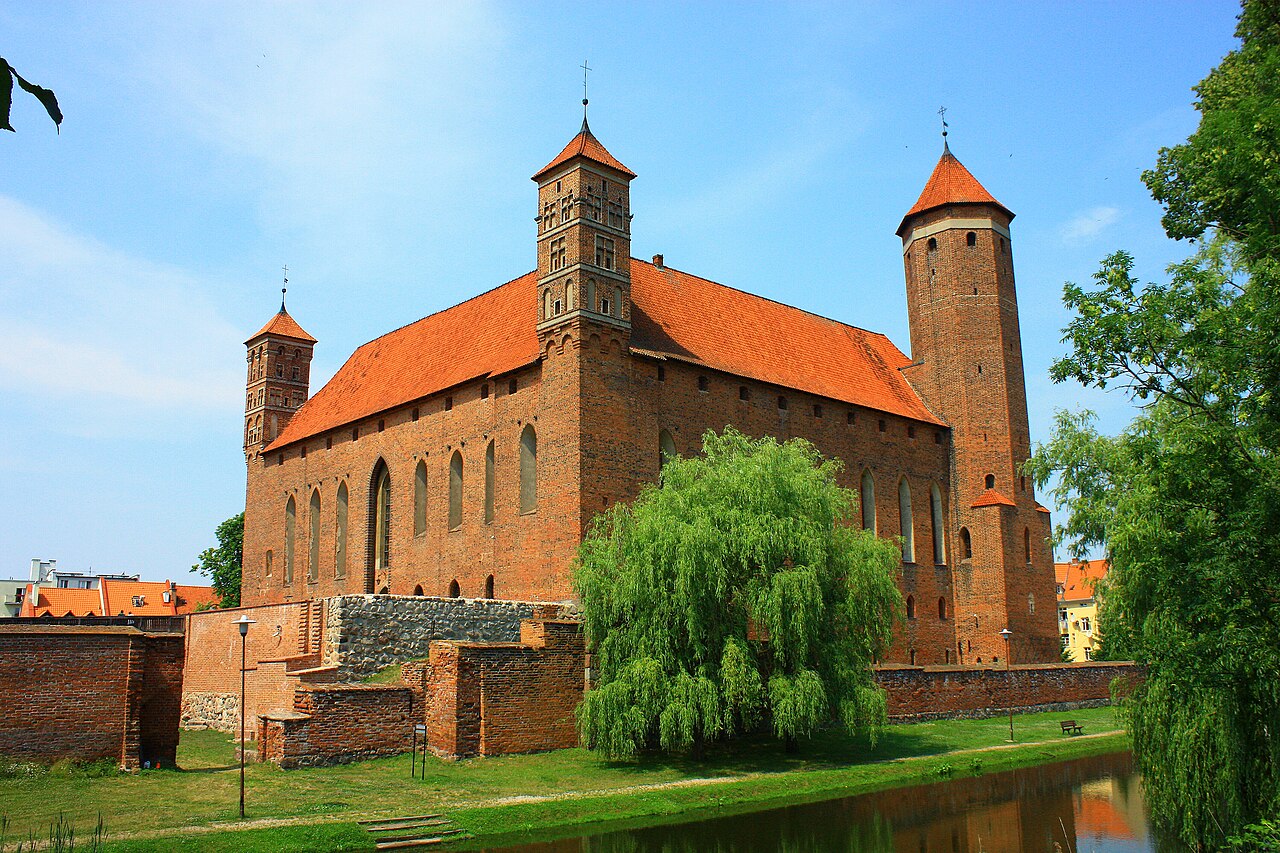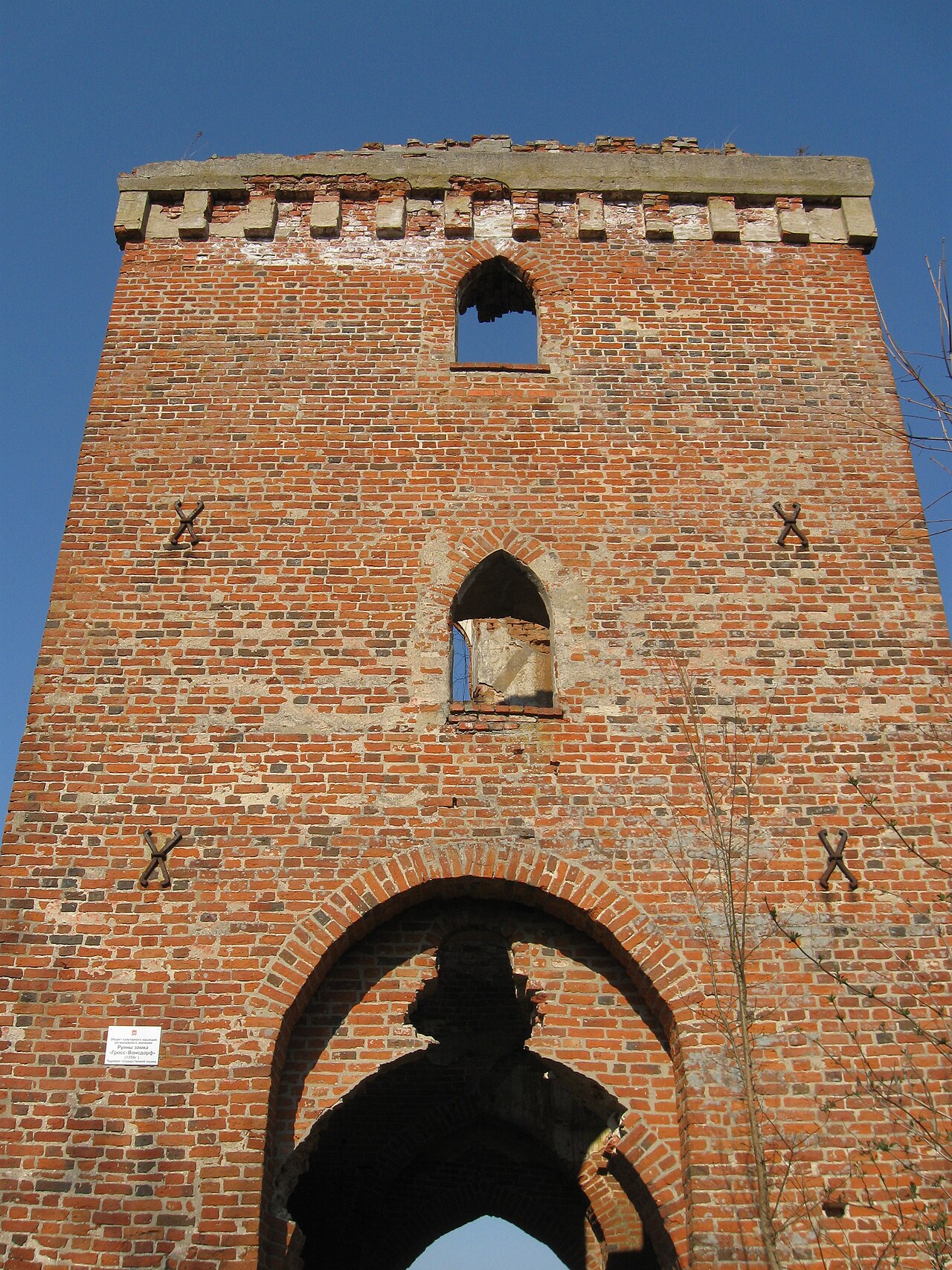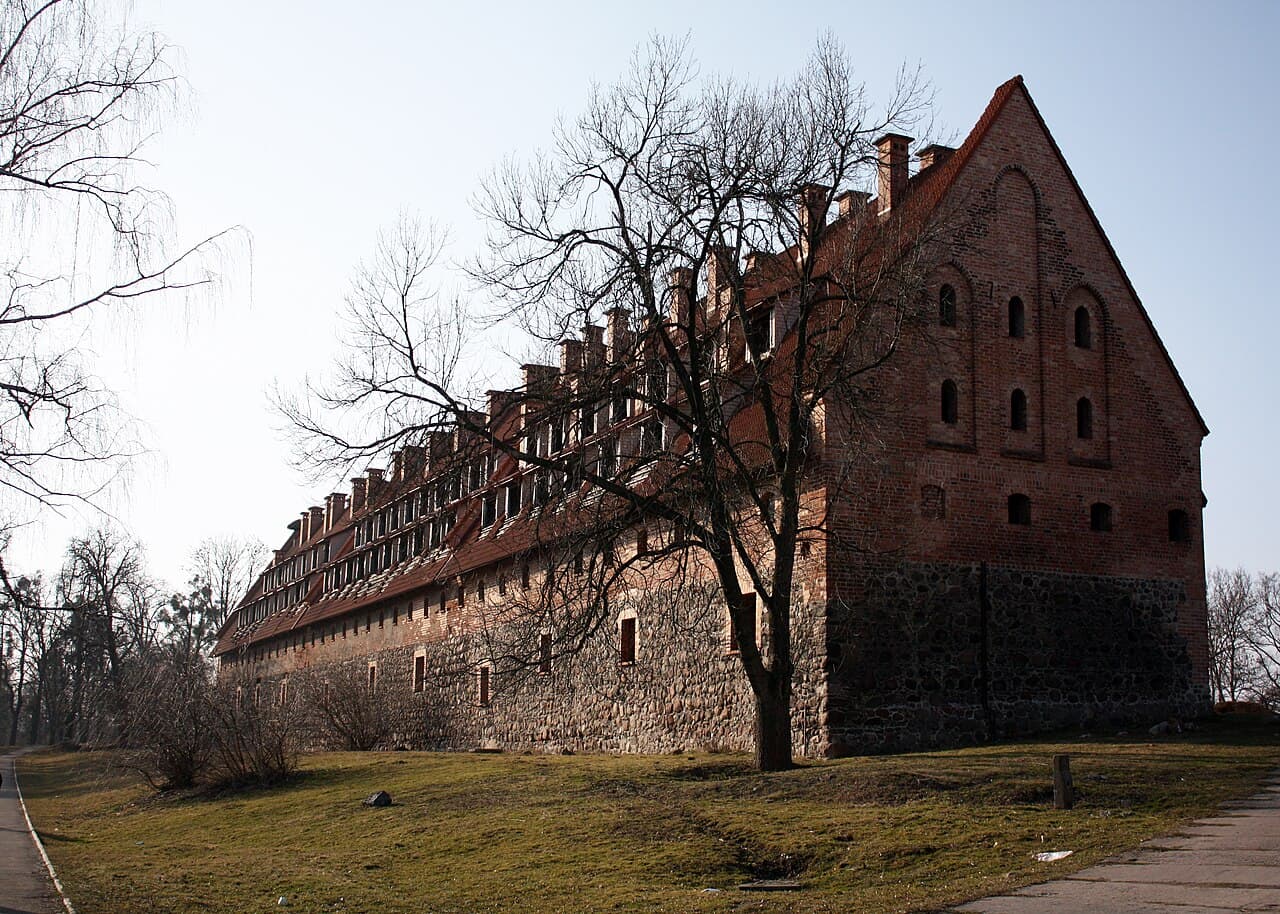
Preußisch Eylau Castle
Preußisch Eylau Castle, located in the municipality of Bagrationovsk, Russia, is a significant example of a late medieval hill castle constructed by the Teutonic Knights in the early 14th century. Founded in 1325 under the direction of Grand Master Werner von Orseln, the castle was built on the site of an earlier Old Prussian fortress called Sutwrit. The construction was overseen by the master builder Arnold von Eilenstein and supervised by Dietrich von Altenburg, the Komtur of the nearby Balga commandry. This fortress was strategically positioned in the heart of the Old Prussian region of Natangia, serving as both a military stronghold and an administrative center.
Architectural design and fortifications
The castle was designed as a quadrangular fortress, measuring approximately 41 by 43 meters, surrounded by a water-filled moat that enhanced its defensive capabilities. The moat was part of an artificially created island, formed by damming a river and raising water levels to protect the site naturally. The fortress featured drawbridges that controlled access across the moat and gates equipped with portcullises, heavy grilled doors that could be lowered to secure the entrance against attackers.
An extensive outer bailey was added along the eastern side, expanding the castle's footprint and providing additional space for military and administrative functions. The outer bailey included various service buildings and was integral to the castle's defense system. The entire complex exemplifies typical Teutonic Order military architecture, combining robust fortifications with functional administrative spaces.
Historical significance and events
Initially known as "Ile" and later "Iladia," the castle was renamed Preußisch Eylau ("Preußisch-Ilow") and played a central role in the region's governance. Until 1347, it served as the residence of the Order’s pfleger, a local administrative official. Subsequently, it became the seat of the chamber administration related to the Balga commandry, underscoring its administrative importance within the Teutonic Order's territorial network.
The castle witnessed several military engagements, notably during the Thirteen Years' War (1454–1466). On May 24, 1455, it was besieged by troops of the Prussian Confederation under Remschel von Krixen but successfully resisted the attack. Later, during the Horsemen's War in 1520, it endured another siege by forces of the Polish Kingdom, which, while failing to capture the fortress, resulted in the devastation of the surrounding village.
The castle also held local legal significance; in 1427, the Eylau County Law (Eylauer Landesordnung) was promulgated here by the Teutonic Order, reflecting its role as a regional administrative hub.
Post-medieval history and preservation
Through the centuries, Preußisch Eylau Castle transitioned from a military fortress to a residential and administrative site. Remarkably, it sustained relatively minor damage during World War II and remained in residential use until the early 1960s. Ownership transferred to the regional consumer cooperative raypotrebsoyuz in 1961, which repurposed the castle for storage.
By 1964, scientific restoration assessments revealed the castle was in poor condition due to neglect. In the post-war period, a shooting range was constructed on the site of the original western wing but was dismantled in the 1990s, restoring the area closer to its historic layout.
The castle's outer bailey roof deteriorated significantly by the late 1980s, culminating in a destructive fire in August 1990 that destroyed the central roof section. Another fire in June 2016 damaged roughly 80 square meters of the roof, exacerbating the structure's vulnerability. Restoration efforts began in the late 2010s, including rebuilding the wooden rafter framework, installing new roof tiles, and reconstructing window openings.
In December 2023, a wooden canopy was erected over the citadel ruins to protect the remains from further damage. The outer bailey was reopened for guided tours in September 2025, coinciding with stabilization work on the citadel ruins to prevent further deterioration. Plans include converting the castle’s cellars into museum space, aiming to provide cultural and educational value to visitors.
Cultural and architectural legacy
Preußisch Eylau Castle stands as a testament to the Teutonic Order's military and administrative presence in the Baltic region during the late medieval period. Its architecture reflects the strategic importance of fortifications in the borderlands of the Order’s state, combining defensive features such as moats, drawbridges, and portcullises with functional spaces for governance and residence.
The castle’s evolution from a fortress to a residential and administrative center illustrates broader historical shifts in the region, including changes in military technology, political authority, and local governance. Today, ongoing restoration efforts seek to preserve this heritage, offering insight into medieval construction techniques and the complex history of the Teutonic Knights in what is now the Kaliningrad Oblast of Russia.
Frequently asked questions (FAQ)
- How do I visit Preußisch Eylau Castle?
- Preußisch Eylau Castle is located in Bagrationovsk, Kaliningrad Oblast. Visitors can access the site by car or local transport. The outer bailey is open for guided tours, especially in the warmer months. Check local tourism resources for updated visiting hours and tour availability.
- What is the historical significance of Preußisch Eylau Castle?
- Built by the Teutonic Knights in 1325, Preußisch Eylau Castle served as a military fortress and administrative center in the Old Prussian region of Natangia. It played a role in regional conflicts such as the Thirteen Years' War and Horsemen's War, reflecting its strategic importance.
- What architectural features does Preußisch Eylau Castle have?
- The castle features a quadrangular layout with a water-filled moat, drawbridges, and portcullises. It includes a large outer bailey and was built on an artificial island, showcasing typical Teutonic Order military architecture from the late medieval period.
- Is Preußisch Eylau Castle accessible for visitors with mobility issues?
- Due to the castle's historic and partially restored condition, some areas may be challenging for visitors with mobility issues. The outer bailey is more accessible, but the citadel ruins involve uneven terrain and limited facilities.
- When is the best time to visit Preußisch Eylau Castle?
- The best time to visit is during late spring to early autumn when weather conditions are favorable and guided tours of the outer bailey are available. Winter months may limit access due to weather and site maintenance.
Photo gallery

Information
Sources & official resources
Verify the information above using these authoritative references.
Loading map...
Visitor reviews
No reviews yet. Been here? Write the first review and help other travelers!
Write the first reviewVisited this castle? Share your experience
Your review helps other travelers and adds first-hand knowledge to our encyclopedia.