Pietra Castle

Pietra Castle in Calliano, Italy
Calliano, Italy
High Medieval (11th–13th c.)
Restored

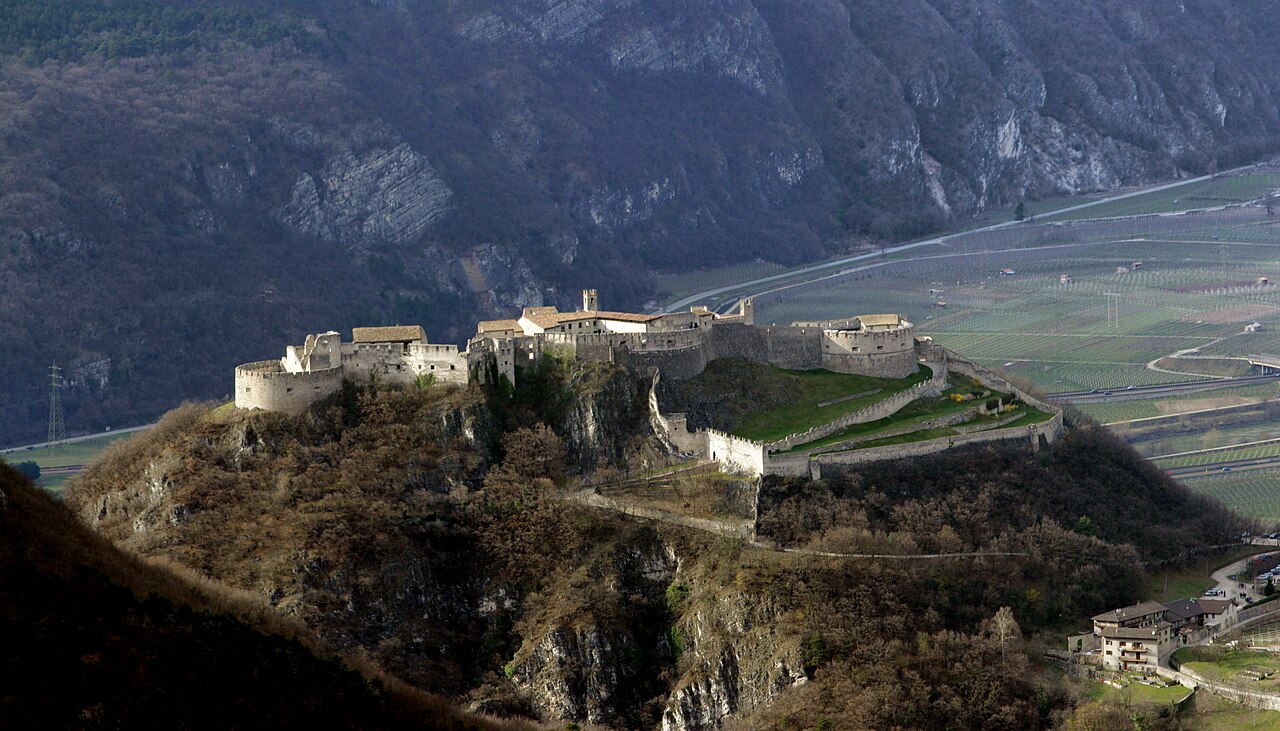
Pietra Castle is a remarkable example of a High Medieval fortress strategically perched on a massive boulder detached from the nearby Cengio Rosso rock formation. Located in Calliano, Italy, this castle occupies a crucial position that historically marked the border between the Italian Tyrolean territories, the Bishopric of Trent, and the Republic of Venice. Its commanding placement provided both defensive advantages and control over the surrounding valleys, making it a significant military stronghold during the Middle Ages.

Historical significance and military role

Constructed in the 13th century, Pietra Castle played a pivotal role in regional conflicts, particularly during the 15th and 16th centuries. This period was marked by intense territorial disputes between the Republic of Venice and the Principality of Tyrol, supported by Austrian forces. The castle served as a defensive bastion against Venetian incursions attempting to advance northward. Several important pitched battles unfolded in the vicinity of the castle, underscoring its strategic importance in controlling access routes and maintaining territorial integrity.

Architectural features and design

The castle's architecture reflects its Gothic style influences, visible in the design of its rooms and decorative elements. One of the standout features is the Hall of Justice, which retains a strictly Gothic atmosphere. This hall is illuminated by windows with a distinctive Guelph-style arch, characterized by their pointed tops and elegant form. The walls of the hall are adorned with 15th-century frescoes, which add artistic and historical value to the interior spaces.

Structural components

Pietra Castle is built directly upon a huge boulder, integrating natural rock formations into its defensive structure. This fusion of natural and man-made fortifications enhanced its resilience against sieges. The castle includes typical medieval defensive features such as battlements, thick stone walls, and fortified gates, designed to withstand assaults and provide vantage points for defenders. The elevated position also offered extensive views of the surrounding landscape, crucial for early warning of approaching enemies.

Restoration and current status

Today, Pietra Castle is restored and remains privately owned and inhabited. Its preservation allows visitors to appreciate the castle's medieval character and architectural details. Although it is not a public museum, its historical and architectural significance continues to attract interest from scholars and enthusiasts of medieval fortifications.

Geographical and cultural context

Situated in the Trentino-Alto Adige/Südtirol region, Pietra Castle stands as a testament to the complex political and cultural history of northern Italy. The castle’s location near the border of several historical territories highlights the region's strategic importance during the Middle Ages. The interplay between Italian and Tyrolean influences is evident in the castle's design and history, reflecting the broader cultural dynamics of the area.

Legacy and heritage

Pietra Castle is recognized not only for its military and architectural features but also for its role in the historical narrative of border defense and regional power struggles. Its Gothic interiors and preserved frescoes contribute to the understanding of medieval artistic traditions in northern Italy. The castle’s continued existence and restoration underscore the value placed on cultural heritage preservation in the region.

Frequently asked questions (FAQ)

How do I get to Pietra Castle?
Pietra Castle is located in Calliano, Italy, and can be accessed by car or public transport. The nearest train station is in nearby Rovereto, from where you can take a bus or taxi to reach the castle.
What is the historical significance of Pietra Castle?
Pietra Castle, dating back to the 13th century, played a vital role in the defense of the region against invasions. Its strategic location allowed it to control the important trade routes in the area, making it a key fortification in the history of Trentino.
When was Pietra Castle built?
Construction of Pietra Castle began in the early 1200s, with several modifications and expansions occurring over the centuries. The castle's architecture reflects the various historical periods it has witnessed, showcasing a blend of medieval and Renaissance styles.
Can I visit Pietra Castle with a guided tour?
Yes, guided tours are available at Pietra Castle, providing visitors with insights into its rich history and architecture. These tours are typically conducted in multiple languages and allow you to explore the castle's fascinating features.
Why is Pietra Castle considered an architectural gem?
Pietra Castle is renowned for its impressive stone walls, well-preserved towers, and stunning views of the surrounding landscape. Its unique architectural design showcases the defensive strategies of the time while also reflecting the artistic trends of the era.
Is it possible to access Pietra Castle for individuals with disabilities?
While Pietra Castle has made efforts to improve accessibility, some areas may still pose challenges for visitors with mobility impairments. It is advisable to contact the castle administration in advance to inquire about specific accessibility options available during your visit.
What is the best time to visit Pietra Castle?
The best time to visit Pietra Castle is during the spring and early autumn when the weather is mild, and the surrounding scenery is at its most picturesque. Additionally, visiting during weekdays can help you avoid larger crowds.
What are the opening hours for Pietra Castle?
Pietra Castle is typically open to visitors from 10 AM to 6 PM, with extended hours during the peak tourist season. However, it is recommended to check the official website or contact the castle directly for the most current information on opening times.
What are the ticket prices for visiting Pietra Castle?
Ticket prices for Pietra Castle vary depending on age and group size, with discounts often available for students and seniors. Family packages may also be offered, making it an affordable option for those wanting to explore the castle's history.
Are there any nearby attractions to visit along with Pietra Castle?
Yes, the area surrounding Pietra Castle is rich in attractions, including the beautiful town of Rovereto and the stunning landscapes of the Vallagarina valley. Additionally, nearby museums and hiking trails offer visitors a chance to immerse themselves in the local culture and natural beauty.

Information

Hill Castle

Loading map...

Visitor reviews

No reviews yet. Been here? Write the first review and help other travelers!

Write the first review

Visited this castle? Share your experience

Your review helps other travelers and adds first-hand knowledge to our encyclopedia.
Write a review

(5/5)

0/2000 characters

Your review will be visible after admin approval

Nearby castles

1.6 km
Beseno Castle — Italy castle

Beseno Castle

Besenello, Italy

Beseno Castle stands as the largest fortified complex in the Trentino region of northern Italy, occupying a commanding hilltop location overlooking the Vallagarina valley between Rovereto and Trento. Constructed originally in the 12th century, this high medieval hill castle was built to control key routes including access to the Folgaria Plateau, making it a vital military and administrative stronghold for centuries. The castle's strategic importance is reflected in its extensive fortifications, which evolved significantly over time, particularly in the 16th century when the fortress was adapted to the era of firearms. The imposing lunated bastions that characterize Beseno Castle today date from this period, designed to withstand artillery attacks and provide comprehensive defensive coverage from multiple angles. These bastions, combined with massive stone walls and fortified gates, form a roughly triangular layout enclosing large courtyards and various functional buildings. Architectural features and layout The castle occupies an elliptical limestone hill approximately 250 meters long and 50 meters wide. Its fortifications include three prominent bastions positioned at the corners of the triangular plan, reflecting advanced military architectural principles of the Renaissance adapted to earlier medieval structures. The main entrance was originally protected by a drawbridge and a gatehouse with gunports, some of which remain visible in the first courtyard. Within the walls, visitors can explore extensive courtyards and buildings that historically served as kitchens, bread ovens, wine cellars, and storage warehouses. The walkway along the ramparts offers panoramic views across the valley and towards the Folgaria Plateau, emphasizing the castle’s commanding position. The fortress also includes a clock tower, a hayloft, and the Palace of Marcabruno, a 14th-century residence that now hosts a permanent exhibition on the Battle of Calliano (1487). Historical significance and events Beseno Castle has a rich history marked by numerous military engagements and political shifts. Initially held by the Counts of Appiano and their vassals, the Da Beseno family, the castle’s ownership later fragmented between family branches, leading to internal conflicts and a decline in regional influence. Portions of the castle also came under the control of the Trentino church in the 13th century. The 14th century saw revitalization under Guglielmo II da Castelbarco, who undertook significant restoration efforts. The castle played a critical role during the turbulent 15th century, particularly during the Battle of Calliano on August 10, 1487. This battle saw Tyrolean forces successfully repel an invasion by the Republic of Venice, which sought expansion towards Trento. The Venetian commander, Roberto Sanseverino d’Aragona, was killed during the conflict, marking a decisive moment in regional history. Following a devastating fire in the 16th century, the castle was extensively rebuilt to incorporate modern defensive features suitable for firearm warfare. This reconstruction transformed Beseno from a medieval fortress into a fortified residence, blending military utility with domestic functions. In the late 18th century, the castle endured a prolonged siege by Napoleonic forces. The arrival of Austrian reinforcements forced the French to retreat, highlighting the fortress’s enduring strategic value even in the age of gunpowder. Decline and restoration With the advent of more stable political conditions in the 19th century, Beseno Castle gradually lost its military importance and fell into neglect. Parts of the structure were dismantled, including the demolition of a tower in 1957 for road safety reasons. Additionally, the castle was left uncovered for a period to avoid property taxation. In 1973, the castle was donated to the Autonomous Province of Trento by the Von Trapp family. This transfer initiated extensive restoration projects aimed at preserving and stabilizing the fortress. Since 1988, Beseno Castle has been open to the public as part of the provincial museum network, hosting exhibitions, cultural events, and historical reenactments. The Palace of Marcabruno now features a permanent exhibition dedicated to the Battle of Calliano, including a collection of original and replica weapons. Visitors are encouraged to interact with historical armor and helmets, making the experience engaging for all ages. Visitor experience and cultural events Today, Beseno Castle is not only a monument of military architecture but also a vibrant cultural venue. The large Campo dei Tornei (Tournament Field) has been transformed into a well-maintained garden, serving as a picturesque setting for temporary exhibitions, period costume pageants, and other cultural events. The castle’s evocative atmosphere, combined with its panoramic views and well-preserved structures, makes it a compelling destination for history enthusiasts and tourists alike. Visitors can access the castle from the nearby town of Besenello or via the state road SS350, which traces historical routes once guarded by the fortress. Informational displays and audiovisual presentations in the former gunpowder magazine enhance the educational experience. Architectural and historical legacy Beseno Castle exemplifies the evolution of medieval fortifications adapting to the changing demands of warfare over several centuries. Its blend of high medieval origins with Renaissance military innovations offers valuable insights into the development of defensive architecture. The castle’s preservation and adaptive reuse as a cultural site underscore its importance as a symbol of regional heritage and identity. Its commanding position overlooking the Adige valley continues to captivate visitors, providing a tangible connection to the historical landscape shaped by centuries of conflict and governance. Beseno Castle remains a testament to the strategic ingenuity and architectural skill of its builders, as well as the complex history of Trentino-Alto Adige.

High Medieval (11th–13th c.)
Details
5.4 km

Rovereto Castle

Rovereto, Italy

Rovereto Castle stands prominently on a rocky hill overlooking the right bank of the Leno Torrent in the historic town of Rovereto, nestled in the Trentino-Alto Adige region of northern Italy. This late medieval hill castle is renowned as one of the finest examples of Venetian military architecture in the Alpine region, reflecting centuries of strategic importance and evolving fortification techniques. The castle's origins trace back to the 13th and 14th centuries, initially constructed by the Lords of Lizzana before passing to the influential Castelbarco family in the mid-14th century. These early phases established the core defensive structures and residential quarters that would form the foundation for later expansions and modifications. The castle's location on an irregular pentagonal plan was carefully adapted to the natural topography, covering approximately 8,250 square meters with extensive limestone and brick walls fortified by river stones and large boulders in the courtyard and entrance areas. Venetian transformation and military significance In 1416, after a brief siege, the castle and the surrounding city fell under the control of the Republic of Venice. This marked a pivotal moment in its history, as the Venetians undertook a comprehensive transformation to adapt the fortress for the emerging demands of Renaissance warfare. Between 1487 and the early 16th century, Venetian architects such as Giacomo Coltrino and Bartolomeo d’Alviano redesigned the castle’s defenses to withstand artillery bombardment, a significant advancement from the medieval fortifications. The castle was reinforced with massive bastions and rondelles—circular towers designed to provide wide fields of cannon fire. Key defensive elements include the Malipiero tower at the northwest corner, a covered tower with a 20-meter diameter base rising four stories high, and the Marino tower at the southeast corner, standing approximately 25 meters tall with four cannon embrasures. The Coltrino rondelle at the southwest corner, a semi-circular artillery tower, completed the main defensive circuit. Additionally, the D’Alviano bastion projects between the Malipiero and Marino towers to cover blind spots with artillery fire, while the smaller Bastioncello Priuli fortifies the southern wing. Surrounding the castle is a deep moat nearly 15 meters in depth on the northern and eastern sides, while the southern side slopes steeply down to the Leno river, enhancing natural defenses. The western walls survive partially as ruins. Access is gained through a walled corridor beneath the Coltrino tower, leading to the vaulted southern wing and the central courtyard, which houses a deep well over 57 meters deep, constructed during the Venetian period to ensure a reliable water supply during sieges. Habsburg control and later history Following the Venetian defeat at the Battle of Agnadello in 1509, the castle was captured by Emperor Maximilian I and incorporated into the County of Tyrol under Habsburg rule. It served as the residence of the imperial district captain and remained largely unchanged for centuries. In 1782, Emperor Joseph II ordered partial demolition, including filling in the moat and removing the drawbridge, signaling a decline in the castle's military role. During the Napoleonic Wars (1796–1815), the castle was briefly occupied and suffered fire damage. Subsequently, it was looted and fell into neglect. Between 1833 and 1859, it was repurposed as a poorhouse and forced labor camp. The Austrian military later used it as barracks until World War I, when it became a frontline fortress housing the 3rd Kaiserjäger Regiment and heavy artillery units. The castle sustained significant damage from Italian artillery during this conflict. After World War I, the Italian military converted the castle into a prisoner-of-war camp, during which prisoners dismantled wooden interiors for heating. Restoration efforts began in 1920 to establish the Italian War History Museum, which opened in 1921 and remains a key cultural institution within the castle, featuring extensive exhibits on the two world wars, including weaponry, armor, and historical artifacts. Architectural features and interior layout The castle’s interior is complex and layered due to numerous modifications over centuries, making the original medieval plan difficult to discern. Notable surviving features include the former chapel dedicated to Saint Mark, commissioned in 1493 by Gerolamo Marino and restored in the late 20th century. This chapel is part of the museum exhibitions, highlighting the castle’s religious and cultural history. Defensive features include an earthen embankment known locally as the "Füllwerk", situated between the outer and inner walls to absorb cannon fire impact. Covered tunnel-like passages connect the bastions and rondelles, allowing protected movement between defensive points; however, these passages are not currently open to the public. The Malipiero tower’s roof was reconstructed in the early 21st century to reflect its late 15th-century appearance, replacing damage caused by an 18th-century fire. The Marino tower houses exhibition halls displaying arms from the 16th to 18th centuries, while the Malipiero tower features archaeological displays on weaponry from prehistoric times through the Middle Ages. War museum and cultural significance Since 1921, Rovereto Castle has hosted the Italian Historical War Museum, which offers both permanent and temporary exhibitions focused on the history of warfare, particularly the First World War. The museum’s collections include artillery pieces, firearms, armor, and the original plaster model of the famous Maria Dolens—the Bell of the Fallen Soldiers—which was housed at the castle until 1961 before being relocated to the Miravalle hill. The museum also dedicates rooms to the memory of war heroes and significant battle sites, providing educational programs aimed at school groups to foster historical awareness. The castle’s role as a cultural and historical landmark continues to attract visitors interested in military history, architecture, and Alpine heritage. Restoration and preservation efforts Beginning in 2001, extensive restoration projects have aimed to preserve Rovereto Castle’s architectural integrity and highlight its historical features. These efforts included the restoration of the Malipiero and Marino towers, reconstruction of the Malipiero tower’s wooden roof, and conservation of defensive walls and bastions. The restoration work has been carried out in phases, extending through 2016 with plans to complete a visitor path that educates the public about the castle’s rich history and strategic significance. Today, Rovereto Castle stands as a well-preserved monument to late medieval fortification and Venetian military engineering, offering a unique glimpse into the turbulent history of the Alpine region and its role in European conflicts over several centuries.

Late Medieval (14th–15th c.)
Details
6 km

Noarna Castle

Nogaredo, Italy

Noarna Castle stands prominently overlooking the Lagarina valley near Nogaredo, Italy, with origins dating back to the 11th century. This historic fortress was initially a possession of the Castelbarco family before passing to the Lodron family in the late 15th century. The castle's location suggests it may have been built on the site of a former Roman fortification, highlighting its long-standing strategic importance in the region. Medieval origins and architectural features The core of Noarna Castle is its 13th-century keep, which includes a main tower topped by distinctive Guelph-style battlements. These battlements are characterized by their square-shaped merlons, a defensive architectural feature common in northern Italy during the medieval period. The keep also contains two guardrooms and a prison, reflecting the castle's defensive and judicial functions. Architectural elements such as rounded arches within the structure testify to its medieval origins. These arches are typical of Romanesque influence, prevalent in the region during the castle's early construction phases. The castle's robust walls and elevated position provided a commanding view of the valley, crucial for surveillance and defense. Historical significance and ownership The castle's history is marked by conflict and noble ownership. In 1177, Noarna Castle suffered damage during violent fighting, underscoring its military importance in regional disputes. After this period, it became firmly associated with the Castelbarco family, a noble lineage influential in Trentino's medieval history. In 1486, ownership transferred to the Lodron family, who transformed the fortress into an aristocratic mansion. This transition involved architectural modifications that softened the castle's military character, adapting it for residential and representational purposes. The Lodrons used the castle as a summer residence after 1876, reflecting changes in aristocratic lifestyles during the late 19th century. Witch trials and cultural heritage Noarna Castle is notably linked to a dark chapter in local history: it was the site of a notorious witch trial. This trial involved dozens of individuals from the Lagarina valley and resulted in five local women being sentenced to death. The event highlights the castle's role not only as a military and noble residence but also as a center of judicial authority during the medieval and early modern periods. Later history and current status Following its use as a summer residence, the castle was eventually abandoned towards the end of the 19th century. Despite this, Noarna Castle remains well-preserved enough to retain its historical character. Today, it serves a new cultural function: it houses a renowned wine cellar with approximately 35,000 bottles, linking the site to the region's rich viticultural tradition. Architectural and cultural importance Noarna Castle exemplifies the evolution of medieval fortifications in northern Italy, transitioning from a defensive stronghold to an aristocratic residence. Its Guelph battlements and Romanesque arches offer insight into the architectural styles of the High Medieval period. The castle's association with significant historical events, including warfare and witch trials, enriches its cultural significance within the Trentino region. The castle's location overlooking the Lagarina valley underscores its strategic importance, controlling a vital passage through the Italian Alps. Its preservation allows visitors to explore a site that encapsulates centuries of regional history, architecture, and social change.

High Medieval (11th–13th c.)
Details

