
Petavonium
Petavonium represents a significant Roman legionary fortress and ancient city located in the valley of Vidriales, within the modern area of Santibanez de Vidriales and its hamlet Rosinos de Vidriales in the province of Zamora, Castilla y Leon, Spain. This archaeological site offers a rare glimpse into the military and urban development of Roman Hispania from the early 1st century AD through to the decline of Roman authority in the 5th century.
The military origins of petavonium
Originally established as a Roman castrum for the Legio X Gemina, Petavonium served as a strategic military base during the Cantabrian Wars, a series of campaigns aimed at subjugating the Astures and Cantabri peoples in northwestern Iberia. The fortress was positioned to control vital routes connecting the region with Gallaecia, the Douro valley, and Lusitania. These routes were critical for the movement of troops and the transportation of valuable resources, including gold from the renowned Las Médulas mines.
The original legionary camp covered approximately 20 hectares, enclosed by defensive walls and fortified gates. Archaeological excavations have uncovered a wealth of artifacts including ceramic fragments, coins, weapons, and metal objects, many stamped with the insignia of the Legio X Gemina, confirming the site's military function and occupation.
Transition to a civilian settlement and continued military presence
Following the departure of the Legio X Gemina around 63 AD, the site experienced a decline but soon recovered during the Flavian dynasty, likely under Emperor Domitian. At this time, the Ala II Flavia Hispanorum Civium Romanorum, a cavalry unit, was stationed within a newly constructed smaller fortification, or castellum alae, occupying about 4 hectares within the original camp's perimeter.
This military presence catalyzed the growth of a vicus, a civilian settlement of approximately 80 hectares surrounding the fort. The influx of Hispanic and Italian settlers fostered a dense network of rural communities in the Vidriales valley, gradually evolving into the urban center known as Petavonium. By the 2nd and 3rd centuries AD, it had become one of the largest cities in the Asturian territory.
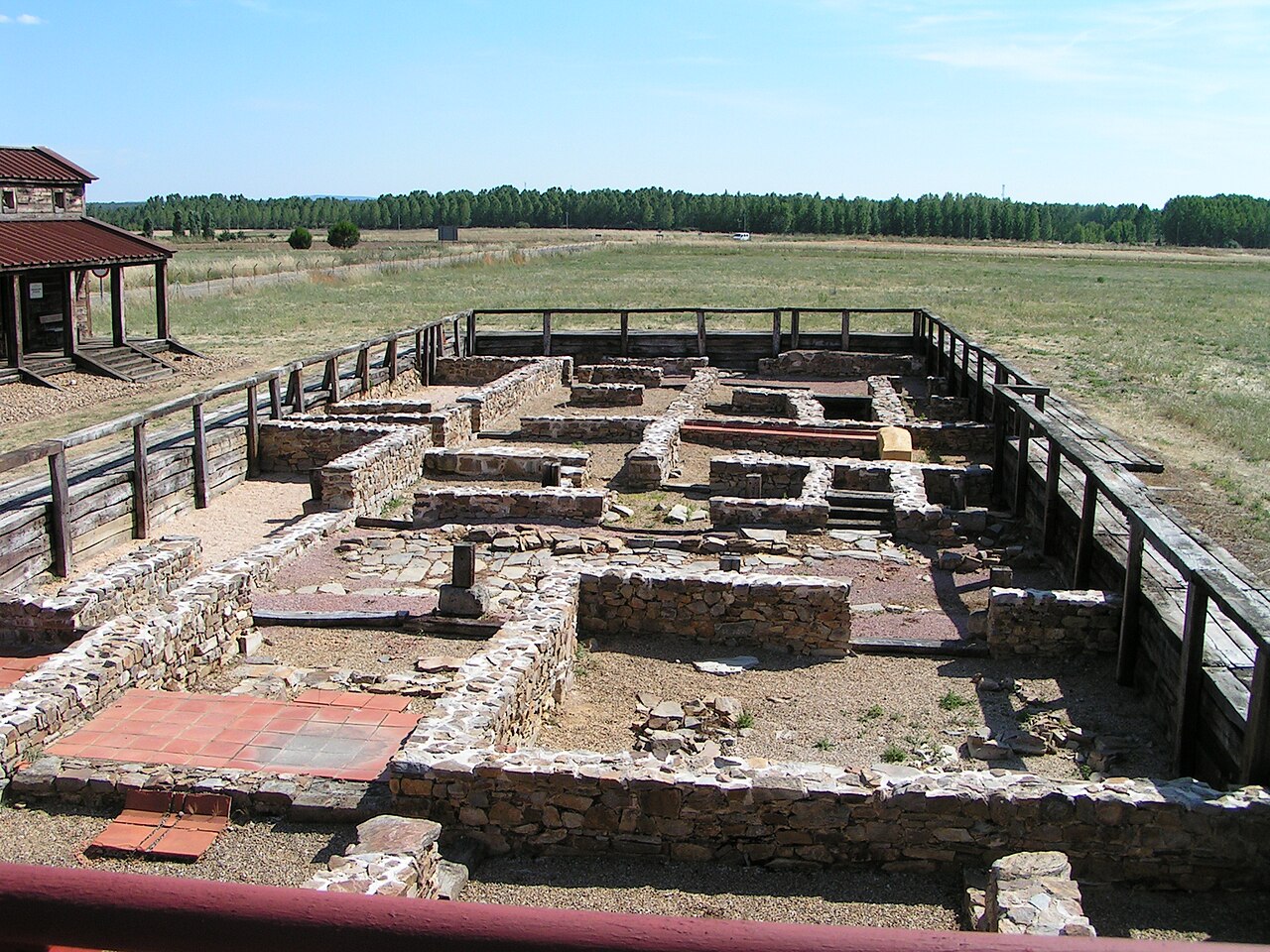
Photo by Majemico • CC BY-SA 3.0 es
Architectural remains and archaeological findings
Excavations at Petavonium have revealed substantial remains of key military and civic structures. Notable among these are the praetoria double gates, which served as the main entrance to the fortress, the principia or headquarters building, and the valetudinarium, the military hospital. These structures illustrate the typical layout and organization of Roman military installations adapted to local conditions.
Numerous artifacts have been recovered, including coins dating from the 1st to the 4th centuries AD, terra sigillata pottery, and weapons. Building materials such as bricks stamped with the motifs of the Ala II Flavia Hispanorum and the Legio VII Gemina have been found, indicating the collaboration and movement of troops between regions, including Africa and northern Portugal near Aquae Flaviae (modern Chaves).
Late antiquity and decline
During the later Roman Empire, possibly from the reign of Emperor Diocletian in the late 3rd century, the military presence at Petavonium was maintained by the Cohors II Flavia Pacatiana. This unit is documented as active at the site until at least the end of the 4th century, as recorded in the Notitia Dignitatum, a late Roman administrative document.
The civilian settlement is referenced in the Antonine Itinerary as a mansio, a way station on the Roman road linking Asturica Augusta (modern Astorga) with Bracara Augusta (modern Braga). This highlights Petavonium's role as a logistical and communication hub in Roman Hispania.
Inscriptions and architectural fragments from Petavonium have been reused in local houses and churches in nearby villages, demonstrating the site's lasting impact on the regional cultural landscape.
The city was ultimately abandoned in the 5th century AD, a consequence of the widespread barbarian invasions that marked the collapse of Roman authority in the Iberian Peninsula.
Archaeological significance and preservation
Today, Petavonium is classified as an archaeological ruin site. The remains provide valuable insights into Roman military architecture, urban planning, and the socio-economic dynamics of a legionary fortress transitioning into a thriving Roman city. The site's preservation of gates, headquarters, hospital buildings, and extensive artifact assemblages makes it a critical resource for understanding Roman military and civilian life in northwestern Spain.
Frequently asked questions (FAQ)
- What is the historical significance of Petavonium?
- Petavonium is an ancient Roman fortification that played a crucial role in the defense and administration of the region during the Roman Empire. Its ruins offer insight into the architectural styles and military strategies of the time, making it a valuable site for historians and archaeologists.
- When was Petavonium built?
- Petavonium was constructed in the 1st century AD, serving as a strategic military outpost. Over the centuries, it evolved, reflecting the changes in Roman architectural techniques and military needs.
- What are the opening hours for Petavonium?
- Petavonium is open to visitors from 9 AM to 6 PM daily, with extended hours during the summer months. It's recommended to check the official website for any seasonal changes or special events that may affect opening times.
- Can I access Petavonium with a wheelchair?
- Yes, Petavonium is equipped with accessible paths to ensure that all visitors can explore the site. However, some areas may have uneven terrain, so it's advisable to check in advance for the best routes.
- What is the best time to visit Petavonium?
- The best time to visit Petavonium is during the spring and fall months when the weather is mild and comfortable for exploring. Additionally, these seasons often feature fewer crowds, allowing for a more enjoyable experience.
- How much do tickets to Petavonium cost?
- Tickets to Petavonium are priced at €5 for adults, while children under 12 can enter for free. Discounts may be available for students and seniors, so be sure to inquire at the ticket office.
- Are there any nearby attractions to visit after Petavonium?
- Yes, visitors can explore other nearby historical sites such as the Roman Theatre of Mérida and the stunning Alcazaba of Badajoz. These attractions offer a deeper understanding of the region's rich history and cultural heritage.
Photo gallery

Information
Loading map...
Visitor reviews
No reviews yet. Been here? Write the first review and help other travelers!
Write the first reviewVisited this castle? Share your experience
Your review helps other travelers and adds first-hand knowledge to our encyclopedia.