
Pardubice Castle
Pardubice Castle stands as a remarkable example of a late medieval fortress transformed into a Renaissance palace, located in the historic town of Pardubice in the Czech Republic. Its origins trace back to the end of the 13th century, initially established as a water fortress by the noble Lords of Dubá and Pardubice. Over centuries, it evolved through significant architectural and functional transformations, reflecting the changing political, military, and cultural landscape of Central Europe.
Early history and medieval origins
The castle's foundation dates to the late 13th century, when it was constructed as a water fortress surrounded by moats, strategically positioned to control the surrounding region. The earliest documented owners include the Lords of Dubá and subsequently the Lords of Pardubice, with records from the early 14th century, notably under Puta of Frýdlant in 1318-1319. During the turbulent Hussite Wars in the early 15th century, the castle came under the control of Viktorin Boček of Kunštát and Poděbrady, an ally of the Hussite leader Jan Žižka, embedding the site in the religious and military conflicts of the period.
Renaissance transformation under the Pernštejn family
The most profound changes occurred after 1491 when Vilém II of Pernštejn, a prominent Moravian nobleman, acquired the castle and made it his main Bohemian residence. He initiated a comprehensive reconstruction that converted the medieval fortress into a four-winged late Gothic palace fortified to withstand artillery attacks. This included the construction of a broad water-filled moat and robust defensive walls.
Vilém II’s sons, Vojtěch I and Jan IV of Pernštejn, continued the castle’s enhancement in the early 16th century by adding Renaissance architectural elements. These included an additional floor, richly decorated interiors, and the introduction of Renaissance frescoes, coffered ceilings, and sgraffito facades that exemplify the fusion of Gothic and Renaissance styles.
Architectural features and artistic heritage
The castle’s central building is a late Gothic palace with four wings enclosing a closed courtyard. The courtyard is surrounded by service buildings and defensive works, including the distinctive triangular barbican called "Příhrádek". Originally accessed by a wooden bridge, this was replaced by a stone bridge after 1804.
The main gate features a sculpted stone portal carved between 1529 and 1538, installed in 1541, exemplifying Renaissance craftsmanship. The castle also boasts several halls adorned with some of the oldest Renaissance frescoes in the Czech Republic. The Mázhaus hall contains early Renaissance murals depicting "Law and Grace," influenced by the German Renaissance painter Lucas Cranach the Elder. The Vojtěch Hall holds the earliest known Renaissance wall painting in the country, illustrating the biblical story of "Samson and Delilah" from 1532, alongside heraldic decorations and a late Gothic bay window crafted by royal stonemason Hans Spiess.
The Column Hall features a late Gothic coffered ceiling with early Renaissance plant motifs, dating from 1520 to 1530. A similar coffered ceiling exists on the third floor of the eastern wing. The chapel of the Three Kings, built in the early 16th century, includes a vaulted ceiling supported by a central pillar and a lord’s tribune, combining religious function with noble status.
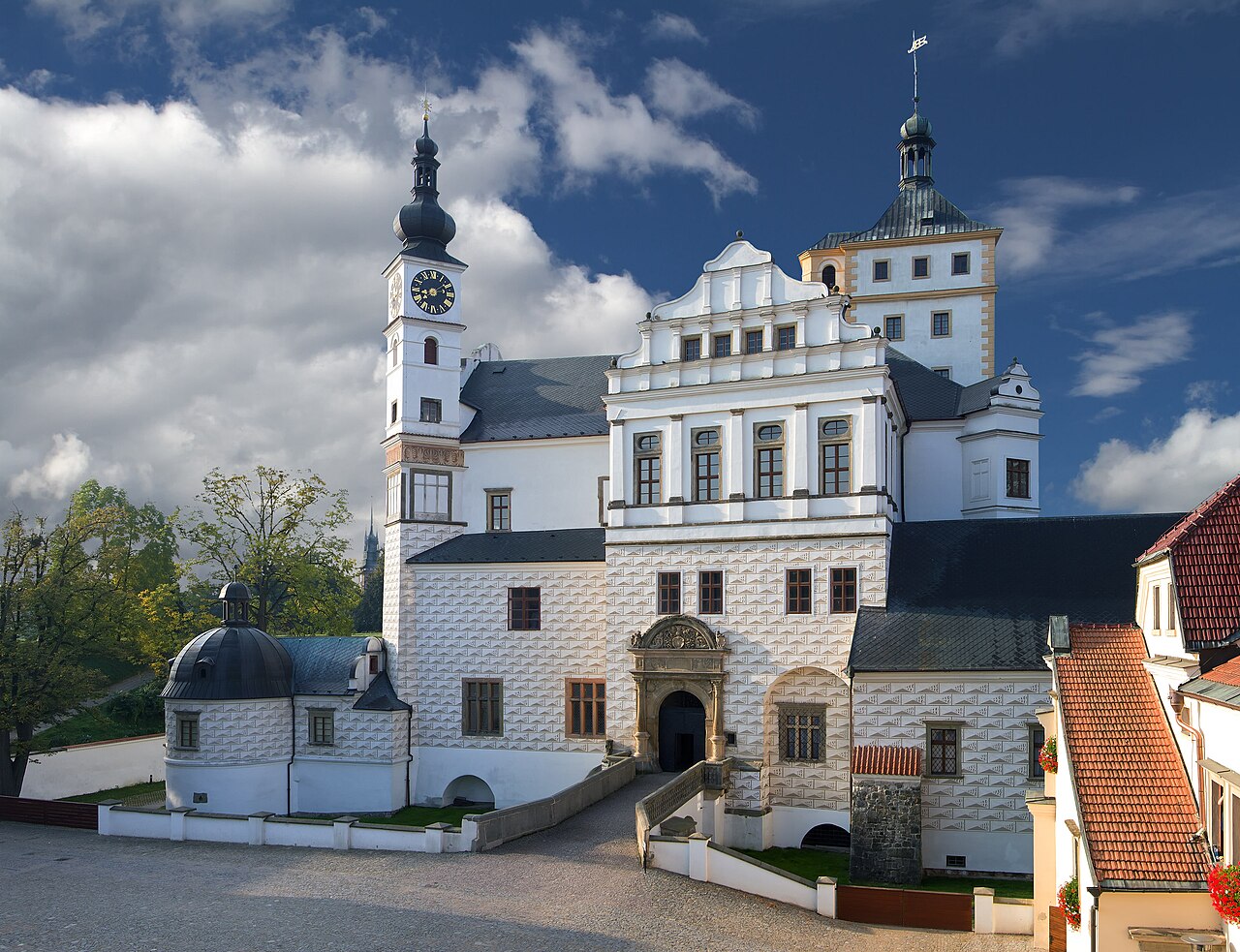
Photo by Karel Sakař • CC BY-SA 3.0
Fortifications and military architecture
The castle’s fortifications evolved significantly over time. Initially, four rounded corner turrets were constructed after the Hussite Wars, with two still partially preserved. In the early 16th century, these were replaced by imposing earthen ramparts featuring angular bastions designed to resist artillery fire, an advanced military innovation of the period.
The ramparts reached heights equal to the castle’s second floor and were protected by outer walls with narrow gun slits for defensive weapons. The surrounding moat was maintained by a sophisticated water supply system connected to the city, ensuring a continuous barrier against attackers.
Additional defensive structures include a polygonal barbican with a square tower guarding the second gate, showcasing late Gothic artillery defense techniques. Remnants of a 14th-century donjon with thick opuka stone walls were uncovered in 2020 beneath the central courtyard, highlighting the castle’s deep medieval roots.
Post-medieval history and modern use
After the Pernštejn family sold the castle to Archduke Maximilian in 1560, it became royal property and served as an administrative center. Between 1574 and 1579, court architect Ulrico Aostalli de Sala led Renaissance renovations, adding sgraffito facades, a risalit entrance, a grand staircase, and a large hall on the northern wing’s third floor.
In the 17th century, the castle’s military role declined, and it was repurposed for industrial activities, including a brewery and factories for paper, tanning, and leather production. Baroque modifications by František Maxmilián Kaňka between 1723 and 1726 altered interiors but preserved the core structure.
The castle lost its defensive function by 1836, with some bastions converted into gardens and vineyards. Ownership passed to private hands in the late 19th century before the Pardubice Museum Society acquired it in 1920, initiating restoration efforts. Nationalization in 1953 led to periods of neglect, but restoration resumed in the 1990s, culminating in the castle’s reopening in 1997.
Since 2001, the castle has been owned by the Pardubice Region and houses the Museum of East Bohemia, the Gallery of East Bohemia, and the regional office of the National Heritage Institute. It was declared a national cultural monument in 2010, recognizing its exceptional historical and architectural value. The chapel of the Three Kings was reopened in 2013, restoring a significant religious and cultural feature.
Archaeological significance and preservation
Archaeological research has revealed important structural layers beneath the castle, including original cellar spaces and foundational elements predating the Renaissance remodeling. The preservation of early Renaissance frescoes, coffered ceilings, and sgraffito facades makes Pardubice Castle a unique repository of Central European Renaissance art and architecture.
The castle’s fortifications, including surviving bastions and the moat, represent a rare example of transitional military architecture adapting to the advent of artillery. The presence of a two-story civil defense shelter built in 1953 within the ramparts adds a layer of 20th-century historical significance.
Today, the castle’s combination of Gothic and Renaissance architectural elements, fortified structures, and richly decorated interiors offer visitors a comprehensive insight into the evolution of Central European noble residences from the medieval period through the Renaissance and beyond.
Frequently asked questions (FAQ)
- What is the history of Pardubice Castle?
- Pardubice Castle, originally built in the 13th century, has undergone numerous renovations and expansions throughout its history. It served as a royal residence and a fortress, reflecting various architectural styles from Gothic to Renaissance. Today, it stands as a significant cultural and historical landmark in the Czech Republic.
- When is the best time to visit Pardubice Castle?
- The best time to visit Pardubice Castle is during the spring and early autumn months when the weather is mild, and the surrounding gardens are in full bloom. Additionally, many cultural events and guided tours take place during these seasons, enhancing the visitor experience. Summer months can also be enjoyable, but they tend to be busier with tourists.
- Can I take guided tours of Pardubice Castle?
- Yes, guided tours are available at Pardubice Castle, providing visitors with in-depth insights into its history and architecture. These tours are offered in multiple languages and typically last about an hour. It's advisable to check the castle's official website for tour schedules and availability before your visit.
- Is Pardubice Castle accessible for visitors with disabilities?
- Pardubice Castle is committed to accessibility, with measures in place to assist visitors with disabilities. Ramps and elevators are provided to ensure access to various areas of the castle. However, some historical sections may have limited access due to their original architecture.
- What are the opening hours for Pardubice Castle?
- Pardubice Castle is generally open to visitors from Tuesday to Sunday, with specific hours that may vary throughout the year. During peak tourist season, the castle often extends its hours to accommodate more visitors. It's best to check the official website for the latest information on opening hours and any holiday closures.
- What are the ticket prices for visiting Pardubice Castle?
- Ticket prices for Pardubice Castle vary depending on the type of tour and age of the visitor, with discounts available for students and seniors. A standard adult ticket typically costs around 100 CZK. Family tickets and group rates may also be offered, making it an affordable option for families and larger parties.
- Are there any nearby attractions to visit after Pardubice Castle?
- Yes, after exploring Pardubice Castle, visitors can enjoy nearby attractions such as the Pardubice Renaissance Town Hall and the Green Gate. The region is also known for its beautiful parks and the historic city center, making it a great destination for a full day of sightseeing. Many local cafes and restaurants are available for a refreshing break as well.
Photo gallery

Information
Website
Visit websiteSources & official resources
Verify the information above using these authoritative references.
Loading map...
Visitor reviews
No reviews yet. Been here? Write the first review and help other travelers!
Write the first reviewVisited this castle? Share your experience
Your review helps other travelers and adds first-hand knowledge to our encyclopedia.