Palace of Andrei Bogolyubsky
The Palace of Andrei Bogolyubsky stands as a remarkable monument of 12th-century Rus' architecture, located in the settlement of Bogolyubovo near the city of Vladimir in modern-day Russia. Constructed between 1158 and 1165, this palace was the white-stone residence of Prince Andrei Yuryevich, also known as Andrei Bogolyubsky, a pivotal figure in the history of medieval East Slavic civilization, specifically the Kievan Rus'. The palace complex not only served as a princely residence but also symbolized the political and spiritual aspirations of its era, reflecting the fusion of secular power and religious devotion.
Historical context and significance
Andrei Bogolyubsky was a prominent ruler who played a crucial role in the consolidation of power in northeastern Rus'. His decision to establish a residence at Bogolyubovo marked a shift from the traditional centers of power such as Kiev and Vladimir. The palace's construction coincided with a period of cultural flourishing and architectural innovation in Rus', characterized by the extensive use of white limestone, a material that became synonymous with princely prestige and durability.
The settlement of Bogolyubovo itself grew around the palace, eventually lending its name to the prince, underscoring the close connection between the ruler and his estate. The palace was the site of significant historical events, including the assassination of Andrei Bogolyubsky in 1174, an event that took place within or near the palace complex, specifically near the staircase tower, which chronicles identify as the probable location of his murder orchestrated by boyars, the high-ranking nobility.
Despite its initial prominence, the palace suffered considerable damage during the Mongol-Tatar invasion in the 13th century, a catastrophic event that reshaped the political landscape of Rus'. Over subsequent centuries, the palace's function shifted as it came under monastic possession, which influenced its maintenance and architectural evolution. By the late 18th century, many of the original defensive structures, including walls, gates, and towers, were dismantled, reflecting changing military needs and architectural tastes.
Architectural features and layout
The Palace of Andrei Bogolyubsky was conceived as a white-stone complex, centered around a two-story palace and accompanied by ecclesiastical buildings, all enclosed within a rectangular wall constructed from well-dressed white limestone blocks. These walls were filled with rubble and bound by mortar, lacking corner watchtowers, which suggests their primarily ornamental rather than defensive purpose.
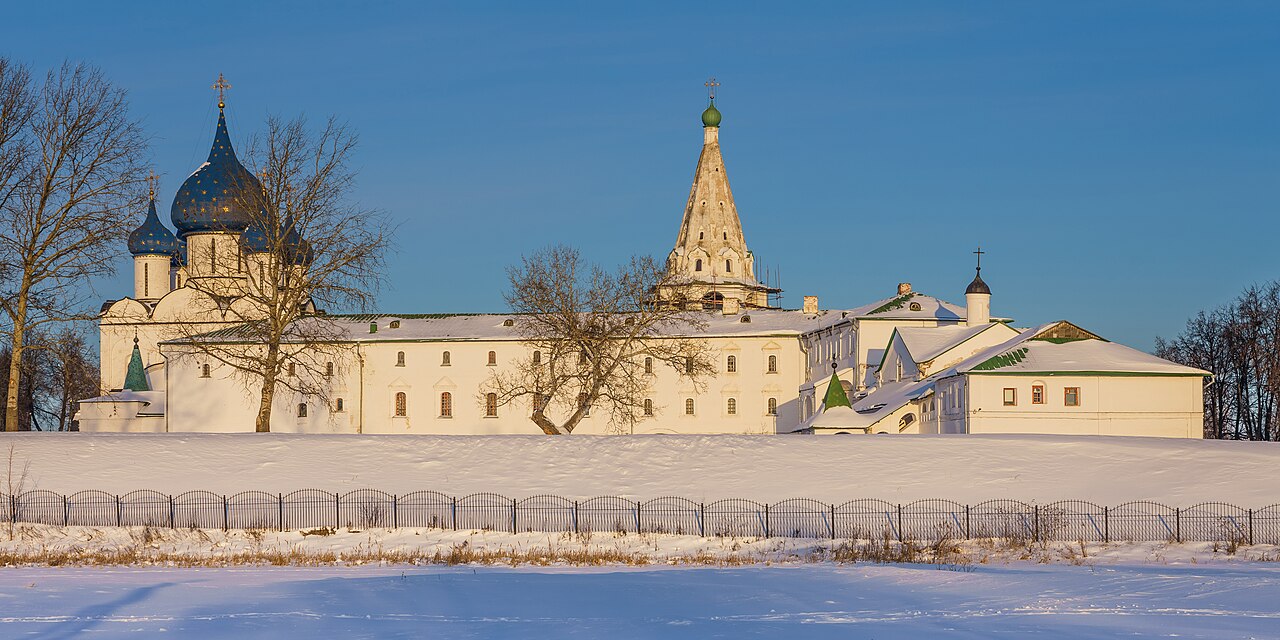
A defining architectural element is the staircase tower, which forms part of an arched passage on the second floor. This passage connected the palace residence to the choir area of the adjacent Church of the Nativity of the Theotokos. The tower remains partially intact, with its lower sections preserved and topped by a later 18th-century pyramidal bell tower. This feature exemplifies the architectural integration of secular and religious spaces within the complex.
The Church of the Nativity was originally a richly decorated, smaller four-pillared structure inspired by the grander six-pillared Assumption Cathedral in Vladimir. In front of the church was a stone-paved square featuring a canopy known as a kivory. Although the original church collapsed in 1722, foundational elements and fragments of the lower façade survive beneath the mid-18th-century reconstruction, which incorporated a bell tower that altered the original cubic shape and roofline.
Archaeological excavations have revealed the palace's foundations, providing insight into its original scale and spatial organization. The estate also included the Leontievsky Church, contributing to the sacred atmosphere that surrounded the princely residence. Together, these structures illustrate a sophisticated architectural ensemble blending princely authority with ecclesiastical grandeur.
Religious and cultural landscape
Close to the palace, the Church of the Intercession on the Nerl River, constructed around 1166, stands approximately one kilometer away. This church served as a prominent landmark visible to travelers approaching the palace by river, symbolizing the spiritual dimension of the princely domain. The proximity of these religious monuments underscores the intertwined nature of political power and Orthodox Christianity in medieval Rus'.
The palace and its associated churches are now part of the UNESCO World Heritage site known as the White Monuments of Vladimir and Suzdal. This designation recognizes their outstanding cultural and historical significance as rare surviving examples of pre-Mongol Rus' architecture.
Archaeological rediscovery and preservation
The palace complex was rediscovered archaeologically in 1954 by historian Nikolai Voronin, who identified key structural elements that had been obscured over centuries. The site now lies within the grounds of the Bogolyubovo Monastery, which developed nearby and continues the religious tradition of the location. Adjacent to the palace ruins stands the monastery's five-domed blue church, reflecting the ongoing spiritual importance of the site.
Today, the remains of the palace and its churches offer a tangible connection to the 12th-century Rus', illustrating the blend of princely grandeur and religious devotion that defined Andrei Bogolyubsky's residence. The preservation of the staircase tower, the arched passage, and the foundational ruins provide valuable insights into the architectural and cultural history of medieval Russia.
Legacy and influence
The Palace of Andrei Bogolyubsky remains a unique example of secular architecture from the pre-Mongol period, distinguished by its white-stone construction and integration with religious structures. It reflects the political ambitions and cultural identity of a formative era in Russian history. The palace's story, marked by dramatic events and architectural innovation, continues to captivate historians, architects, and visitors alike.
Its inclusion in the White Monuments of Vladimir and Suzdal highlights its enduring significance as part of Russia's cultural heritage. The site exemplifies the artistic and spiritual achievements of medieval Rus', serving as a testament to the legacy of Andrei Bogolyubsky and the historical narrative of the region.
Frequently asked questions (FAQ)
- How do I visit the Palace of Andrei Bogolyubsky?
- The Palace of Andrei Bogolyubsky is located in Bogolyubovo, Vladimir Oblast, Russia. Visitors can reach the site by car or public transport from Vladimir city. The palace ruins are accessible year-round, but it is advisable to check local conditions and opening hours of nearby Bogolyubovo Monastery for guided tours.
- What is the historical significance of the Palace of Andrei Bogolyubsky?
- The palace was the residence of Prince Andrei Bogolyubsky, a key figure in 12th-century Rus'. It symbolizes the political and religious power of the era and is part of the UNESCO-listed White Monuments of Vladimir and Suzdal.
- What architectural features remain at the palace?
- Visitors can see the partially preserved staircase tower with an 18th-century bell tower addition, the arched passage linking the palace to the Church of the Nativity of the Theotokos, and foundational ruins revealing the original layout.
- Is the palace accessible for visitors with mobility issues?
- The site consists mainly of ruins and uneven terrain, which may pose challenges for visitors with mobility impairments. Assistance and planning are recommended to ensure a comfortable visit.
- When is the best time to visit the Palace of Andrei Bogolyubsky?
- The best time to visit is during late spring to early autumn when the weather is mild and the surrounding landscape is at its most picturesque, enhancing the experience of exploring the historic ruins.
Information
Sources & official resources
Verify the information above using these authoritative references.
Loading map...
Visitor reviews
No reviews yet. Been here? Write the first review and help other travelers!
Write the first reviewVisited this castle? Share your experience
Your review helps other travelers and adds first-hand knowledge to our encyclopedia.