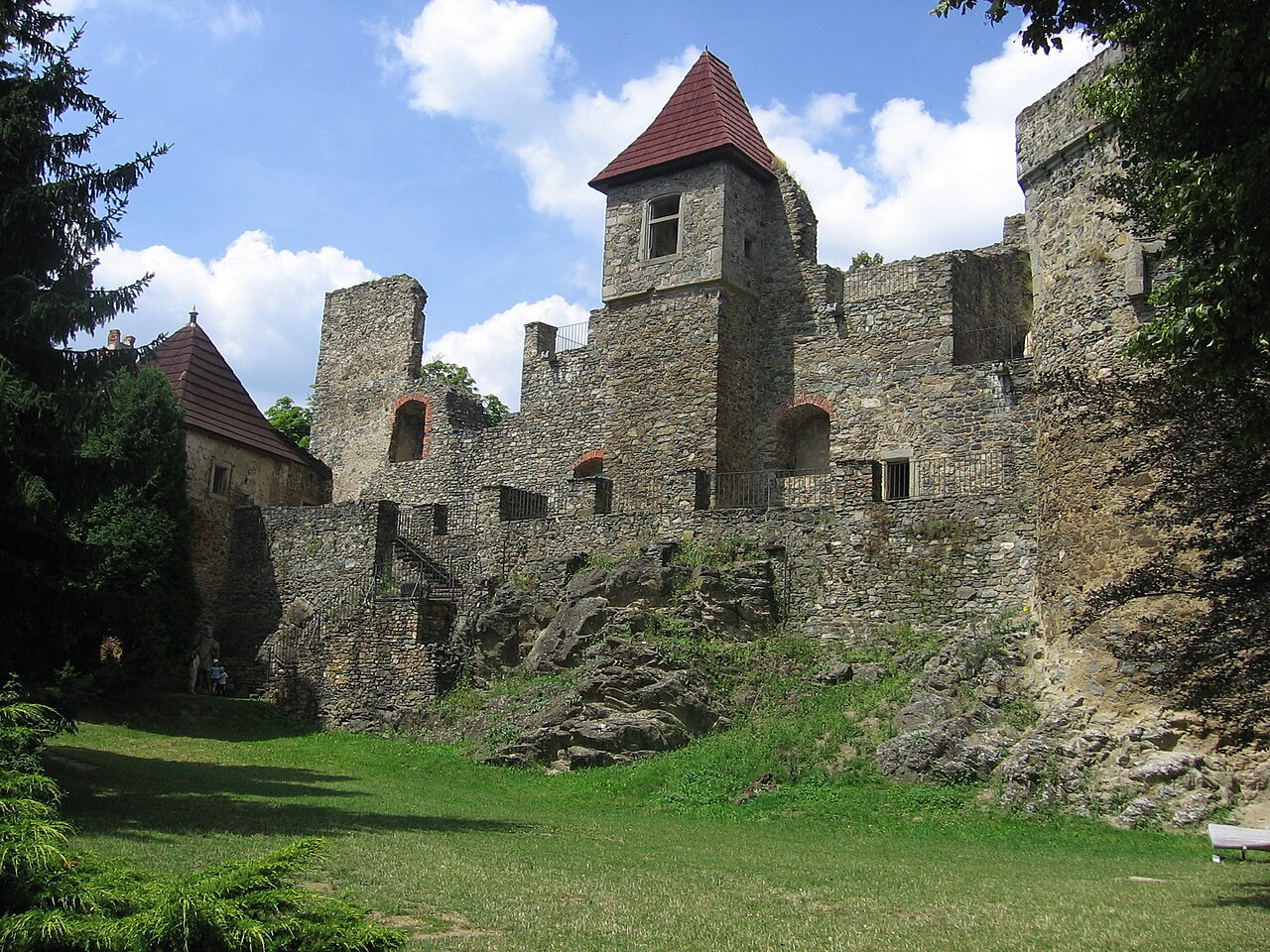
Pajrek Castle
Pajrek Castle, also known historically as Burg Bayereck, stands as a significant medieval hill castle ruin located above the town of Nýrsko in the western Bohemian Forest of Czechia. Perched at approximately 505 meters above sea level on a rocky ridge, this fortress was originally constructed in the early 14th century to serve as a strategic border defense. Though now largely in ruins, the castle's imposing remains, especially its massive donjon tower, testify to its former military importance and architectural ambition during the Late Medieval period.
Historical significance and ownership
The castle was built by the noble Janovice family, who controlled the fortress for nearly two centuries. The earliest documented mention of Pajrek dates back to 1360, referencing a noble named Něpr of Pajrek, confirming the castle's status as a recognized stronghold within the region. Throughout the 15th century, Pajrek Castle was deeply involved in the tumultuous political and religious conflicts of the era, notably the Hussite Wars. The castle's lord, Jan of Janovice, exhibited pragmatic allegiances, shifting support between the Hussite reformers and Catholic forces, reflecting the complex dynamics of Bohemian nobility during this period.
In 1472, the castle endured a decisive assault by Bavarian troops, who captured and set it ablaze, marking a significant military defeat that led to its abandonment. The fortress was partially rebuilt in the early 16th century, around 1504, under the ownership of Jindřich Kostomlatský of Vřesovice. Kostomlatský used Pajrek as a base for raids in the surrounding region, a practice that ultimately led to his capture and execution in Prague. Following his demise, the castle's ownership became contested among noble families, including the Kostomlatský and Vidhostic lineages. By the mid-16th century, Pajrek Castle was completely abandoned and fell into ruin.
After abandonment, the castle's stones were frequently repurposed for local construction. It was not until 1964 that Pajrek Castle was officially protected as a cultural monument, preserving its ruins as a testament to the region's medieval heritage.
Architectural features and layout
The donjon tower
The core of Pajrek Castle was its massive donjon, a prismatic tower that served both defensive and residential functions. This tower measured approximately 16 meters on each side, making it one of the largest medieval towers of its kind in the Czech lands. The walls at the base were exceptionally thick, up to 2.4 meters, tapering towards the upper floors to reduce weight. Today, the tower's remains reach up to the fourth floor on the northern and western sides, with traces of the original plaster still visible. The southern wall, weakened by window openings, has suffered more extensive damage.
The tower's entrance was originally positioned on the western wall's second floor, a defensive design to limit ground-level access and enhance security. This doorway was partially sealed with brickwork in the late 19th century. The heavy wooden door was secured by a locking mechanism involving a massive beam sliding into a carved wooden slot measuring 25 by 25 centimeters. Internally, the tower housed multiple floors supported by large wooden beams approximately 35 by 35 centimeters in cross-section and 12 meters in length. These beams rested on stone offsets embedded in the masonry walls and were supported by central wooden posts, confirming at least three stories within the tower, possibly more.
Courtyard and defensive structures
Surrounding the donjon was a roughly square courtyard enclosed by robust stone curtain walls. At the northeastern corner stood a smaller tower, which was likely connected to the main donjon by a drawbridge, facilitating controlled access between the two structures. The castle's natural defenses were enhanced by steep slopes to the north and south, supplemented by rock-cut ditches. The southern approach featured additional moats and walls protecting the original entrance, likely constructed or reinforced in the late 15th century following the Bavarian attack.
Today, visitors can observe the substantial remains of the main tower alongside fragments of the smaller tower and enclosing walls. The castle's defensive design thoughtfully integrates the natural terrain, demonstrating medieval military architectural principles. No decorative elements or inscriptions have survived, underscoring the fortress's primarily utilitarian purpose.
Strategic location and landscape
Pajrek Castle's position on the northern slopes of Hraničář mountain at an elevation between 617 and 620 meters provided commanding views over the surrounding landscape and the borderlands. Its location within the Bohemian Forest region was strategically chosen to monitor and control important routes and to serve as a frontier defense against incursions from neighboring territories. The castle's elevated placement and integration with rugged terrain maximized its defensive capabilities, making it a formidable obstacle for any attacking force.
Preservation and cultural importance
Although Pajrek Castle has been in ruins since the mid-16th century, its remains have been preserved as an important cultural monument since 1964. The site offers valuable insights into Late Medieval military architecture and the lifestyle of border nobility in the Bohemian Forest. Archaeological studies have helped document the castle's structure and history, contributing to the understanding of regional defensive networks. Today, the ruins attract visitors interested in medieval history, architecture, and the natural beauty of the surrounding forested landscape.
Efforts to maintain and protect the site ensure that Pajrek Castle remains a tangible link to the past, highlighting the complex historical narratives of border defense, noble power struggles, and architectural innovation during the 14th to 16th centuries.
Frequently asked questions (FAQ)
- When was Pajrek Castle built and by whom?
- Pajrek Castle was constructed in the early 14th century by the noble Janovice family, who owned it for nearly two centuries.
- What architectural features characterize Pajrek Castle?
- The castle is noted for its massive prismatic donjon tower with thick walls, a square courtyard with curtain walls, and a smaller tower connected by a drawbridge.
- Why was Pajrek Castle abandoned?
- The castle was abandoned after being captured and burned by Bavarian troops in 1472, followed by partial restoration and final desertion by the mid-16th century.
- Can visitors access the ruins of Pajrek Castle today?
- Yes, the ruins are preserved as a cultural monument and can be visited, offering insights into medieval fortification and history.
- What role did Pajrek Castle play during the Hussite Wars?
- During the Hussite Wars, the castle's lord Jan of Janovice shifted allegiances between Hussite and Catholic forces, reflecting the era's complex political landscape.
Information
Website
Visit websiteSources & official resources
Verify the information above using these authoritative references.
Loading map...
Visitor reviews
No reviews yet. Been here? Write the first review and help other travelers!
Write the first reviewVisited this castle? Share your experience
Your review helps other travelers and adds first-hand knowledge to our encyclopedia.