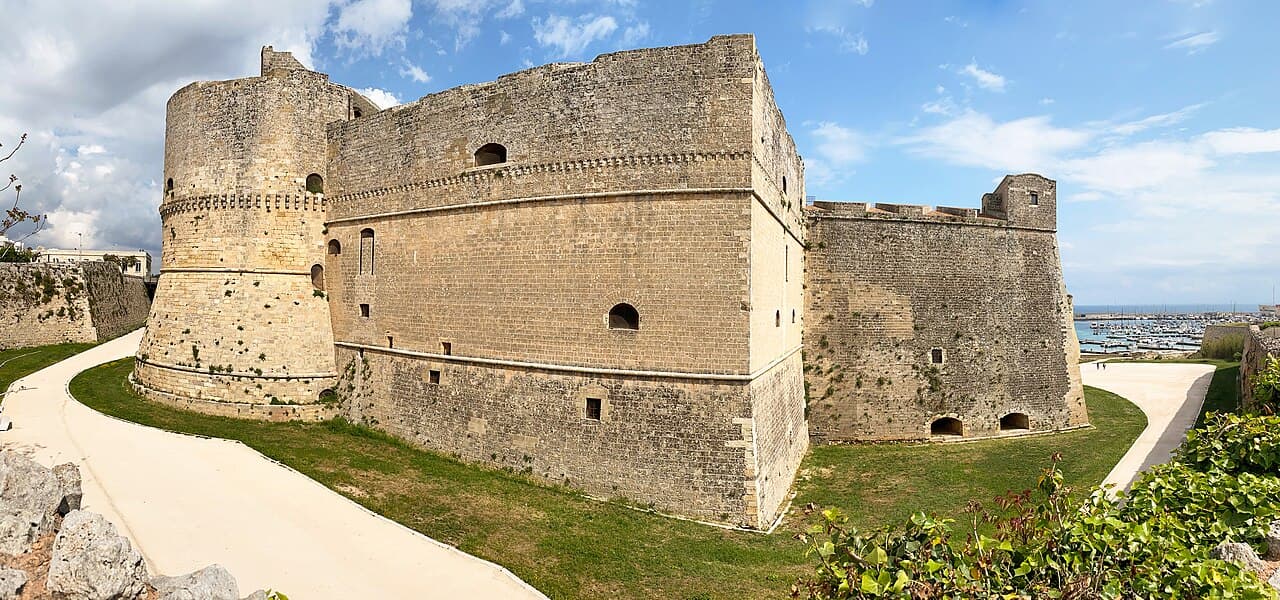
Otranto Castle
Otranto Castle, also known as the Aragonese Castle, stands as a monumental testament to the rich military history and architectural evolution of southern Italy. Located in the coastal city of Otranto in the Puglia region, this fortress has guarded the strategic gateway between Italy and the eastern Mediterranean for centuries. Its imposing walls, bastions, and towers reflect the successive layers of fortification built from the High medieval period through the Renaissance and into the early modern era.
Originally constructed on the site of earlier fortifications damaged during the siege of 1067, the castle was first significantly rebuilt under the orders of Roberto il Guiscardo, a Norman ruler who reinforced the defenses to protect against further incursions. The most notable early medieval reconstruction occurred in 1228 under Emperor Frederick II of Swabia, who introduced a quadrangular plan with cylindrical towers at the corners, traces of which remain visible in the northeast bastion and curtain walls. This early layout exemplifies the military architectural trends of the High medieval period.
Historical evolution and strategic importance
Throughout its history, Otranto Castle has played a pivotal role in the defense of the southern Italian coast. Its location made it a crucial point of control over maritime routes and a bulwark against invasions from the east. The castle's significance was dramatically underscored during the Ottoman siege of 1480, when the city fell to Turkish forces. Following the reconquest, Alfonso of Aragon, Duke of Calabria, undertook extensive rebuilding to strengthen the fortress against artillery and new siege technologies.
By the end of the 15th century, the castle passed under Venetian influence, which led to further enhancements adapting the fortress to the evolving demands of warfare. The most transformative phase occurred in the 16th century under the guidance of Francesco di Giorgio Martini, a renowned military architect. Martini reconfigured the defenses, giving the castle its characteristic pentagonal plan surrounded by a wide moat and punctuated by four towers: three circular and one lance-shaped bastion facing the sea.
The Spanish viceroy Don Pedro de Toledo further expanded the fortress in 1578 by adding two polygonal bastions on the seaward side, incorporating the earlier Aragonese bastion into a more complex defensive system. These additions marked the castle as a masterpiece of Renaissance military architecture, blending functional artillery defenses with imposing stonework.
Architectural features and layout
Fortification plan and towers
The castle’s pentagonal layout is a distinctive feature that reflects the transition from medieval fortresses to early modern bastioned fortifications designed to withstand cannon fire. The surrounding moat, once filled with water, provided an additional layer of defense, with entry granted via a stone-arched bridge that replaced the original drawbridge.
The four towers include three circular "rondelle" constructed from local carparo stone, known for its durability and characteristic warm color. These towers were equipped with artillery positions, featuring hemispherical domes and cannon embrasures. The fourth tower, the lance-shaped bastion, projects toward the harbor, guarding the most vulnerable approach to the city.
Interior spaces and defensive innovations
Inside the fortress, two floors surround a central courtyard. Although much of the interior was remodeled in the 20th century, significant architectural elements remain, including vaults with barrel and star patterns. Notably, two unusual rooms lie outside the main quadrangle: the Triangular Hall (Sala Triangolare), built in the mid-16th century using innovative defensive techniques, and a rectangular chamber with a vaulted ceiling formed by intersecting pavilion-shaped ribs of carparo stone.
The underground network beneath the castle is remarkably well-preserved, consisting of tunnels, galleries, and small chambers dating to the late 15th century. These subterranean spaces provide valuable insights into the castle’s phased construction and defensive planning during the transition from medieval to Renaissance military architecture.
Decorative elements and heraldry
The castle’s exterior and interior spaces display heraldic shields representing the successive rulers and noble families associated with the fortress. The coat of arms of Emperor Charles V adorns the main entrance portal, while the emblems of the Mendoza family and Pedro de Toledo are displayed on the bastion. These symbols underscore the castle’s historical significance and the layers of political authority that shaped its development.
Later history and cultural legacy
By the 19th century, the military importance of Otranto Castle had diminished. The moat was filled in and the surrounding area paved to create a public square, while interior spaces were adapted for municipal offices. The buried moat was rediscovered and restored in 1958, highlighting ongoing interest in preserving the fortress’s heritage.
Beyond its military and administrative roles, the castle has left a profound cultural legacy. It inspired Horace Walpole’s 1764 novel The Castle of Otranto, widely regarded as the first Gothic novel, which helped establish the Gothic literary genre. The castle also influenced Voltaire’s 1769 opera buffa Le Baron d’Otrante, demonstrating its impact on European cultural history.
Today, the castle serves as a vibrant cultural center, hosting international exhibitions and events that celebrate its rich history. Visitors can explore its imposing walls, bastions, and towers, appreciating the architectural ingenuity and historical layers that make Otranto Castle a unique monument of Mediterranean military heritage.
Visitor experience and notable features
Visitors to Otranto Castle can walk along the battlements and terraces, gaining panoramic views of the Adriatic Sea and the historic city. The castle’s thick walls, cannon embrasures, and vaulted chambers provide a tangible connection to its martial past. The small chapel near the entrance contains remnants of frescoes and stone cornices carved from Lecce stone, including a tomb epitaph commemorating Donna Teresa De Azevedo, reflecting the personal histories intertwined with the fortress.
The castle’s acoustic properties within the circular towers offer a unique sensory experience, where voices and sounds are amplified by the domed stone ceilings. This intriguing feature adds to the castle’s allure and demonstrates the thoughtful design of its defensive architecture.
Frequently asked questions (FAQ)
- How do I get to Otranto Castle?
- Otranto Castle is easily accessible by car or public transportation. If you're coming from major cities like Lecce, you can take a train or bus to Otranto, and the castle is within walking distance from the town center.
- What is the historical significance of Otranto Castle?
- Otranto Castle, originally built in the 15th century, played a crucial role in defending the region against invasions. It is also known for its fascinating history, including its connection to the Battle of Otranto in 1480, where many locals were martyred.
- When was Otranto Castle built?
- Construction of Otranto Castle began in 1485, under the rule of the Aragonese. The castle was completed in the early 16th century and has since undergone various renovations, preserving its historical architecture.
- Can I enter Otranto Castle?
- Yes, visitors can enter Otranto Castle and explore its impressive architecture and panoramic views of the surrounding area. There are guided tours available that provide in-depth information about the castle's history and significance.
- Why is Otranto Castle a popular tourist attraction?
- Otranto Castle is popular due to its rich history, stunning coastal views, and well-preserved structure. The castle also offers visitors a glimpse into the past, making it a favorite for history enthusiasts and tourists alike.
- Is it possible to visit Otranto Castle year-round?
- Yes, Otranto Castle is open to visitors throughout the year, although hours may vary by season. It's advisable to check the official website for the most current opening times before planning your visit.
- What are the ticket prices for Otranto Castle?
- Ticket prices for Otranto Castle are generally affordable, with discounts available for children, seniors, and groups. It's best to check the official website for the latest pricing information and any special promotions.
- When is the best time to visit Otranto Castle?
- The best time to visit Otranto Castle is during the spring and early fall when the weather is pleasant and crowds are smaller. Summer can be quite hot and busy, making it a less ideal time for a visit.
- Are there any nearby attractions to Otranto Castle?
- Yes, there are several nearby attractions, including the beautiful beaches of Otranto, the Cathedral of Santa Maria Assunta, and the picturesque old town. These sites complement your visit to the castle and provide a full experience of the region's history and culture.
Photo gallery

Information
Website
Visit websiteSources & official resources
Verify the information above using these authoritative references.
Loading map...
Visitor reviews
No reviews yet. Been here? Write the first review and help other travelers!
Write the first reviewVisited this castle? Share your experience
Your review helps other travelers and adds first-hand knowledge to our encyclopedia.



