Opole
Opole castle, located in the city of Opole in the Opolskie region of Poland, stands as a significant monument of medieval Polish history and architecture. Its most recognizable feature, the Piast tower, has become a symbol of the city and the annual Polish Song Festival held there. This tower is the only surviving part of the original castle complex, which dates back to the 13th century and is among the oldest defensive structures in Poland.
The castle's origins trace back to a strategic site on Ostrówek, a promontory on the Pasieka island in the Oder River, which was inhabited by the Opolan tribe since the 8th century. In the 10th century, a wooden and earth fortification was established here, serving as a defensive stronghold. After the formal establishment of the city on the right bank of the Oder, the island became the property of the Opole dukes.
Medieval foundation and early construction
The construction of the stone castle began in 1218 under the direction of Prince Kazimierz I, son of Mieszko Plątonogi, following his return from a crusade. Due to the high costs, half of the funding was provided by Palatine Klemens Gryfita of Ruszcza, who received the villages of Niemodlin and Czeladź in exchange. The initial castle likely consisted of a standalone quadrangular building, possibly serving as a keep (donjon), surrounded by defensive walls partially built of brick. A quadrangular tower stood to the north, and the irregularly shaped defensive walls followed the outline of the earlier fortifications. The main gate was located on the eastern wall.
Successors of Kazimierz I, including his son Władysław I and grandson Bolesław I, continued the expansion. Between 1283 and 1289, a new building known as the "new castle" was constructed along the southern wall. This structure featured three rooms on the ground floor, including an alcove and a prince's chamber, with three chambers and a hall on the upper floor. The courtyard also contained economic buildings, a two-story kitchen, a bakery, and a well. In 1307, a chapel dedicated to St. John the Evangelist, the apostles Peter and Paul, and Mary Magdalene was established on the first floor.
Fourteenth-century expansions and fortifications
During the first half of the 14th century, under Bolesław II, the castle underwent significant enhancements. A gatehouse was built to house the chancellery and the burgrave's residence. Adjacent to it, stables capable of accommodating 80 horses were constructed. A cylindrical brick tower was erected near the gate on a stone foundation six meters deep. This tower, reaching 35 meters in height with walls over three meters thick at the base, had its entrance several meters above ground level. The lower floor served as a dungeon, with rooms and guard posts above. While traditionally dated to around 1300, recent archaeological research suggests the tower was built in the mid-14th century, likely during Bolesław II's reign.
Additional buildings were constructed along the perimeter walls, including the "widow's court" opposite the gate, which was destroyed by fire in 1514. The castle was not only a princely residence but also a formidable defensive fortress, evidenced by its successful defense against the 1395 siege by Polish King Władysław Jagiełło's forces during conflict with Władysław Opolczyk. Further attacks, including a 1474 siege involving artillery and assaults by Hussites who captured the city but not the castle, underscored its military resilience.
Transition and decline in the early modern period
The death of the last Piast duke, Jan II the Good, in 1532 marked a turning point. The Duchy of Opole-Racibórz passed to George of Hohenzollern, a vassal of the Czech king. The castle's movable assets were sent to Vienna and appropriated by Ferdinand I of Habsburg. Treated as collateral by the Habsburgs, the castle gradually fell into neglect. In 1552, the duchy was pledged to Isabella of Hungary, who initiated repairs and refurnishing to make the castle habitable again. Renovations included raising and rebuilding the southern and western wings. In 1564, ground subsidence caused cracks in the walls, which were stabilized with 22 iron clamps.
By the late 16th century, the castle was modernized with four semicircular bastions reflecting contemporary fortification trends. Inventories from this period mention three main buildings: the high house, the burgrave's house, and the main building. However, a devastating fire on August 28, 1615, destroyed much of the castle and the city, sparing only the mill, powder magazine, and the estate on Pasieka island.
Sieges, wars, and further deterioration
During the Thirty Years' War, the castle was occupied by Protestant forces who used its restored fortifications to repel attacks by imperial troops under General Goetz in 1633-34. Despite withstanding sieges, the castle sustained significant damage. In 1645, Emperor Ferdinand III pledged the duchy to Polish King Władysław IV Vasa, who did not invest in its upkeep. The castle's condition worsened, and during the Swedish invasion known as the "Deluge," King Jan Kazimierz chose to stay elsewhere due to the castle's poor state.
Modern transformations and preservation
In the early 18th century, the ruined western wing was demolished and replaced by a free-standing castle chapel. Fires in 1737 and 1739 caused further destruction. By 1764, the Prussian authorities adapted one building for court use. The mid-19th century saw the demolition of the defensive walls and moat, as well as the removal of the court building and castle mill. Remaining structures were renovated to house offices of the Opole Regency.
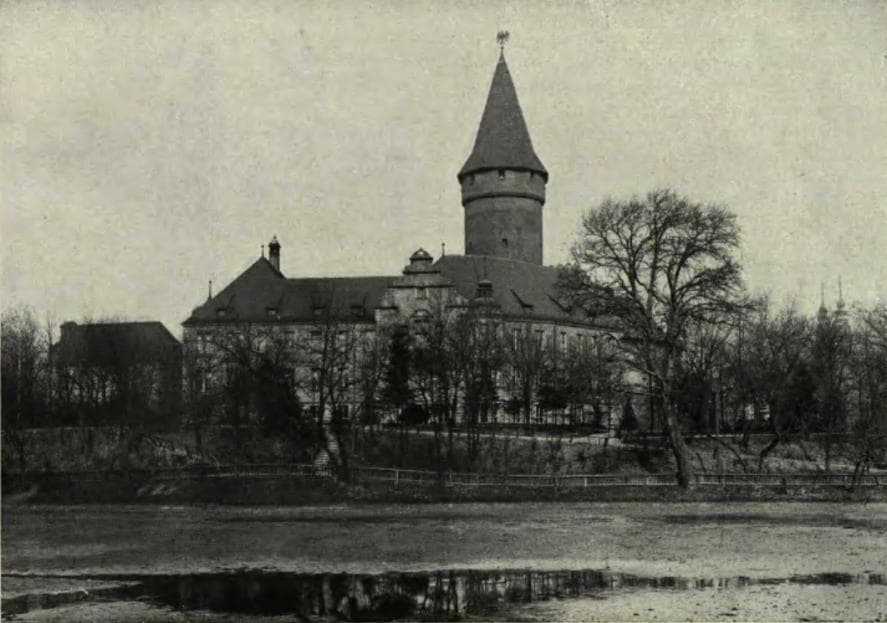
After a fire in 1880, the crenellations of the tower were replaced with a masonry roof topped with a granite spire. Between 1904 and 1906, a new two-story Neo-Renaissance wing was added on the southwest side, and the tower was capped with a red tile roof. Despite plans in 1928 to demolish the castle and build a new administrative building, only the tower, known as the "Piast tower," survived. This tower remains the sole relic of the castle that once served as the seat of the Opole dukes.
Architectural significance
The Opole castle is classified as a hill castle built during the high medieval period. Its architectural style is predominantly Gothic, with later Renaissance and Neo-Renaissance modifications. The castle's design reflects the transition from wooden fortifications to stone masonry, incorporating defensive features such as thick walls, bastions, a gatehouse, and a prominent cylindrical tower with dungeon facilities.
Cultural and historical importance
As the seat of the Piast dukes of Opole, the castle played a vital role in the political and military history of the region. Its endurance through multiple sieges and wars highlights its strategic significance. Today, the surviving Piast tower serves as a cultural landmark and a reminder of Opole's medieval heritage.
Visiting information
The restored Piast tower is accessible to visitors and often features in cultural events, including the annual Polish Song Festival. Its location in the city center makes it an important tourist attraction, offering insights into medieval architecture and regional history.
Frequently asked questions (FAQ)
- What is the historical significance of Opole Castle?
- Opole Castle, located in the heart of Opole, Poland, dates back to the 10th century and has played a crucial role in the region's history. Originally a defensive fortress, it has undergone numerous renovations over the centuries, reflecting various architectural styles and the rich heritage of Silesia.
- When was Opole Castle built?
- The construction of Opole Castle began in the 10th century, making it one of the oldest castles in the area. It has seen many changes and reconstructions, particularly during the Middle Ages and the Renaissance, which shaped its current appearance.
- What are the opening hours for visiting Opole Castle?
- Opole Castle is typically open to visitors from 10 AM to 6 PM during the summer months, and from 10 AM to 4 PM in winter. However, it is recommended to check the official website for any seasonal changes or special events that might affect visiting hours.
- Can I purchase tickets online for Opole Castle?
- Yes, visitors can purchase tickets online through the official Opole Castle website, which allows for a convenient and hassle-free entry. On-site ticket sales are also available, but online booking is recommended to avoid long lines, especially during peak tourist seasons.
- Is it possible to take guided tours of Opole Castle?
- Yes, guided tours are available at Opole Castle, providing a deeper insight into its history and architectural features. These tours are conducted in various languages and are an excellent way to enhance your understanding of the castle's significance.
- What is the best time to visit Opole Castle?
- The best time to visit Opole Castle is during the spring and summer months, from May to September, when the weather is pleasant and the gardens are in full bloom. Additionally, many cultural events and festivals take place during this time, adding to the overall experience.
- Are there any nearby attractions to visit after exploring Opole Castle?
- Yes, after visiting Opole Castle, you can explore the beautiful Opole Cathedral and the picturesque Market Square, both just a short walk away. The area is rich in history and offers various cafes and shops for a delightful day out.
- Is Opole Castle accessible for visitors with disabilities?
- Opole Castle strives to be accessible to all visitors, with ramps and designated pathways for those with mobility challenges. It's advisable to contact the castle in advance to inquire about specific accessibility features and any assistance you may need during your visit.
- What architectural styles can be seen at Opole Castle?
- Opole Castle showcases a blend of architectural styles, including Romanesque, Gothic, and Renaissance elements, reflecting its long history and various renovations. The castle's impressive towers, fortified walls, and decorative details make it a fascinating example of historical architecture in Poland.
Photo gallery

Photo by Max Glauer•Public domain
Information
Loading map...
Visitor reviews
No reviews yet. Been here? Write the first review and help other travelers!
Write the first reviewVisited this castle? Share your experience
Your review helps other travelers and adds first-hand knowledge to our encyclopedia.