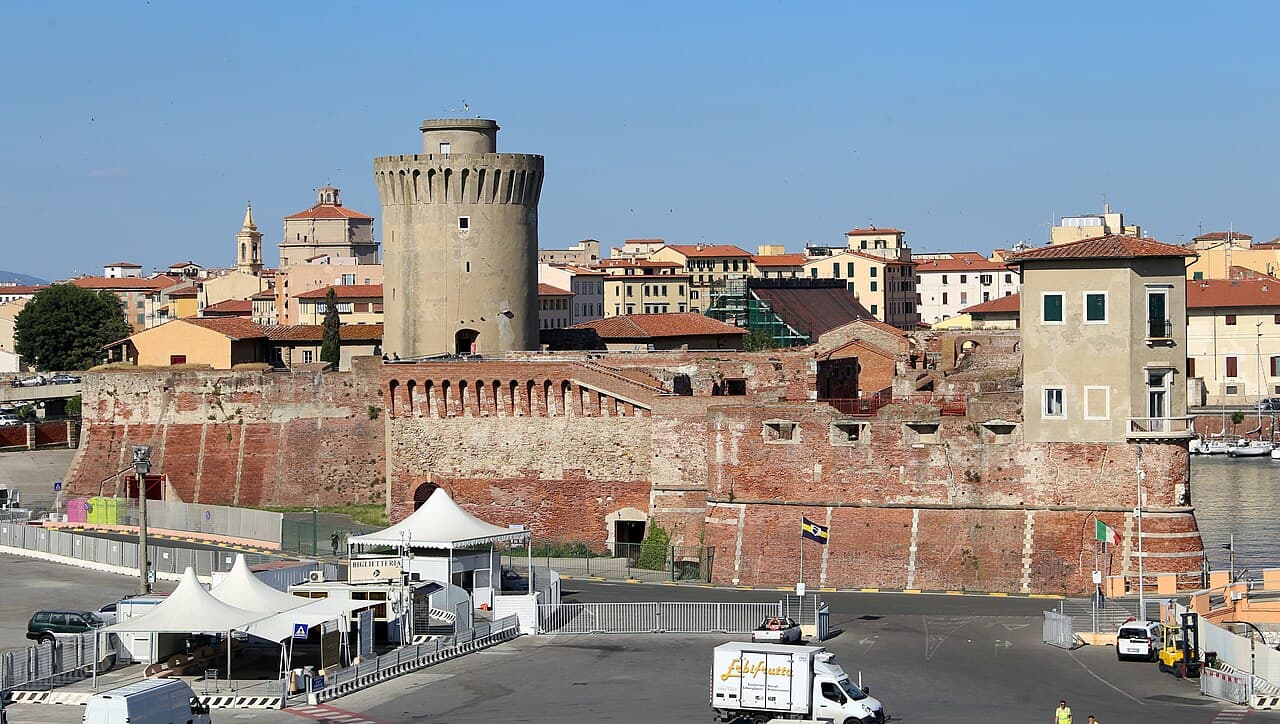
The Old Fortress of Livorno (Fortezza Vecchia di Livorno) stands as a significant historical monument in the coastal city of Livorno, Italy. This bastioned fortress traces its origins back to the 11th century, evolving from an earlier medieval keep constructed by Countess Matilda of Tuscany. Over time, it transformed into a critical military stronghold, reflecting the strategic importance of Livorno as a maritime hub.
Historical origins and early construction
The initial fortification on the site was a medieval keep attributed to Countess Matilda of Tuscany, a powerful feudal ruler in the High Medieval period. This tower formed the nucleus of what would later become the Old Fortress. In the subsequent centuries, the city of Pisa undertook the construction of a more substantial fortification incorporating the original tower. Pisa's efforts aimed to secure their maritime interests along the Tyrrhenian Sea, given Livorno's emerging role as a port.
Development under Pisan and Medicean rule
During the late Middle Ages and Renaissance, the fortress underwent significant expansion and modernization. The Pisans built a robust bastioned fortress around the older keep, adapting to advances in military architecture that responded to the introduction of gunpowder artillery. The fortress is characterized by its thick walls and angled bastions designed to withstand cannon fire and provide overlapping fields of defensive fire.
In the 16th century, the Medici family took control of Livorno, transforming the city and its port into a major naval and commercial center. The fortress became a symbol of Medicean power and maritime ambition. The Medici constructed the Medicean Darsena, or old dock, adjacent to the fortress, integrating it into the broader defensive and commercial infrastructure of the port.
Architectural features and military significance
The Old Fortress features a classic bastioned design typical of Renaissance military engineering, with angular bastions projecting from the main walls to eliminate blind spots and strengthen defense against artillery attacks. The incorporation of the 11th-century tower within the fortress walls provides a rare example of continuity between early medieval and Renaissance fortifications.
The fortress includes multiple defensive elements such as thick ramparts, a moat, and strategically placed gates. The walls have embrasures for cannons and other artillery, reflecting the transition from medieval to early modern warfare. The layout allowed defenders to cover all approaches, making the fortress a formidable obstacle to naval or land-based attackers.
Role in Livorno’s urban and cultural history
The Old Fortress is not only a military structure but also a cultural landmark. On 19 March 1606, the fortress was the site of the ceremony proclaiming Livorno as a city, marking its official elevation in status under the Grand Duchy of Tuscany. This event underscores the fortress's role as a center of civic authority and pride.
Throughout its history, the fortress has witnessed numerous conflicts, sieges, and changes in political power. It symbolizes the maritime and military heritage of Livorno and the broader Tuscan coast. Today, it remains a prominent historical monument and a testament to the evolution of fortification architecture from the High Medieval period through the Renaissance.
Preservation and current status
The Old Fortress of Livorno is currently well preserved and accessible to the public. It serves as a cultural venue hosting exhibitions and events that highlight its historical significance. The fortress's preservation allows visitors to explore its bastions, walls, and the ancient tower, offering insights into centuries of military architecture and Tuscan history.
Its location by the sea and proximity to the historic port area make it a key attraction for those interested in maritime history and Renaissance military engineering. The fortress continues to be an emblem of Livorno's historical identity and its strategic importance on the Mediterranean coast.
Frequently asked questions (FAQ)
- What is the historical significance of Old Fortress?
- The Old Fortress, built in the late 16th century, played a crucial role in defending the city of Livorno against invasions. Its strategic location allowed it to control the entrance to the port, making it a key military site during various historical conflicts.
- When was the Old Fortress constructed?
- Construction of the Old Fortress began in 1577 and was completed in 1620. It was designed by the architect Giovanni Battista Bellucci and reflects the military architecture of its time.
- What are the opening hours for the Old Fortress?
- The Old Fortress is typically open to visitors from 9:00 AM to 7:00 PM daily, although hours may vary seasonally. It is advisable to check the official website for the most current information before planning your visit.
- Can I purchase tickets in advance for the Old Fortress?
- Yes, visitors can purchase tickets online in advance to avoid long lines at the entrance. This is especially recommended during peak tourist seasons when the fortress attracts many visitors.
- Is it possible to access the Old Fortress with a wheelchair?
- While the Old Fortress has made some efforts to improve accessibility, certain areas may still be challenging for wheelchair users due to uneven terrain and stairs. It is best to contact the fortress management for specific accessibility information before visiting.
- What is the best time to visit the Old Fortress?
- The best time to visit the Old Fortress is during the spring and early fall, when the weather is mild and pleasant. Additionally, these seasons tend to have fewer tourists, allowing for a more enjoyable experience.
- Are there any nearby attractions to visit after the Old Fortress?
- Yes, after exploring the Old Fortress, visitors can enjoy nearby attractions such as the Terrazza Mascagni, a beautiful seaside promenade, and the Naval Museum of Livorno, which showcases the city's maritime history. Both sites are within walking distance and offer unique insights into the region.
- What architectural features can I expect to see at the Old Fortress?
- The Old Fortress features impressive bastions, a moat, and thick stone walls that are characteristic of Renaissance military architecture. Visitors can also admire the well-preserved towers and gates that highlight the fortress's historical significance and engineering prowess.
- What are the ticket prices for visiting the Old Fortress?
- Ticket prices for the Old Fortress are generally affordable, with discounts available for children, students, and seniors. It is recommended to check the official website for the latest pricing information and any special offers that may be available for visitors.

Information
Current owner
Municipality of Livorno
Loading map...
Visitor reviews
No reviews yet. Been here? Write the first review and help other travelers!
Write the first reviewVisited this castle? Share your experience
Your review helps other travelers and adds first-hand knowledge to our encyclopedia.



