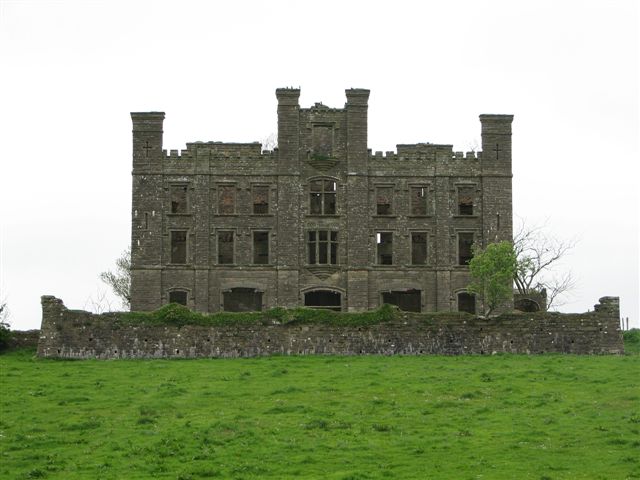
Ogilby's Castle
Ogilby's Castle, also known as Altnacree, Altinaghree Castle, or Liscloon House, stands as a distinctive 19th-century stone mansion ruin located on farmland between the villages of Dunnamanagh and Ballyneaner, south of the town of Londonderry in County Tyrone, Northern Ireland. Though not a medieval fortress, its imposing structure and romantic history make it a notable example of rural Irish country houses from the Victorian era.
Historical background and construction
The exact construction date of Ogilby's Castle remains uncertain, with sources citing either 1850 or 1860 as the year it was built. The mansion was constructed entirely of Irish cut stone, a material transported by horse and cart from nearby Dungiven, reflecting the considerable effort and resources invested in its creation. The castle was surrounded by a substantial stone wall made of the same material, emphasizing its grandeur and the owner's desire for a stately residence.
Unlike traditional castles built for defense, Ogilby's Castle was a modern Victorian mansion designed primarily for comfort and social status. It featured lavish furnishings and a banquet room renowned throughout Tyrone for its size and elegance. This room hosted distinguished guests, including bishops and politicians from London, Dublin, and Belfast, highlighting the social prominence of the estate during its heyday.
The Ogilby family and romantic history
The castle was intended as the home of James Douglas Ogilby, a member of the Ogilby family. However, family tensions arose when James fell in love with Mary Jane Jamieson, a seamstress working in a local factory. His parents disapproved of the match, considering Mary Jane to be beneath their social standing, and refused to allow the marriage.
In defiance, James disappeared for seven years, only to return in 1884 to elope with Mary Jane. Following their marriage, the couple emigrated to Australia, where James became a notable ichthyologist. This romantic episode adds a poignant human story to the castle's history, contrasting with its grand architectural presence.
Architecture and design features
Ogilby's Castle exemplifies Victorian-era country house architecture rather than medieval fortification. Its construction from locally sourced cut stone gives it a robust and enduring appearance. The surrounding stone wall served both as a boundary and a symbol of status rather than a defensive structure.
The mansion's interior was reputedly lavish, with the banquet hall being a highlight. While detailed architectural plans are scarce, the castle likely included typical Victorian features such as high ceilings, large windows, and ornate woodwork, designed to impress visitors and accommodate social gatherings.
Decline and current condition
The castle was reportedly inhabited for only about 30 years. The reasons for its abandonment are unclear, though the departure of the Ogilby family likely contributed. Over time, the mansion fell into ruin, leaving behind a hauntingly atmospheric site that captures the imagination.
Today, Ogilby's Castle remains on private farmland and is not open to public access. However, it is visible from the public road, allowing visitors to appreciate its silhouette against the landscape. The ruin's spooky ambiance, especially at dusk, has made it a favorite subject for photographers and enthusiasts of historic architecture.
Visiting and accessibility
While Ogilby's Castle cannot be entered due to its private ownership and unsafe condition, it can be viewed clearly from Crumlin Road. Visitors interested in Irish Victorian architecture and romantic historical stories will find the site intriguing. The castle's remote rural setting adds to its mystique and offers a glimpse into 19th-century life in County Tyrone.
Frequently asked questions (FAQ)
- When was Ogilby's Castle built?
- Ogilby's Castle was constructed around 1850 to 1860, during the Victorian era, using locally sourced Irish cut stone.
- Can I visit Ogilby's Castle?
- The castle is on private farmland and is not open to the public, but it can be viewed clearly from the nearby Crumlin Road.
- Why is Ogilby's Castle also called Altnacree or Liscloon House?
- The castle is known by several names, including Altnacree, Altinaghree Castle, and Liscloon House, reflecting local naming conventions and historical associations.
- Who was James Douglas Ogilby?
- James Douglas Ogilby was the intended resident of the castle who famously eloped with Mary Jane Jamieson, a seamstress, against his family's wishes.
- What architectural style is Ogilby's Castle?
- Ogilby's Castle is a Victorian-era mansion built with Irish cut stone, representing rural 19th-century Irish country house architecture rather than medieval styles.
Information
Current owner
Private owner
Address
Crumlin Road, Northern Ireland
Loading map...
Visitor reviews
No reviews yet. Been here? Write the first review and help other travelers!
Write the first reviewVisited this castle? Share your experience
Your review helps other travelers and adds first-hand knowledge to our encyclopedia.