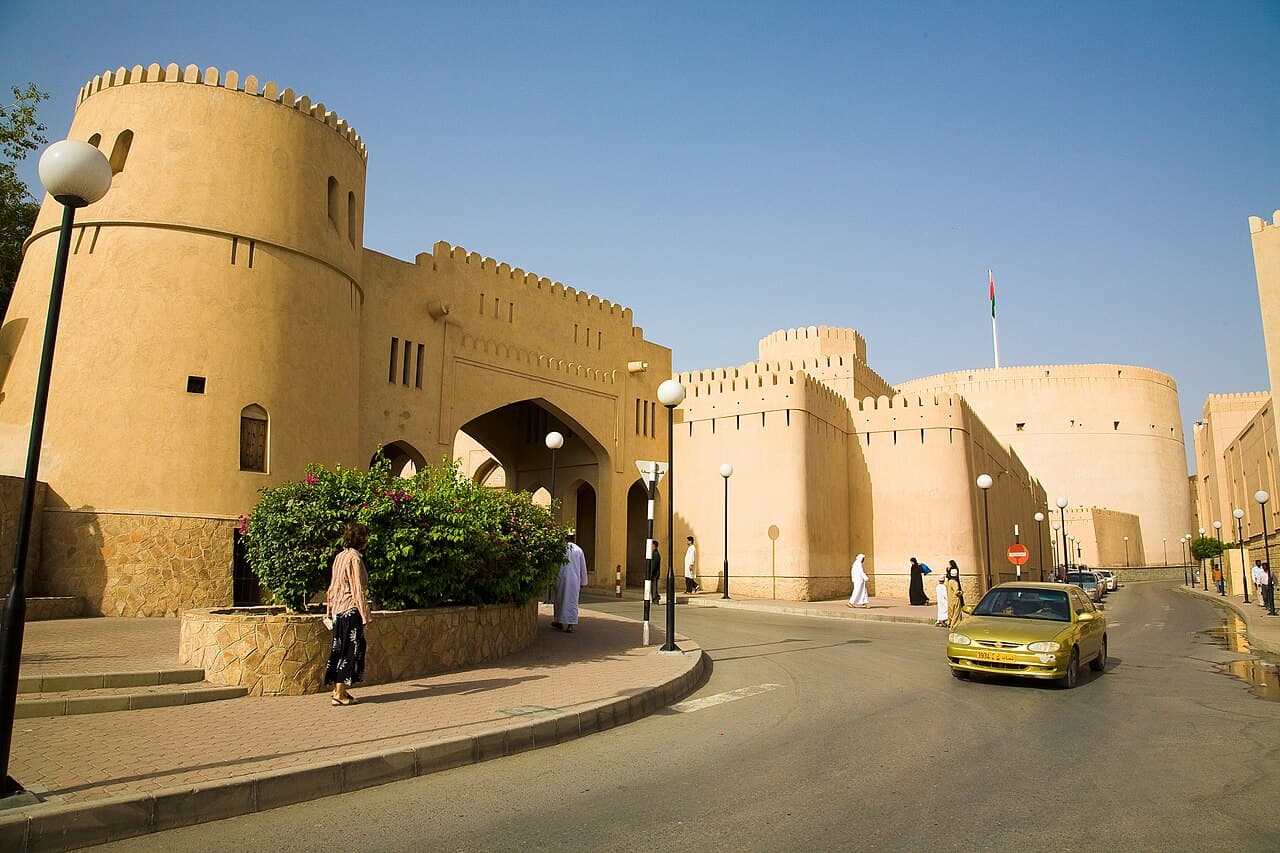
Nizwa Fort is a monumental hill castle located in the historic city of Nizwa, within the Ad Dakhiliyah Governorate of Oman. This imposing fortress stands as a testament to Oman's rich military and political history, particularly during the 17th century under the Yaruba dynasty. The fort is renowned for its massive circular tower, which is considered one of the largest of its kind in the Arabian Peninsula, and for its sophisticated defensive architecture designed to withstand prolonged sieges.
The site of Nizwa Fort has been a strategic and cultural center since at least the 8th century, when the original fortress was established by Imam Mohammed bin Abdullah of the Yahmadi tribe. The castle’s early foundations were expanded in the 9th century by Imam Al-Salt bin Malik, reflecting Nizwa's importance as a political and religious hub. The current fort structure, however, primarily dates from the mid-17th century when it was extensively rebuilt and fortified by Imam Nasir bin Murshid and his successor, Imam Sultan bin Saif I, both key figures in Oman's history for expelling Portuguese colonial forces and consolidating local power.
Historical significance and political role
Nizwa Fort served as the administrative and military center for the imams who combined religious and political authority in Oman. It was the seat of regional governors (Wālī) and played a crucial role in the governance and defense of the interior regions. The fort's strategic location in Nizwa, an important oasis town, allowed control over trade routes and local tribes.
The fort’s history is intertwined with the struggle against foreign powers, notably the Portuguese and Persians, who sought to exert influence over Oman. The Yaruba dynasty's efforts to rebuild and strengthen the fort symbolized the assertion of Omani sovereignty and the defense of Islamic rule. The fort also functioned as a judicial center, with prison cells for detaining criminals and political prisoners, illustrating its multifaceted role beyond military defense.
Architectural features and defensive design
The great round tower
The defining feature of Nizwa Fort is its massive round tower, which rises to nearly 30 meters in height and has an inner diameter of approximately 39 meters. The tower’s lower half is a solid mass of stone and rubble, pierced only by a narrow, winding staircase designed to slow and trap attackers. This staircase includes multiple trap doors, murder holes, and pitfalls, all defensive mechanisms intended to hinder enemy progress.
The upper part of the tower features a wide wall-walk capable of accommodating up to 120 guards, who were equipped with muskets and flintlocks. The battlements provide extensive views of the surrounding countryside, enabling early detection of approaching threats. The tower is reputed to be the largest round defensive tower in the Arabian Peninsula, underscoring its military significance.
Walls, gates, and internal structures
The fort's walls are thick and rounded, constructed from stone, rubble, and mortar to resist cannon fire and explosive mortar rounds. The heavy wooden doors are reinforced with iron spikes to prevent forced entry, while murder holes above the gates allowed defenders to pour boiling oil or water on attackers.
Inside, the fort is a labyrinth of corridors, gates, courtyards, terraces, halls, and narrow stairways designed to confuse and delay invaders. Secret passages and fall doors could be used to block access or provide escape routes. The presence of underground storage rooms for food and weapons, as well as cisterns fed by an underground river, ensured the fort could withstand prolonged sieges without running out of essential supplies.
Water supply and sustainability
A remarkable feature of Nizwa Fort is its water supply system, which taps into an underground river flowing beneath the fortress. This ingenious design guaranteed fresh water access even during extended sieges, a critical factor in the fort's defensive resilience. The cisterns and water channels demonstrate advanced engineering and strategic planning by the fort's builders.
Cultural and architectural legacy
Nizwa Fort is not only a military stronghold but also a cultural landmark that reflects the architectural and engineering prowess of Omani builders during the early modern period. The fort’s design incorporates traditional Islamic military architecture with adaptations suited to the local environment and the specific threats faced by Oman in the 17th century.
The fort is closely associated with the Yaruba dynasty, especially Imam Nasir bin Murshid and Imam Sultan bin Saif I, who are celebrated for their leadership in restoring Omani independence and expelling foreign occupiers. Their legacy is embodied in the fort’s robust construction and strategic features.
Visitor experience and modern significance
Today, Nizwa Fort is a popular tourist destination, attracting visitors interested in Omani history, architecture, and culture. The fort is well-preserved and accessible for exploration, with its complex interior offering a glimpse into the defensive strategies and daily life of the past.
Visitors can explore the extensive battlements, climb the towering round tower, and wander through the maze of corridors and chambers. The adjacent traditional souk adds to the cultural experience, offering a vibrant market atmosphere that complements the historical setting.
While the fort can become crowded during peak tourist seasons, it remains a must-visit site for those seeking to understand Oman’s heritage. The fort’s combination of historical significance, architectural grandeur, and cultural context makes it a key highlight of any visit to Nizwa.
Practical information for visitors
- Opening hours: Typically open daily from morning until late afternoon, though specific times may vary seasonally.
- Admission fees: A modest ticket price is charged for entry, supporting the fort’s maintenance and preservation.
- Accessibility: The fort’s historic nature means some areas involve steep stairs and uneven surfaces; visitors should be prepared for moderate physical activity.
- Nearby attractions: The old town of Nizwa and its bustling souk offer additional cultural and historical exploration opportunities.
Frequently asked questions (FAQ)
- What is the historical significance of Nizwa Fort?
- Nizwa Fort, built in the 17th century, is one of Oman’s most important historical sites. It served as a defensive fortress and a symbol of power for the leaders of the region, playing a crucial role in the defense against external invasions.
- When was Nizwa Fort built?
- Nizwa Fort was constructed in 1668 during the reign of Sultan Bil'arab bin Sultan. Its strategic location was chosen to monitor the surrounding areas and provide protection to the town of Nizwa.
- What are the opening hours of Nizwa Fort?
- Nizwa Fort is typically open to visitors from 9:00 AM to 4:00 PM, Saturday through Thursday, and closed on Fridays. It is advisable to check for any seasonal changes in opening hours before planning your visit.
- Can I take photos inside Nizwa Fort?
- Yes, visitors are generally allowed to take photos inside Nizwa Fort. However, it is recommended to respect any specific guidelines or restrictions indicated by the staff regarding photography.
- Is Nizwa Fort accessible for visitors with mobility challenges?
- Nizwa Fort has some areas that may be challenging for visitors with mobility issues due to its historical architecture. However, the site does have some accessible pathways and staff available to assist where possible.
- When is the best time to visit Nizwa Fort?
- The best time to visit Nizwa Fort is during the cooler months from October to April, when the weather is more pleasant for exploring outdoor sites. Early morning or late afternoon visits also offer a more comfortable experience with fewer crowds.
- What are the ticket prices for Nizwa Fort?
- The admission fee for Nizwa Fort is typically very affordable, with tickets costing around 5 Omani Rials for adults. Discounts may be available for children and students, so it's worth checking at the entrance.
- What nearby attractions can I visit while in Nizwa?
- While in Nizwa, you can explore the Nizwa Souq, known for its traditional crafts and local products, as well as the historic Nizwa Grand Mosque. The beautiful Hajar Mountains are also nearby, offering stunning landscapes and hiking opportunities.
Photo gallery

Information
Website
Visit websiteSources & official resources
Verify the information above using these authoritative references.
Loading map...
Visitor reviews
No reviews yet. Been here? Write the first review and help other travelers!
Write the first reviewVisited this castle? Share your experience
Your review helps other travelers and adds first-hand knowledge to our encyclopedia.


