Namutoni
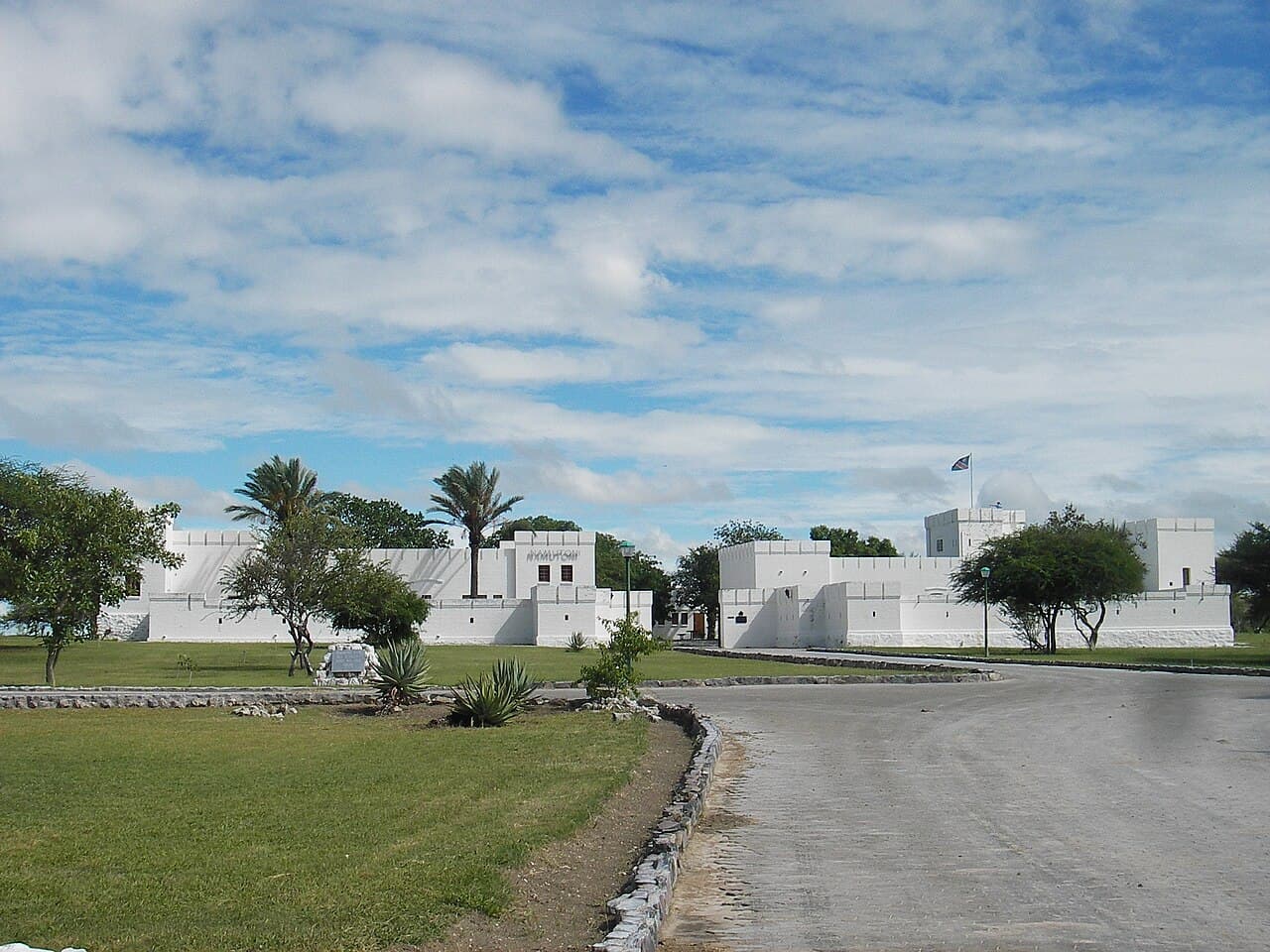
Fort Namutoni stands as a notable 19th-century bastioned fortress located on the eastern edge of the Etosha Pan within the Oshikoto Region of northern Namibia. Originally constructed in 1896 by German colonial authorities, the fort was established primarily as a police post and a veterinary control point along the Red Line, a boundary designed to control livestock diseases and regulate movement in the region. The Red Line extended from Okaukuejo in the west to Otjituuo in the east, making Fort Namutoni a strategic point in colonial administration and control.
Architectural design and fortifications
The fort was built with a bastioned fortress design, characterized by angular bastions projecting from the main defensive walls to provide overlapping fields of fire. This design was typical of late 19th-century military architecture aimed at maximizing defensive capabilities against attacks. The original structure featured thick walls, a central courtyard, and multiple defensive towers. Although the fort was destroyed in 1904 during the Battle of Namutoni, it was rebuilt shortly thereafter, preserving its original military architectural style.
Historical significance and military role
Fort Namutoni played a significant role during the period of German colonial rule in Namibia, then known as German South West Africa. It served as a police outpost to maintain colonial order and enforce veterinary controls crucial for the protection of livestock. During World War I, the fort was repurposed to detain English prisoners, reflecting its continued military importance. After the war, control of the territory passed to South Africa under a League of Nations mandate, and the fort was subsequently used as a police post and later as a South African army base.
Preservation and current status
The fort was declared a National Monument in 1947 by the South West Africa Monuments Council, recognizing its historical and cultural significance. In 1957, Fort Namutoni underwent restoration to serve as a lodge and visitor stopover within the Etosha National Park. It provided accommodation and a viewpoint for tourists exploring the park for several decades. However, with the development of larger and more modern restcamp facilities nearby, the fort is currently unused as lodging but remains an important heritage site within the park.
Surrounding features and accessibility
Adjacent to Fort Namutoni is the King Nehale waterhole, a popular wildlife viewing spot frequented by visitors. The fort's proximity to the Von Lindequist Gate, approximately 10 kilometers east, marks one of the main entrances to Etosha National Park. Additionally, the nearby Namutoni Airport features a dirt landing strip primarily used by wildlife conservation and emergency services, facilitating access to this remote region.
Cultural and touristic importance
Today, Fort Namutoni remains a symbol of Namibia's colonial history and military architecture. Its preservation as a national monument provides visitors with insight into the region's past conflicts, colonial administration, and evolving use from a military stronghold to a heritage site within one of Africa's premier wildlife reserves. The fort's location within Etosha National Park also enhances its appeal to tourists interested in both cultural history and wildlife experiences.
Frequently asked questions (FAQ)
- What is the historical significance of Fort Namutoni?
- Fort Namutoni was built in 1896 as a German police post and veterinary control point along the Red Line. It played a military role during World War I and was later used by South African forces. It is now a declared National Monument within Etosha National Park.
- Can visitors stay overnight at Fort Namutoni?
- Currently, Fort Namutoni is not used for lodging as newer restcamp facilities nearby offer more comfortable accommodations. Visitors can explore the fort as a heritage site during their visit to Etosha National Park.
- How do I get to Fort Namutoni?
- Fort Namutoni is accessible via the Von Lindequist Gate, one of the main entrances to Etosha National Park, located about 10 kilometers east of the fort. The nearby Namutoni Airport also serves wildlife and emergency flights.
- What architectural style characterizes Fort Namutoni?
- Fort Namutoni features a bastioned fortress design typical of late 19th-century military architecture, with angular bastions for defense and thick protective walls.
- When was Fort Namutoni restored?
- The fort was restored in 1957 to serve as a lodge and visitor stopover within Etosha National Park, preserving its historical military architecture.
Photo gallery

Information
Loading map...
Visitor reviews
No reviews yet. Been here? Write the first review and help other travelers!
Write the first reviewVisited this castle? Share your experience
Your review helps other travelers and adds first-hand knowledge to our encyclopedia.