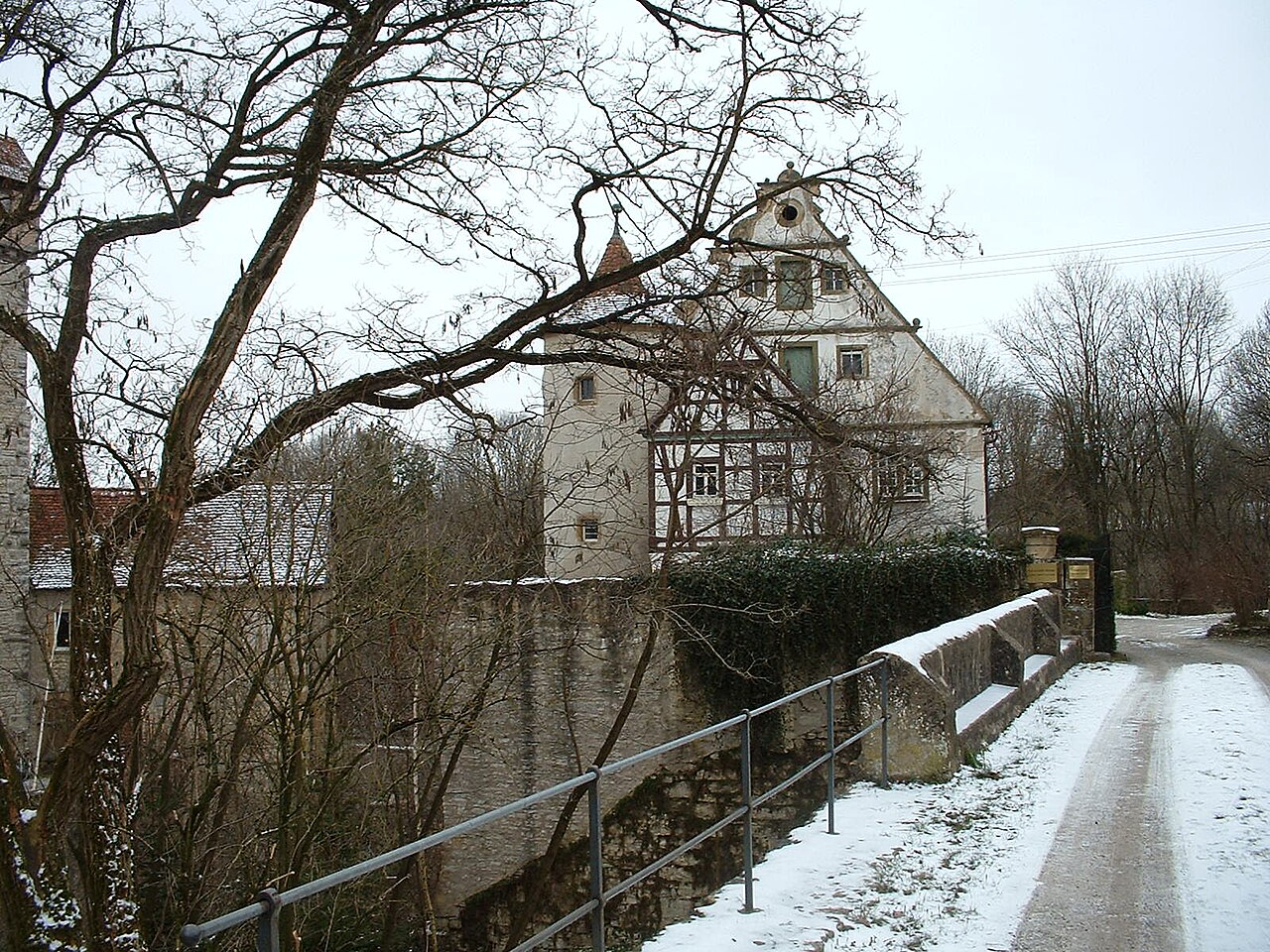
Morstein Castle
Morstein Castle stands as a remarkable example of a medieval hill castle located near the village of Morstein within the municipality of Gerabronn, Germany. This fortress, constructed in the 13th century by the Lords of Morstein, a knightly family active during the Staufer period, served as their hereditary seat and a potent symbol of noble status. The castle's strategic position atop a rocky spur overlooking the Jagst valley and the Dünsbach ravine provided significant natural defensive advantages, a common feature of hill castles designed to control surrounding terrain and resist assaults.
First documented in 1240, Morstein Castle has witnessed centuries of noble lineage and architectural evolution. In the mid-14th century, ownership transferred to the Lords of Crailsheim, who have preserved the estate within their family for over six centuries. This continuity reflects the castle's enduring role as both a residence and a defensive stronghold in the region.
Historical development and noble lineage
The castle's history is marked by significant events that shaped its structure and function. Two devastating fires, in 1571 and again in 1669, led to major reconstruction phases. After the 1571 fire, the palas (main residential building) and the large round tower within the inner castle were rebuilt in the Renaissance architectural style, introducing ornamental elements such as an ornate stepped gable facing the village. The 1669 fire prompted the replacement of the original village church with a chapel annexed to the castle, underscoring the site's ongoing religious significance.
Further enhancements occurred in the 18th century with the construction of a gatehouse in 1758, reflecting continued investment in the castle's fortifications and access control. These developments illustrate the castle's adaptation to changing architectural trends and functional requirements over time.
Architectural layout and defensive features
Morstein Castle's complex layout is defined by its natural and man-made defenses. The castle is enclosed by a continuous ring wall that surrounds two primary areas: the outer bailey (Vorburg) and the inner bailey (Kernburg). The outer bailey includes a strategically placed round tower at its southern point, where the neck ditch meets the Dünsbach ravine, enhancing defense at this vulnerable junction.
Access to the castle is via a stone bridge crossing the neck ditch, leading to a half-timbered gate tower marking the main entrance. The outer bailey's western boundary is secured by a section wall, while an inner ditch between the outer and inner baileys provides an additional defensive barrier. A stone bridge now spans this ditch, replacing an earlier drawbridge whose remains are still visible.
The inner bailey and key structures
The inner bailey is the heart of the fortress, enclosed by the ring wall, inner ditch, and an opposite wall creating a zwinger-like enclosure. The centerpiece is the medieval keep (Bergfried), constructed of bossage stones with a distinctive textured surface. Positioned centrally along the wall facing the inner ditch, the keep served as a last line of defense and a symbol of the castle's strength.
Attached to the keep's southern side is the palas, remodeled in Renaissance style after the 1571 fire. This building features the characteristic stepped gable and served as the main residential quarters. Adjacent to the palas is a massive round tower with a broad gallery extending along the main building, likely used for patrols and living space.
The castle's religious function is represented by an annexed chapel on the west-northwest side of the palas, replacing the earlier village church after the 1669 fire. Additional ancillary buildings at the northern entrance and along the slope toward the Jagst valley supplemented the castle's facilities, including storage and defense support.
Cultural significance and literary connection
Beyond its architectural and historical importance, Morstein Castle holds a place in German cultural heritage. It served as the fictional setting for Agnes Günther's novel Die Heilige und ihr Narr, where it is depicted as Schloss Thorstein. This literary association highlights the castle's evocative presence and its role as an inspiration for storytelling.
Preservation and current condition
Today, Morstein Castle remains a well-preserved hill castle that showcases a blend of medieval fortification principles and Renaissance architectural refinements. Its continuous ownership by the Lords of Crailsheim has contributed to its maintenance and conservation. Visitors can observe the layered defensive structures, the imposing keep, and the Renaissance palas, all set within the picturesque landscape of the Jagst valley.
The castle's combination of natural topography, robust defensive features such as the neck ditch and zwinger enclosures, and architectural evolution over centuries make it a significant site for understanding the development of noble residences and fortifications in southern Germany.
Frequently asked questions (FAQ)
- How do I access Morstein Castle?
- Morstein Castle is accessed via a stone bridge crossing the neck ditch, leading to a half-timbered gate tower marking the main entrance.
- What architectural styles are visible at Morstein Castle?
- The castle features a mix of medieval defensive architecture and Renaissance style, particularly visible in the palas rebuilt after the 1571 fire.
- When was Morstein Castle originally built?
- Morstein Castle was constructed in the 13th century, with the first historical record dating back to 1240.
- Who currently owns Morstein Castle?
- The castle has been owned by the Lords of Crailsheim since the mid-14th century and remains in their possession today.
- What significant events affected Morstein Castle's structure?
- Two major fires in 1571 and 1669 led to significant reconstruction, including Renaissance-style rebuilding and the addition of a chapel replacing the village church.
Information
Current owner
Lords of Crailsheim
Loading map...
Visitor reviews
No reviews yet. Been here? Write the first review and help other travelers!
Write the first reviewVisited this castle? Share your experience
Your review helps other travelers and adds first-hand knowledge to our encyclopedia.