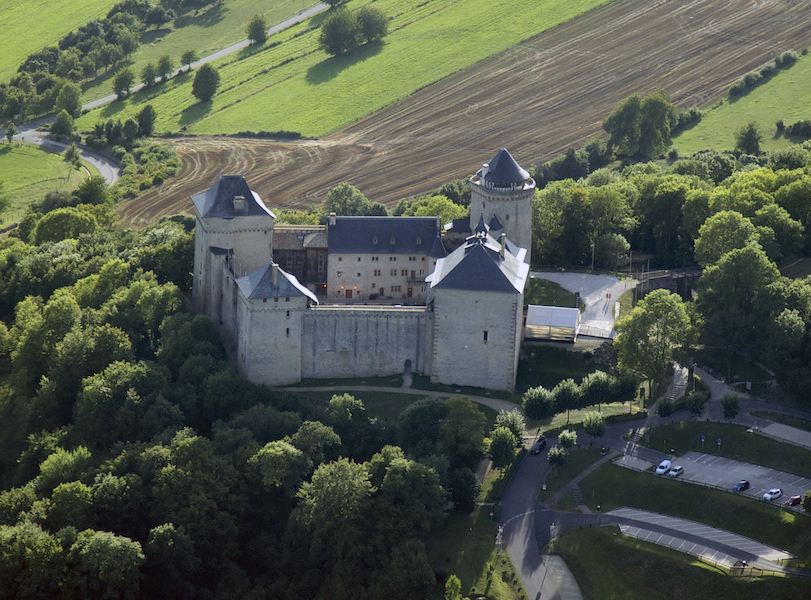
Montclair Castle
Montclair Castle, also known locally as Burg Montclair, is a significant medieval hill castle ruin located west of the village of Mettlach in the Saarland region of Germany. This castle's history spans several centuries, reflecting a complex evolution from ancient fortifications to a prominent High Medieval stronghold and later a smaller Renaissance-era fortress. The castle’s strategic position on a mountain spur within a meander of the Saar River provided natural defenses that were enhanced by successive fortifications over time.
Early fortifications and Celtic origins
The site of Montclair Castle has been used for defensive purposes since ancient times. The earliest known fortification dates back to the Celtic period, when a protective wall was constructed to block access to the mountain spur, turning it into a refuge. During Roman times, archaeological evidence shows occupation on the sun-facing slopes of the hill, indicating the site's continued strategic importance in controlling the surrounding territory.
The first medieval castles: Skiva and Alt-Montclair
The motte-and-bailey castle Skiva (9th–11th century)
Following the decline of Roman influence, the Frankish nobility established the first medieval castle on this site, known as Burg Skiva or Sissiva. This was a motte-and-bailey castle featuring a raised earthwork (motte) and an enclosed courtyard (bailey). The castle served as a local stronghold until it was destroyed in 1016 by Archbishop Poppo of Trier. Today, only the motte remains east of the current castle.
Alt-Montclair: a major Romanesque fortress (late 12th century)
In the late 12th century, a much larger castle called Alt-Montclair was constructed on the site with the approval of Archbishop Arnold I of Trier. Built for Arnulf von Walecourt, who adopted the name Arnold de Monclir, this castle was one of the largest High Medieval fortifications in Germany. It extended approximately 450 meters in length, with the entire complex, including the outer bailey, spanning nearly 900 meters.
Alt-Montclair was a Romanesque hill castle situated atop a high ridge about 290 meters above sea level. The natural topography provided steep cliffs on the northwest and south sides, while the landward side was protected by an artificial neck ditch. The castle featured three main sections separated by deep ditches: an eastern outer bailey, a central main castle with a bergfried (a tall defensive tower), gatehouse, chapel, residential quarters, stables, and barns.
Throughout the Middle Ages, Alt-Montclair was a key stronghold contested between the Archbishopric of Trier and the Duchy of Lorraine. It was held by notable noble families such as the Joinville and Clermont houses and served as the seat of the knights known as the Herren von Montclair. The castle was largely destroyed in 1351 during a siege led by Archbishop Balduin of Luxembourg and subsequently fell into ruin, with only small wall fragments and foundations remaining today.
Neu-Montclair: the 15th-century successor castle
Following the destruction of Alt-Montclair, a new castle called Neu-Montclair (New Montclair) was built nearby between 1434 and 1439 by Arnold VI von Sierck, who also constructed Malbrouck Castle in the vicinity. Neu-Montclair was a smaller, more compact fortress measuring approximately 32 meters by 19 meters.
The castle's design included two large round towers on the eastern corners: the northeast tower stood 22 meters tall with a 15-meter external diameter, and the southeast tower was 20 meters high and 13 meters across. These towers had walls up to 4 meters thick, emphasizing their defensive purpose. The main gate was located between these towers and protected by a 12-meter-wide moat with a drawbridge. Smaller round towers fortified the western corners, and the courtyard housed the economic building used for storage and daily operations.
The towers were originally topped with conical roofs and surrounded by battlements featuring machicolations and arrow slits, allowing defenders to repel attackers effectively. Parapet walkways provided patrol routes along the walls. The architectural style and construction techniques of Neu-Montclair closely resemble those of nearby Meinsberg Castle, reflecting early 15th-century military architectural trends.
Ownership and historical events
In 1370, the Montclair lands passed to the Lords of Sierck through marriage, and Neu-Montclair was built by Arnold VI von Sierck in the early 15th century. The castle later passed to the Counts of Sayn in 1453 and was restored and expanded between 1581 and 1583 by Heinrich IV von Sayn. In 1601, the castle was donated to Katharina Dorothea, niece of Heinrich IV, who was married to Karl Ludwig I, Count of Sulz. This transfer brought Montclair into the Sulz family.
However, ownership was contested by the Archbishop-Elector of Trier, who occupied the castle but failed to maintain it properly. After 1620, Montclair gradually fell into disuse, with only the courtyard house and chapel remaining functional. In 1661, following the Treaty of Vincennes, Montclair became part of France. Louis XIV agreed with the Archbishop of Trier that the castle would not be rebuilt to prevent its use as a military threat. Consequently, the ruin deteriorated further, and the courtyard house was repurposed as a farm building.
Montclair was transferred back to the Archbishopric of Trier in 1778, but the reconstruction ban remained in effect. In 1786, the last building in use burned down, leaving the castle a total ruin. Stones from the ruins were repurposed for local construction, including repairs to the Saar riverbed in 1844.
Restoration and modern history
Restoration efforts began in 1855 under the ownership of Eugen von Boch, director of the Villeroy & Boch ceramics company. Archaeological excavations in the 19th and 20th centuries uncovered prehistoric fortifications, medieval walls, and a hoard of coins dating to the mid-14th century, linked to the 1351 siege.
During the Nazi era in the 1930s, plans to convert Montclair and the surrounding mountain spur into an Ordensburg (a Nazi educational castle) were thwarted by the Boch family, who refused to sell the property. At the end of World War II, the castle was used by the Volkssturm militia and suffered further damage from US artillery bombardment.
In the 1990s, the castle ruins were restored and opened to the public. Today, Montclair Castle is a well-preserved hill castle ruin accessible by a 20-minute forest walk. The site offers visitors a glimpse into the layered history of fortification architecture from the Celtic era through the Renaissance, with significant remains of both Alt-Montclair and Neu-Montclair.
Architectural significance and features
Montclair Castle exemplifies the evolution of medieval fortifications in the Saarland region. The extensive Romanesque Alt-Montclair castle showcased advanced defensive features such as deep ditches, a bergfried, multiple towers, and a large outer bailey. Its location exploited natural topography for defense, a hallmark of hill castles.
The later Neu-Montclair castle reflects the transition to more compact and heavily fortified designs in the early 15th century, with thick-walled round towers, machicolated battlements, and a protected gatehouse with a drawbridge. These features illustrate the military architectural trends of the High Medieval and early Renaissance periods.
Restoration work has preserved key elements while adapting the site for educational and touristic purposes. The castle's surviving structures, such as the towers, gatehouse remains, and curtain walls, provide valuable insights into medieval castle construction and defensive strategies.
Visiting Montclair Castle
The castle is open to visitors for a fee, though access requires a walk of approximately 20 minutes through forest trails starting from the nearby village of Mettlach. The site offers scenic views of the Saar River and the surrounding landscape. Visitors can explore the ruins, including the towers and courtyard, and learn about the castle’s rich history through onsite information.
Due to its location and preservation status, visitors should prepare for uneven terrain and limited accessibility for those with mobility challenges. The best time to visit is during the warmer months when the forest paths are most navigable.
Frequently asked questions (FAQ)
- How do I get to Montclair Castle?
- Montclair Castle is accessible by a 20-minute walk through forest trails from the village of Mettlach. Visitors should wear comfortable walking shoes due to uneven terrain.
- What is the historical significance of Montclair Castle?
- Montclair Castle has a layered history from Celtic and Roman times through the High Medieval period, serving as a strategic fortification and noble residence in the Saarland region.
- When was Montclair Castle built?
- The current Neu-Montclair Castle was built in the early 15th century, while earlier fortifications date back to Celtic and Roman periods, with the first medieval castle established in the 9th century.
- Can I visit Montclair Castle year-round?
- Montclair Castle is generally open to visitors throughout the year, but access may be limited during adverse weather due to the forest path leading to the site.
- Is there an entrance fee to visit Montclair Castle?
- Yes, visitors must pay a fee to enter Montclair Castle. Ticket prices vary, so it is recommended to check locally before visiting.
Information
Sources & official resources
Verify the information above using these authoritative references.
Loading map...
Visitor reviews
No reviews yet. Been here? Write the first review and help other travelers!
Write the first reviewVisited this castle? Share your experience
Your review helps other travelers and adds first-hand knowledge to our encyclopedia.