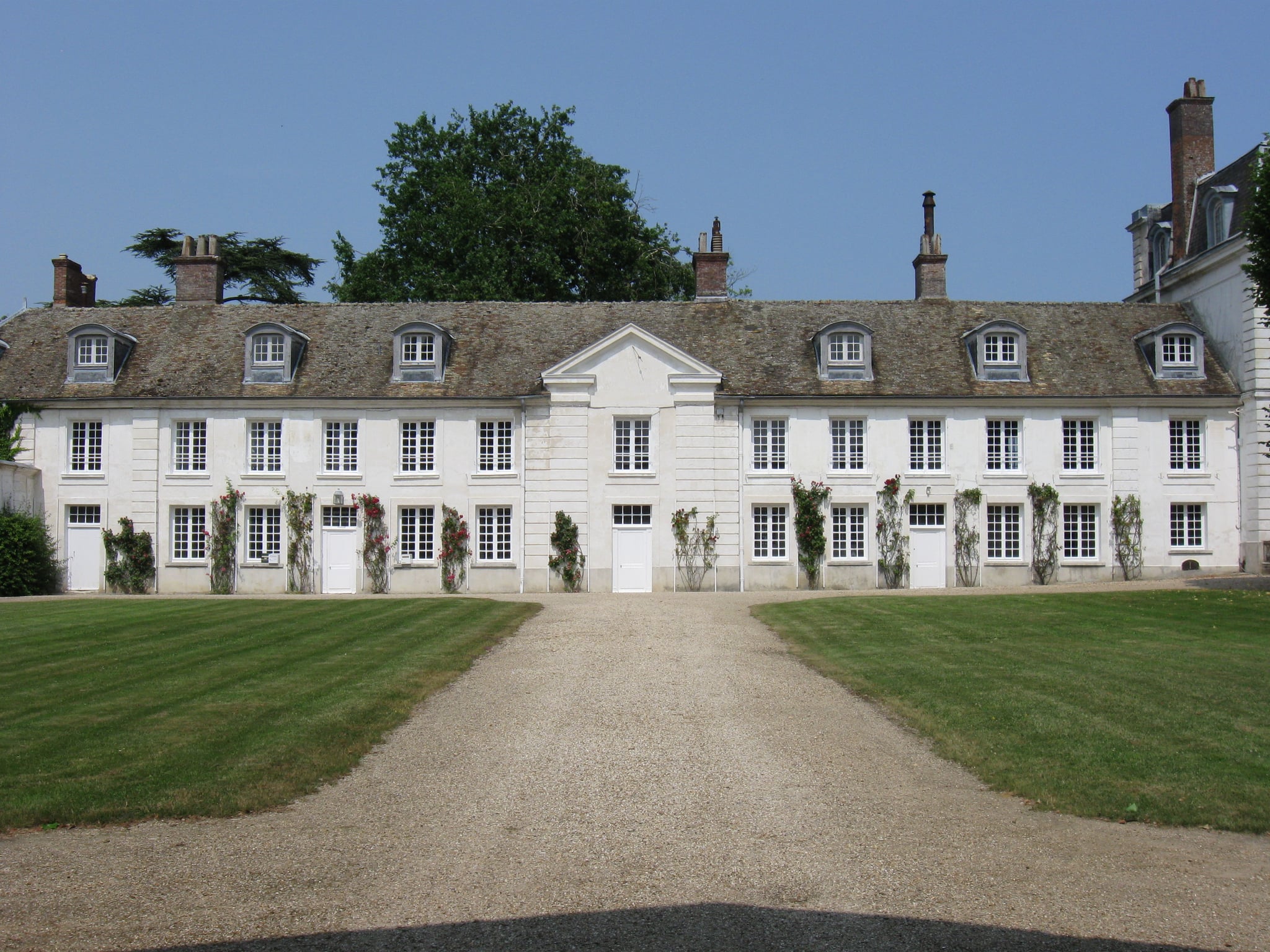
Montchauvet Castle
Montchauvet Castle, locally known as Château de Montchauvet, is a medieval fortress ruin located in the village of Montchauvet in the Yvelines department of France. The castle's origins are closely tied to the early history of the village, which was founded around 1050 near the confluence of the Vaucouleurs river and the Ru d'Houville stream, along an ancient Roman road.
The origins and early fortifications
The earliest known fortification in the area was a wooden fortress situated on the eastern side of the village. This initial defensive structure served to protect the settlement during the High Medieval period. However, as the need for stronger defenses grew, a more permanent stone castle was constructed in the 1130s on a different site, to the west of the medieval village.
Architectural features of Montchauvet Castle
The castle was built as a classic motte-and-bailey type fortress, featuring a five-sided keep positioned atop a raised earthwork mound known as a motte. This keep was connected to a bailey, an enclosed courtyard that would have housed various outbuildings and facilities necessary for the castle’s operation. The design reflects typical defensive strategies of the 12th century, combining elevated vantage points with enclosed living and working spaces.
Town fortifications and Philippe II's enhancements
By around 1200, under the reign of Philippe II 'Auguste', the village of Montchauvet was fortified with a town wall incorporating the castle within its defenses. This wall featured four gates, including the notable Porte de Bretagne, which still partially survives today. These fortifications were part of a broader effort by Philippe II to strengthen royal authority and secure key settlements across France.
Montchauvet during the Hundred Years' War
Throughout the Hundred Years' War, Montchauvet experienced periods of prosperity despite frequent incursions by Anglo-Norman forces in the region. The castle played a defensive role, although its strategic importance fluctuated. In 1378, Charles V of France ordered the dismantling of the castle to prevent its use by enemy forces. However, his successor, Charles VI, restored the fortifications, indicating the ongoing military significance of the site during this turbulent period.
Decline and dismantling in the late medieval period
By the mid-15th century, following the end of the war, the village of Montchauvet had become impoverished, and the castle's strategic value diminished due to its location away from active borders. Eventually, in 1590, Henry IV of France ordered the complete dismantling of Montchauvet Castle. This was part of a wider policy to reduce the number of private fortified places that could challenge royal authority during the Wars of Religion.
The castle ruins today
Today, what remains of the castle are primarily the motte with fragments of the keep walls and one of the original town gates, the Porte de Bretagne. The ruins are in a partially preserved state but are considered unstable, and access to the motte is restricted for safety reasons. Over the centuries, the castle stones were repurposed by local inhabitants as building materials, further reducing the structural remains.
The site is freely visible from the public road, offering a glimpse into the medieval defensive architecture that once dominated the village. Despite its modest remains, Montchauvet Castle provides valuable insight into the military and feudal history of the region during the High Medieval and Late Medieval periods.
Historical significance and cultural heritage
Montchauvet Castle exemplifies the evolution of medieval fortifications in northern France, transitioning from early wooden structures to stone castles integrated within town defenses. Its history reflects the shifting political and military landscape of medieval France, including the centralization efforts of French monarchs and the impact of prolonged conflicts like the Hundred Years' War.
The surviving Porte de Bretagne gate stands as a rare architectural remnant of the village's fortified past and serves as a cultural landmark within the Yvelines department. While the castle no longer functions as a military or residential site, its ruins contribute to the historical identity of Montchauvet and attract visitors interested in medieval architecture and French history.
Frequently asked questions (FAQ)
- How do I visit Montchauvet Castle?
- Montchauvet Castle ruins can be viewed freely from the public road. Access to the motte and keep ruins is restricted due to instability, so visitors should respect safety barriers.
- What is the historical importance of Montchauvet Castle?
- Montchauvet Castle played a role in the defense of the village during the High and Late Medieval periods, especially during the Hundred Years' War. It illustrates medieval fortification methods and royal efforts to control strategic sites.
- When was Montchauvet Castle built and by whom?
- The stone castle was built in the 1130s, replacing an earlier wooden fortress. It was part of a broader wave of castle construction in medieval France during the 12th century.
- Can I see any original parts of the castle today?
- Yes, visitors can see the remains of the motte, parts of the five-sided keep walls, and the Porte de Bretagne, one of the original town gates incorporated into the village walls.
- Why was Montchauvet Castle dismantled?
- The castle was dismantled in 1590 by order of Henry IV to prevent its use as a stronghold during the Wars of Religion and to reduce the power of local nobility.
Information
Address
Rue des Trois Fontaines, Montchauvet, Yvelines, France
Loading map...
Visitor reviews
No reviews yet. Been here? Write the first review and help other travelers!
Write the first reviewVisited this castle? Share your experience
Your review helps other travelers and adds first-hand knowledge to our encyclopedia.