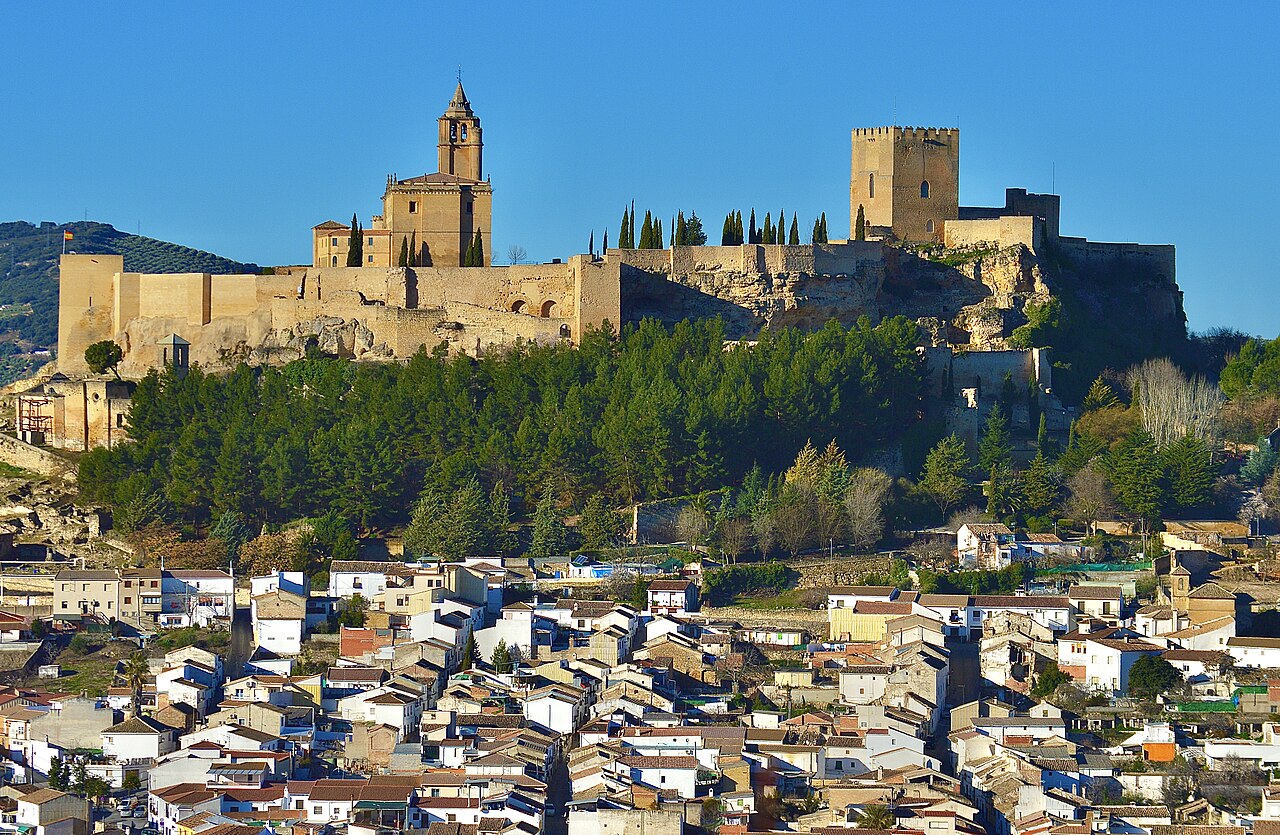
Moclín Castle
Moclín Castle stands as a remarkable example of a 13th-century hill castle located in southern Spain, strategically perched above the town of Moclín. Originally constructed in the high medieval period, this fortress played a pivotal role in the defense of the Nasrid Kingdom of Granada and later during the Christian Reconquista. Known in Arabic as Hisn Al-Muqlin, or "fortress of the two pupils," it was a critical frontier stronghold marking the boundary between the Muslim Nasrids and the Christian Kingdom of Castile.
Historical background and strategic significance
The castle's origins trace back to the mid-13th century, built amidst the turbulent military and political landscape of the Iberian Peninsula. It served as a vital watchtower and defensive position following the Christian capture of nearby fortresses such as Alcaudete in 1340 and Alcalá la Real in 1341. This heightened Moclín's importance as a frontier fortress guarding the Nasrid realm against Castilian advances.
Throughout the 14th and 15th centuries, the castle was repeatedly besieged during the Hispano-Moorish conflicts. Its capture by the Catholic Monarchs in 1486 marked a significant shift in territorial control, ending Nasrid dominance in the area. After the conquest, the castle's inhabitants moved outside the fortifications, and parts of the fortress were repurposed for administrative functions in the Early Modern period, as evidenced by archaeological finds including modern ceramics.
The castle endured damage during the Spanish Civil War, suffering bombings that compromised its structural integrity. Restoration efforts in the early 21st century aimed to stabilize the ruins, though challenges remain in preserving this historic site.
Architectural layout and defensive features
Division into two main sectors
Moclín Castle is divided into two distinct areas: the lower enclosure, which protected the settlement, and the upper castle or alcazaba, located on higher ground. The lower section is enclosed by robust masonry walls built directly on bedrock, with corners reinforced by finely cut ashlar blocks. These walls are topped with battlements made from compacted earth, providing defensive parapets for guards.
A prominent gate tower controls access through a secure double-bend pathway, enhancing the castle's defensibility. Within this lower enclosure stands the Church of the Incarnation, adding a religious dimension to the fortified town.
The alcazaba and key defensive structures
The upper castle is protected on its southern side by two walls: an outer stone masonry wall and an inner wall constructed using rammed earth, a technique involving compressed layers of soil. The northern side, facing the Christian-held fortress of Alcalá la Real, is the largest and most heavily fortified perimeter, reflecting its strategic importance after the Treaty of Jaén (1246).
At the highest point of the alcazaba, approximately 1,100 meters above sea level, stands the Torre de Homenaje or central keep. Originally built of rammed earth, it was later reinforced with stone, emphasizing its role as the final defensive refuge and lookout tower with commanding views over the surrounding landscape, including Alcala La Real.
The castle's entrance features a pointed arch gate connected to a corridor running west to east, typical of its period. The albacar, the space between the alcazaba and the outer walls, provided an additional defensive buffer zone.
Water management and internal facilities
Water supply was crucial during sieges, and the castle contains two cisterns (aljibes) for collecting and storing rainwater. One of these cisterns remains well-preserved and large, underscoring the importance of water management for sustaining the garrison.
While historical records indicate the presence of residential quarters within the castle walls, no internal rooms or homes have survived intact. The fortress also included a network of watchtowers such as Mingoandrés, La Porqueriza, La Mesa, La Solana, and La Gallina, which formed an integrated surveillance system to monitor approaches and provide early warning of enemy movements.
Construction materials and archaeological insights
The construction of Moclín Castle primarily employed stone masonry and rammed earth. The use of rammed earth was particularly notable in the inner walls of the alcazaba and the original keep tower, reflecting local building traditions adapted for defensive purposes. The outer walls and gate towers were reinforced with ashlar blocks to enhance durability.
Archaeological excavations have revealed multiple occupation layers, highlighting the castle's long history of adaptation and reuse. Finds include modern ceramics from the Early Modern period, indicating administrative reuse after the Reconquista. The castle's condition today is classified as partially preserved, with ongoing conservation challenges due to past war damage and natural decay.
Legacy and cultural significance
Moclín Castle remains a powerful symbol of the complex frontier history between Muslim and Christian kingdoms in medieval Spain. Its commanding position and robust fortifications illustrate the military architecture of the high medieval period in the Iberian Peninsula. The castle's layered history—from Nasrid stronghold to Christian fortress and later administrative site—offers valuable insights into the region's cultural and political transformations.
Today, the castle is a site of historical interest attracting visitors who seek to explore its ruins, panoramic views, and the story of a contested borderland. Preservation efforts continue to ensure that this emblematic fortress endures as a testament to Spain's rich medieval heritage.
Frequently asked questions (FAQ)
- When was Moclín Castle built and by whom?
- Moclín Castle was built in the mid-13th century by the Nasrid dynasty to defend the frontier between the Nasrid Kingdom of Granada and the Christian Kingdom of Castile.
- What are the main architectural features of Moclín Castle?
- The castle features two main parts: a lower enclosure with masonry walls and a fortified upper alcazaba with rammed earth and stone walls, including the prominent Torre de Homenaje keep tower.
- Is Moclín Castle open to the public and what are the visiting hours?
- Moclín Castle is open to visitors, typically during daylight hours. It is advisable to check with the local municipality for current opening times and any guided tours.
- How was water supplied to the castle during sieges?
- The castle has two cisterns (aljibes) that collected and stored rainwater, crucial for sustaining the garrison during prolonged sieges.
- What damage did the castle sustain during the Spanish Civil War?
- The castle suffered bomb damage during the Spanish Civil War, which affected its structural integrity and contributed to its current partially preserved condition.
Information
Current owner
Municipality
Loading map...
Visitor reviews
No reviews yet. Been here? Write the first review and help other travelers!
Write the first reviewVisited this castle? Share your experience
Your review helps other travelers and adds first-hand knowledge to our encyclopedia.