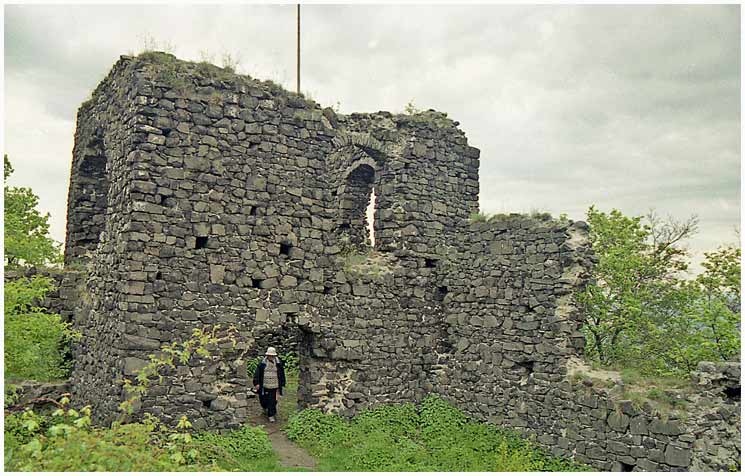
Milčany Castle

Milčany Castle: Gothic hill fortress near Holany, Czechia
Late Medieval (14th–15th c.)
Partially Preserved

Milčany Castle, historically known as Kickelsburg and sometimes confused with Vítkovec, is a Gothic hill castle located near the market town of Holany in the Czech Republic. This fortress, built by local medieval nobility in the late 14th century, exemplifies the defensive architecture typical of the Bohemian Gothic period. Its strategic placement on a rocky promontory overlooking the western edge of Holany pond utilized natural water defenses, a common practice in castle construction of the era.

Origins and early history

The site of Milčany Castle has origins tracing back to an earlier stronghold, believed to have been situated on an island within a nearby pond. This predecessor fortress, likely also called Milčany, disappeared around the turn of the 14th to 15th century. Archaeological investigations date the construction of the current castle to between 1391 and 1402, marking a transition from the original fortified site to a more permanent stone castle. By 1402, the castle was under the ownership of Jindřich of Dubá, a member of a prominent Bohemian noble family, embedding the castle within the complex feudal landscape of medieval Bohemia.

Ownership and historical events

In 1437, the castle passed to Zikmund Děčínský of Vartenberk, a significant noble figure who also founded the nearby Rybnov Castle. This connection linked Milčany to a wider network of noble estates in the region. Historical records indicate that Milčany suffered damage during the 1444 invasion by the Lusatian Six Towns, a military coalition from Lusatia. Despite this assault, the castle remained in use and was part of the dowry of Anežka of Šternberk, Zikmund's second wife, demonstrating its continued importance in noble alliances.

Milčany remained within the holdings of the Rybnov estate until at least 1460. However, by the mid-16th century, between 1543 and 1622, documents describe the castle as deserted. This decline reflects a broader trend of many medieval fortresses losing strategic relevance and falling into ruin during the Renaissance period.

Architectural features and layout

The castle was constructed as a single-part fortress on a rocky outcrop, taking full advantage of the natural landscape for defense. The surrounding pond and water-filled ditches formed integral parts of its defensive system, supplemented by an embankment and a shallow moat on the northwest side. These features created multiple layers of protection against attackers.

Today, the ruins reveal significant remnants of the castle's fortifications. The most prominent surviving structure is a masonry fragment at the southern corner, showing evidence of multiple construction phases. The presence of beam holes in the upper wall section indicates where scaffolding was attached during building or repair works, offering insight into medieval construction techniques.

The eastern wall of the palas or main residential hall stands approximately seven meters tall, showcasing the robust stone masonry typical of the Gothic style. The southern wall remains to a height of about three meters. Unfortunately, later quarrying activities removed large parts of the castle's sandstone, lowering the ground level by three to four meters and significantly altering the site's original appearance.

Later history and cultural significance

For a time, the ruins of Milčany were mistakenly identified with the Renaissance fortress of Vítkovec. This confusion was clarified by researchers František Gabriel and Jaroslav Panáček, who correctly distinguished the two sites. Milčany’s remains have since been recognized for their cultural and historical value, illustrating the evolution of medieval fortifications in the Bohemian region.

In modern times, the castle ruins served as a filming location for the fairy tale film "O princezně Jasněnce a létajícím ševci", highlighting the site's atmospheric qualities and its place in Czech cultural heritage.

Archaeological research and preservation

Archaeological studies at Milčany have helped reconstruct the castle's layout and chronology. Excavations confirmed the castle's construction date and provided evidence of its earlier predecessor. The site’s preservation is challenged by the loss of material due to quarrying, but surviving masonry and fortifications remain valuable for understanding Gothic military architecture in the region.

Today, Milčany Castle stands as a partially preserved hill castle, offering visitors and scholars a tangible connection to the medieval past of Czechia. Its ruins provide a window into the defensive strategies employed by Bohemian nobility and the architectural styles of the late 14th and early 15th centuries.

Frequently asked questions (FAQ)

What is the historical significance of Milčany Castle?
Milčany Castle is a remarkable example of Renaissance architecture in Czechia, reflecting the region's rich history. Originally built in the 16th century, it has witnessed significant events and transformations throughout the ages, making it an important cultural landmark.
When was Milčany Castle built?
Milčany Castle was constructed in the late 16th century, with its foundations laid around 1570. The castle has undergone various renovations and restorations, preserving its architectural integrity and historical value.
What are the opening hours for Milčany Castle?
Milčany Castle is open to visitors from April to October, typically from 10 AM to 6 PM. However, it's advisable to check the official website or contact the castle for exact hours, as they may vary on holidays or special events.
Can I visit Milčany Castle year-round?
While the castle is primarily open to the public during the warmer months from April to October, special tours may be available in the winter. It's best to contact the castle management for information on off-season visits and any special events.
Is it possible to purchase tickets in advance for Milčany Castle?
Yes, tickets for Milčany Castle can be purchased in advance through the official website or at the castle itself. This is recommended, especially during peak tourist season, to ensure a smooth visit.
What is the best time to visit Milčany Castle?
The best time to visit Milčany Castle is during the spring and autumn months when the weather is mild, and the surrounding landscape is particularly beautiful. Additionally, visiting during weekdays can help you avoid larger crowds.
How accessible is Milčany Castle for visitors with mobility challenges?
Milčany Castle has made efforts to accommodate visitors with mobility challenges, including wheelchair access to certain areas. However, some parts of the castle may still pose difficulties due to historical architecture, so it's advisable to check in advance for specific accessibility options.
Are there any nearby attractions to explore after visiting Milčany Castle?
Yes, there are several nearby attractions, including the picturesque town of Holany and beautiful natural parks that offer hiking and sightseeing opportunities. Additionally, the historic city of Liberec is a short drive away and features various cultural and recreational activities.

Information

Hill Castle

Sources & official resources

Verify the information above using these authoritative references.

Loading map...

Visitor reviews

No reviews yet. Been here? Write the first review and help other travelers!

Write the first review

Visited this castle? Share your experience

Your review helps other travelers and adds first-hand knowledge to our encyclopedia.

Write a review

(5/5)

0/2000 characters

Your review will be visible after admin approval

Nearby castles

2.4 km

Jiljov

Holany, Czech Republic

Jiljov is a unique example of a romantic-style hill castle ruin located near the village of Holany in the modern Czech Republic. Unlike medieval castles built for defense or residence, Jiljov was conceived in the early 19th century as part of a deliberate landscape design reflecting the Romantic movement's fascination with medieval aesthetics and picturesque ruins. It stands today as a cultural monument that intertwines natural rock formations with artificial earthworks and masonry, offering visitors a glimpse into the era's artistic landscaping trends rather than military architecture. The creation of jiljov as a romantic garden folly The origins of Jiljov date back to the early 1800s when Vincenc Karel Kounic, the owner of the nearby Zahrádky Castle estate, commissioned significant modifications to the surrounding landscape. These efforts were part of a broader trend among European aristocracy to enhance their estates with scenic elements that evoked a sense of history and nostalgia. The site was transformed into a picturesque retreat featuring an oval-shaped rocky formation surrounded by a broad moat measuring between 15 and 32 meters in width. This moat enclosed an artificially created island, which was stabilized by sandstone masonry walls bonded with clay. These walls were primarily structural features designed to retain the reshaped terrain within the water barrier. Contrary to earlier assumptions by historian August Sedláček, who speculated a medieval origin linked to local nobility, archaeological investigations conducted in 1970 clarified that the site was entirely a product of 19th-century landscaping. The earthworks and masonry remain are not remnants of a defensive fortress but rather a carefully crafted garden folly intended to enhance the romantic ambiance of the estate grounds. Architectural and landscape features of jiljov The layout of Jiljov reflects the romanticized conception of medieval ruins popular in the 19th century. The site incorporates natural rock formations shaped into an oval plan, surrounded by a wide moat that emphasizes isolation and mystery. The surviving masonry fragments along the moat’s edge serve as retaining walls, constructed from sandstone blocks joined with clay mortar. These walls are the only substantial built elements on the site, with no evidence of extensive interior structures or defensive installations. The moat and island create a dramatic visual effect, simulating the appearance of a ruined fortress on a rocky outcrop. This artificial ruin was designed to evoke emotions of nostalgia and romantic melancholy, characteristic of the period’s aesthetic ideals. The site’s integration of natural and man-made elements exemplifies the 19th-century practice of landscape gardening where historic motifs were recreated to enhance the scenic quality of aristocratic estates. Historical significance and protection status Since 1965, Jiljov has been officially protected as a cultural monument in the Czech Republic. This designation recognizes its value not as a medieval fortress but as an important example of 19th-century romantic landscaping and garden architecture. The site provides insight into the cultural and artistic sensibilities of the period, illustrating how historic forms were reimagined to serve aesthetic rather than practical purposes. Visitors to Jiljov can explore the remains of the masonry ruins and the shaped natural rock, appreciating the site's role in the history of landscape design. The castle's location on a rocky hill and its surrounding moat contribute to its atmospheric setting, making it a noteworthy destination for those interested in the intersection of history, art, and nature. Access and visitor experience The ruins of Jiljov are accessible via a side path branching from a hiking trail that connects the villages of Holany and Zahrádky. This trail allows visitors to experience the site's blend of natural scenery and historic landscaping firsthand. The preserved stone fragments and moat outline the perimeter of the artificial island, offering a tangible connection to the 19th-century vision of a romantic ruin. While there are no extensive buildings or interior chambers to explore, the site’s charm lies in its atmospheric setting and the story it tells about the Romantic era’s influence on garden and estate design. Jiljov remains a distinctive cultural landmark that enriches the heritage of the Czech Republic.

Post-Renaissance (17th–18th c.)
Details
3.1 km

Hvězda Castle

Blíževedly, Czech Republic

Hvězda Castle is a medieval hill castle located near the village of Hvězda within the municipality of Blíževedly in the Czech Republic. Constructed in the early 13th century, it stands as a remarkable example of early medieval fortifications integrated with natural sandstone formations. The castle's strategic position atop a sandstone outcrop provided natural defenses, while its architectural features reflect the ingenuity of medieval builders in adapting to challenging terrain. Historical background and ownership The establishment of Hvězda Castle likely dates to the first half of the 13th century, a period marked by the expansion of noble estates and fortifications in the region. Archaeological and historical evidence suggest the castle remained occupied until the 1320s. Although direct documentation is scarce, the castle is commonly associated with the Ronov noble family, a prominent lineage in northern Bohemia. This connection is strengthened by the proximity and contemporaneity of their other stronghold, Frýdlant Castle, first recorded in 1257. Unlike many castles of its time, Hvězda does not appear in records of major military engagements, administrative functions, or ecclesiastical affiliations. Its relatively brief period of habitation and subsequent abandonment in the early 14th century suggest it served primarily as a local defensive residence rather than a center of regional power or religious activity. The later local toponyms such as “Hrad” (castle) and “Loupežný zámek” (robber’s castle) reflect folklore and myths that emerged long after the castle was deserted. Architectural features and construction The castle is uniquely situated on a sandstone outcrop naturally divided into two sections, which shaped its overall footprint. The central architectural element was likely a residential tower with a distinctive hexagonal base, an uncommon form in medieval architecture. This tower was constructed from stone, anchored directly into the sandstone bedrock. Deep grooves carved into the sandstone, measuring between 40 and 80 centimeters wide and up to 60 centimeters deep, served as sockets for the tower’s stone walls, demonstrating sophisticated construction techniques that integrated natural rock formations. On the southwestern side of the rock formation, remains of a stone-built ground floor of a one-story building are visible. A carved foundation groove approximately 1.5 meters wide, hewn from the sandstone, indicates where this adjoining structure once stood. This building likely served residential or utility functions supporting the castle’s occupants. The northeastern section preserves traces of fortifications, including defensive walls and possibly ramparts, which would have protected the castle’s vulnerable approaches. These fortifications highlight the dual role of the site as both a residence and a guarded stronghold. Integration with natural landscape The castle’s builders skillfully utilized the natural sandstone outcrop as part of the defensive system. The rock formations provided natural barriers and foundations, reducing the need for extensive artificial fortifications. This integration of architecture and geology is a distinctive feature of Hvězda Castle, illustrating medieval adaptation to local topography. Archaeological significance and current condition Today, the remains of Hvězda Castle consist primarily of carved features and foundational traces hewn directly from the sandstone bedrock. These physical remnants offer valuable insights into medieval construction methods and the castle’s layout. The survival of the hexagonal tower base and foundation grooves is particularly significant for understanding the architectural innovations of the period. While the castle is now a ruin, it continues to attract historians, archaeologists, and visitors interested in early medieval fortifications and the history of northern Bohemia. The site’s evocative landscape and the enduring presence of carved stone features contribute to its cultural heritage value. Local legends and cultural impact The castle’s later association with names like “robber’s castle” reflects its place in regional folklore. These legends, though not supported by historical evidence, have enriched the cultural narrative surrounding the site and contributed to its mystique. The castle remains an important symbol of medieval history and architecture in the Czech Republic. Visiting information and accessibility Hvězda Castle is accessible to visitors interested in exploring medieval ruins and natural sandstone landscapes. Due to its ruinous state and rugged terrain, visitors should be prepared for uneven paths and limited facilities. The site offers a unique opportunity to observe medieval construction techniques and enjoy panoramic views of the surrounding countryside. While there are no formal visitor centers or extensive amenities, the castle’s location near Blíževedly makes it a worthwhile destination for history enthusiasts and hikers exploring the region.

High Medieval (11th–13th c.)
Details
4.3 km
Ronov Castle — Czech Republic castle

Ronov Castle

, Czech Republic

Ronov Castle (Czech: hrad Ronov) stands as a notable example of a late medieval fortress located in the Liberec Region of the Czech Republic, northeast of Blíževedly in the Česká Lípa District. This 14th-century castle ruin is recognized as a cultural monument and offers valuable insight into the defensive architecture and noble residences of the period. Historical background and ownership The earliest direct records of Ronov Castle date back to the 15th century, although the castle's construction is attributed to the 14th century. By 1438, the castle was under the ownership of Vilém of Ilburk, a nobleman who undertook significant rebuilding efforts to strengthen and possibly modernize the fortress. These renovations likely reflected the evolving military and residential needs of the period, as well as the status of its owners. Following the mid-16th century, specifically after 1538, the castle was abandoned. Over time, it fell into disrepair and gradually transformed into the ruins that remain today. The abandonment might have been influenced by changes in military technology, shifting political circumstances, or the relocation of noble residences to more comfortable or strategically advantageous sites. Architectural features and layout Although much of Ronov Castle lies in ruins, archaeological studies and remaining structures reveal key aspects of its original design. The castle was strategically positioned on elevated terrain, characteristic of hill castles of the late medieval period, to maximize defensive capabilities and surveillance of the surrounding landscape. The castle complex likely included fortified walls, a main gate, and possibly a keep or donjon serving as a last line of defense and residence for the lord. The presence of courtyards and service buildings would have supported the daily life of its inhabitants and garrison. The architectural style reflected the functional Gothic influences common in the region during the late medieval period, emphasizing robust stone construction and defensive features. Defensive structures Key defensive elements probably included battlements and towers positioned to cover the approaches to the castle. The elevated position itself was a natural defense, augmented by man-made fortifications. Although detailed plans are scarce due to the ruinous state, traces of curtain walls and foundation outlines provide clues to the castle's once formidable defenses. Cultural significance and preservation Today, Ronov Castle is protected as a cultural monument of the Czech Republic. Its ruins serve as an important archaeological site that offers historians and visitors a glimpse into the region's medieval past. Preservation efforts focus on maintaining the existing remains and preventing further deterioration while allowing public access for educational and tourism purposes. The castle's location in the picturesque landscape of northern Bohemia adds to its appeal, attracting visitors interested in history, architecture, and hiking. Interpretive signage and guided tours help contextualize the site within the broader narrative of Czech medieval fortifications and noble estates. Visiting ronov castle Visitors to Ronov Castle can explore the ruins and enjoy panoramic views of the surrounding countryside. The site is accessible by hiking trails from nearby villages, making it a popular destination for outdoor enthusiasts and history buffs alike. While the castle is in a ruined condition, the remains provide a tangible connection to the late medieval period and the lifestyle of the regional nobility. There are no extensive facilities on-site, so visitors are advised to prepare accordingly. The best time to visit is during the warmer months when trails are clear and the weather is favorable for outdoor exploration.

Late Medieval (14th–15th c.)
Details