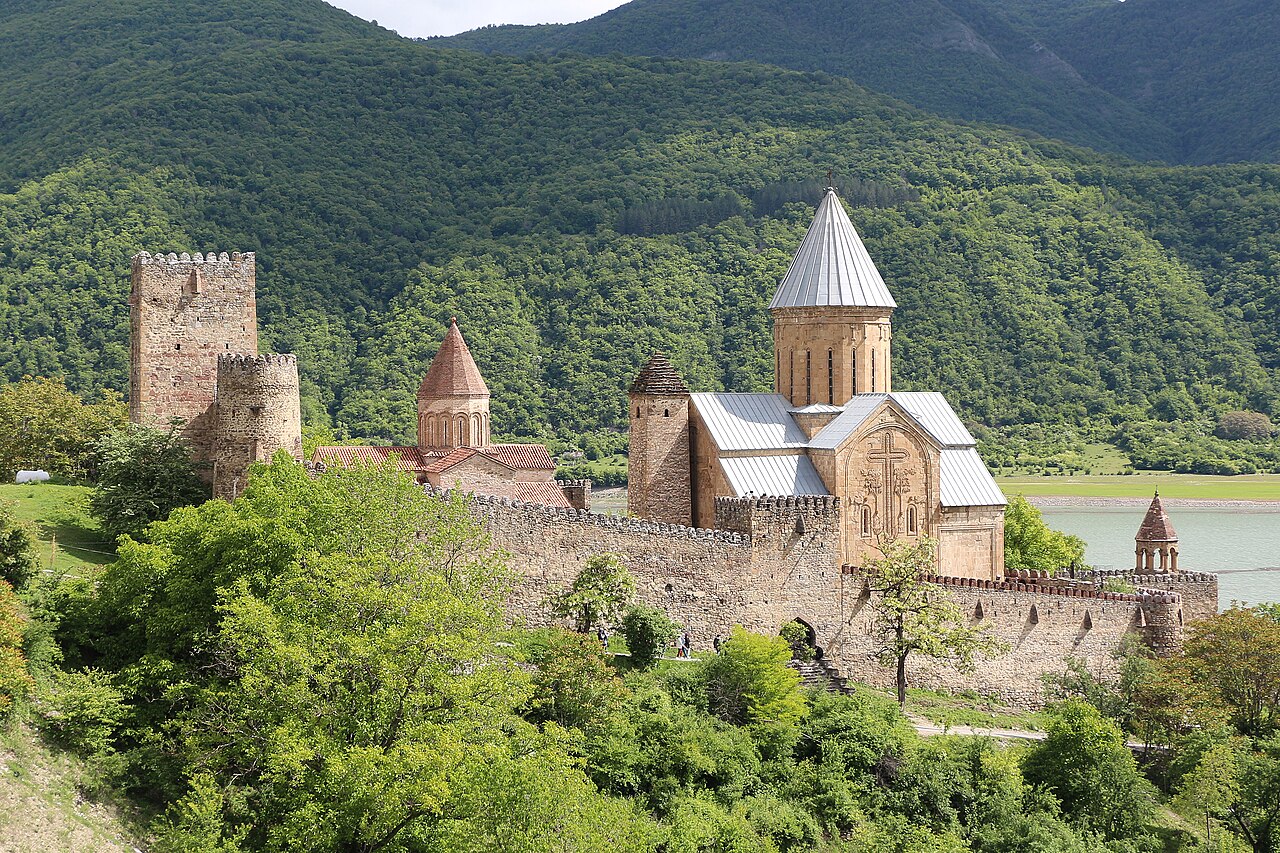
Mere Castle

Mere Castle in Buchaani, Georgia
Buchaani, Mtskheta-Mtianeti, Georgia
Renaissance (15th–17th c.)
Ruins

Mere Castle, also known as Mayres, is a historic fortress located north of the hamlet of Buchaani in the Dusheti municipality, within the Mtskheta-Mtianeti region of Georgia. Perched on a wooded slope on the left bank of the Tetri Aragvi River, the castle occupies a strategic position overseeing the surrounding landscape. Though now a ruin, Mere Castle remains an attractive example of a Renaissance-era fortress adapted to the rugged Georgian terrain.

Architectural features and layout

The oldest and most prominent part of Mere Castle is its D-shaped keep, which forms the core of the fortress. The exact date of the keep's construction is uncertain, but it predates the additional structures built in the second half of the 17th century. During this later period, a curtain wall and several auxiliary buildings were added further down the slope on the castle's southeast side, expanding its defensive perimeter.

The keep's D-shaped design is notable for its adaptation to the natural slope, providing a strong defensive posture while maximizing the use of the terrain. The curtain wall and outbuildings created a fortified compound that could house garrisons and serve administrative functions.

Historical context and ownership

In the 17th century, Mere Castle was owned by the Vashmala family of the Chartli gorge. This family exercised local authority by imposing taxes on the surrounding population. However, the Vashmala were reportedly taxing the locals excessively, which led to a revolt against their rule. During this uprising, the castle's occupants were forced to flee, aided by the Khevsur tribe, a mountain people known for their warrior culture.

Following this turbulent period, Mere Castle came under the control of non-Georgian treasurers. It was used as a defensive structure to protect the local inhabitants from external threats, reflecting its continuing strategic importance in the region.

Preservation and current status

By the late 20th century, Mere Castle had fallen into ruin. In 1983, efforts were made to consolidate the remaining structures to prevent further deterioration. Despite these efforts, the castle remains in a ruined condition and is situated on an inaccessible slope, which currently prevents visitors from exploring the site directly.

However, the castle ruins are easily visible from the nearby S-3 highway, which leads north toward the Russian border. From this vantage point, Mere Castle presents a striking silhouette against the wooded hillside, offering a glimpse into Georgia's rich medieval and Renaissance heritage.

Geographical and cultural significance

Mere Castle's location on the left bank of the Tetri Aragvi River places it within a historically significant corridor in northeastern Georgia. The river valley has long been a route for trade, migration, and military campaigns. The castle's position allowed its occupants to monitor and control movement along this corridor.

The castle is part of the broader cultural landscape of the Mtskheta-Mtianeti region, an area known for its medieval fortifications and mountain communities. Its association with the Vashmala family and the Khevsur tribe highlights the complex social and political dynamics of the region during the Renaissance period.

Frequently asked questions (FAQ)

How do I get to Mere Castle?
Mere Castle is located in Buchaani, Georgia, and can be accessed by car or public transportation. If you are traveling from Tbilisi, you can take a bus to the nearby town and then a taxi to the castle.
What is the historical significance of Mere Castle?
Mere Castle dates back to the 12th century and is a key example of medieval Georgian architecture. It played a crucial role in the defense against invasions and has witnessed significant historical events in the region.
When was Mere Castle built?
Mere Castle was constructed in the 12th century during the height of the Georgian Kingdom. Its strategic location was chosen to provide defense and oversight of the surrounding lands.
Can I take guided tours of Mere Castle?
Yes, guided tours of Mere Castle are available, providing visitors with insights into its history and architecture. Tours typically last about an hour and can be booked in advance or upon arrival.
Why is the architecture of Mere Castle unique?
The architecture of Mere Castle reflects a blend of medieval Georgian styles, characterized by its robust stone walls and intricate design features. The castle's construction showcases the engineering prowess of its time, making it a fascinating site for architecture enthusiasts.
Is it possible to visit Mere Castle year-round?
Yes, Mere Castle is open to visitors year-round, although some facilities may be limited during the winter months. The best time to visit is during spring and fall when the weather is pleasant and the surrounding scenery is at its most beautiful.
What are the opening hours for Mere Castle?
Mere Castle is typically open from 9 AM to 6 PM daily, but hours may vary on public holidays. It is advisable to check the official website or contact local tourism offices for the most current information.
What are the ticket prices for visiting Mere Castle?
Ticket prices for Mere Castle are generally affordable, with discounts available for students and seniors. Children under a certain age may enter for free, but it’s best to verify the latest pricing on the castle's official site before your visit.
Are there any nearby attractions to visit after Mere Castle?
Yes, there are several nearby attractions, including the historic town of Buchaani and picturesque hiking trails that offer stunning views of the region. Additionally, local markets and restaurants provide a taste of Georgian culture and cuisine.

Information

Hill Castle

Loading map...

Visitor reviews

No reviews yet. Been here? Write the first review and help other travelers!

Write the first review

Visited this castle? Share your experience

Your review helps other travelers and adds first-hand knowledge to our encyclopedia.

Write a review

(5/5)

0/2000 characters

Your review will be visible after admin approval

Nearby castles

14.4 km

Avenisi Tower

Avenisi, Georgia

Avenisi Tower is a historic watchtower located near the hamlet of Avenisi in the Dusheti municipality within the Mtskheta-Mtianeti region of Georgia. Positioned on a hill overlooking the northern shore of the Zhinvali Reservoir, the tower commands a strategic view across the water, directly opposite the well-known Ananuri Castle. This placement highlights its probable role in regional defense and surveillance during the 18th century. Architectural features and structure The tower exhibits a rectangular ground plan, a common design for watchtowers intended to maximize interior space while maintaining structural stability. Though now in a state of ruins, the remaining masonry walls give insight into the construction techniques of the period. The tower's elevated position on a hill provided a vantage point for monitoring movements along the nearby roads and waterways. Close to the tower stands a small chapel, adding a religious element to the site which may have served the local community or the tower's occupants. The chapel's presence indicates the integration of spiritual life with the tower's defensive function. Historical context and function While detailed historical records about Avenisi Tower are scarce, its construction in the 18th century places it within the post-Renaissance period of Georgian architecture. During this time, watchtowers were essential components of regional defense systems, especially in mountainous areas like Mtskheta-Mtianeti. The tower likely served as a lookout post to warn of approaching threats and to communicate with nearby fortifications such as Ananuri Castle. The tower's location on the northern shore of the Zhinvali Reservoir, which was created later in the 20th century by damming the Aragvi River, suggests that the original landscape was a strategic corridor for trade and military movements. The tower would have been part of a network of defensive structures safeguarding the region. Current condition and visitor experience Today, Avenisi Tower stands as a modest ruin accessible to visitors. The site is appreciated for its scenic views over the reservoir and the surrounding mountainous landscape. Visitors often note the tranquility of the location, as well as the presence of bats inhabiting the tower ruins. The nearby chapel adds cultural interest to the visit, offering a glimpse into the spiritual heritage connected to the tower. The site is not heavily developed for tourism, maintaining a natural and authentic atmosphere for those interested in Georgian history and architecture. Geographical significance The tower's position in the Dusheti municipality places it within a region known for its rich historical and architectural heritage. The proximity to Ananuri Castle, a major tourist attraction and well-preserved fortress complex, situates Avenisi Tower within a broader context of Georgian defensive architecture along the Aragvi River valley. This area has long been a crossroads between the Georgian heartland and the mountainous northern territories, making watchtowers like Avenisi crucial for regional security and communication.

Post-Renaissance (17th–18th c.)
Details
14.5 km
Ananuri Castle — Georgia castle

Ananuri Castle

Ananuri, Georgia

Ananuri Castle is a remarkable bastioned fortress located in the Mtskheta-Mtianeti region of Georgia, near the village of Ananuri in the Dusheti municipality. This historic complex, perched strategically on a hill at the confluence of the Arkala and Aragvi rivers, now overlooks the southern shore of the Zhinvali Reservoir, a result of the nearby Zhinvali Dam construction. The castle's origins and architectural evolution reflect the turbulent history and cultural richness of the region, making it a significant monument in Georgian heritage. The origins and architectural evolution of Ananuri Castle The oldest surviving element of the complex is the watchtower, built in the style characteristic of the Khevsuri highlanders. This tower dates back to the 14th or 15th century and stands adjacent to the largest church within the fortress walls. The main body of the castle, however, was constructed during the 17th and 18th centuries and served as the seat of the Dukes of Aragvi, a prominent feudal dynasty in Georgian history. The fortress features a rectangular ground plan and is composed of two main castles connected by a crenellated curtain wall, a defensive feature typical of bastioned fortresses. The upper fortification includes a large square tower known as Sheupovari, which functioned as the keep and was the site of the final defense against rival forces. The lower fortification, featuring a round tower, is mostly in ruins today but once contributed to the castle's formidable defenses. Religious architecture within the fortress Within the castle complex stand two notable churches, each reflecting different architectural and historical phases. The smaller, the Church of the Virgin, was built in the first half of the 17th century. Constructed primarily of brick, it abuts the tall square watchtower and contains the graves of several Dukes of Aragvi. Although its interior decoration has largely been lost, a significant feature is the stone baldaquin erected by the widow of Duke Edishera, who died in 1674. The larger church, known as the Church of the Mother of God (Ghvtismshobeli), was constructed in 1689 for the son of Duke Bardzem. This church is a fine example of a central dome style structure with richly decorated façades. Noteworthy are the intricately carved north entrance and the iconic Georgian Orthodox grapevine cross carved into the south façade. Despite suffering extensive damage from a fire in the 18th century, remnants of frescoes still survive, offering a glimpse into the religious art and symbolism of the period. Historical significance and turbulent past Ananuri Castle was a focal point of political and military activity in Georgia. It was the seat of the eristavis (Dukes) of Aragvi, who ruled the region from the 13th century. The castle witnessed numerous battles and sieges, including a devastating attack in 1739 by forces led by Shanshe, Duke of Ksani. During this assault, the castle was set on fire and the Aragvi clan was massacred. Following this tragedy, local peasants revolted against the new rulers imposed by Shanshe, killing the usurpers and inviting King Teimuraz II to assume direct control. The castle then became the residence of royal officials. However, unrest continued, and in 1746, King Teimuraz, with assistance from King Erekle II of Kakheti, suppressed another peasant uprising. By 1786, the castle was part of a small town, but its strategic importance waned over time. During the 1812 Kakheti revolt, Russian troops overran the fortress, marking the beginning of its decline. Since then, Ananuri gradually lost its military and administrative significance. Preservation and modern significance Today, Ananuri Castle is well preserved and accessible to visitors during opening hours. The site remains a popular tourist destination due to its proximity to Tbilisi, attracting many visitors daily. However, the influx of tourists and the commercial activity in the large square in front of the castle can somewhat detract from the historic ambiance. Visitors can explore most of the fortress, though the smaller Church of the Virgin is not open to the public, and photography is prohibited inside the larger Church of the Mother of God. Despite these restrictions, the castle offers a rich experience of Georgian medieval architecture and history. Since 2007, Ananuri Castle has been on the tentative list for UNESCO World Heritage Site designation, reflecting its cultural and historical importance. The complex stands as a testament to Georgia's feudal past, architectural ingenuity, and the resilience of its people through centuries of conflict. Architectural influences and stylistic features The design of Ananuri Castle illustrates a unique blend of architectural influences, combining elements from Georgian Orthodox ecclesiastical architecture with military fortification techniques. The churches exhibit stylistic features reminiscent of Byzantine and Persian traditions, particularly in their decorative motifs and structural designs. The fortress's defensive structures, including the curtain walls, towers, and battlements, showcase the evolution of military architecture in the region during the Renaissance period. The use of bastions and curtain walls reflects advancements in fortification responding to the introduction of gunpowder and artillery warfare. Visitor experience and accessibility Ananuri Castle is open to the public with no significant restrictions on visiting hours, making it an accessible destination for those interested in history and architecture. The site offers panoramic views of the surrounding landscape, including the turquoise waters of the Aragvi River and the Zhinvali Reservoir. While the castle is a major draw for tourists, visitors should be prepared for crowds, especially during peak seasons. The commercial activity around the entrance provides amenities but can affect the tranquility of the visit. Guided tours are available and recommended to fully appreciate the complex's historical and architectural significance.

Renaissance (15th–17th c.)
Details
17.9 km

Mosaxliant Tower

Sepe, Georgia

Mosaxliant Tower is a historic watchtower located near the hamlet of Sepe in the Dusheti municipality, within the Mtskheta-Mtianeti region of Georgia. This tower occupies a strategic position on a hill overlooking the confluence of the Sonchoskhevi and Tetri Aragvi rivers, a location that historically would have provided significant defensive advantages and wide visibility over the surrounding landscape. Architectural features and design The tower has a rectangular ground plan, a common design for watchtowers of its era, which typically emphasized functionality and durability. Built primarily from local stone, the tower's walls are thick, designed to withstand attacks and the elements. Although currently in a state of ruin, the structure still conveys the robust construction typical of post-Renaissance military architecture in the region. The tower's placement on a hilltop allowed it to serve as an observation point, likely to monitor movement along the rivers and nearby routes. Its elevated position also suggests it was part of a network of defensive structures intended to protect local communities and control important transit corridors. Historical context and period While detailed historical records about Mosaxliant Tower are scarce, architectural and regional analysis date its construction to the 18th century, placing it firmly in the post-Renaissance period. This era in Georgian history was marked by local feudal lords building fortified towers and small castles to assert control over their territories and defend against invasions or raids. Such towers were common in the mountainous regions of Georgia, where rugged terrain necessitated compact, defensible structures rather than large castles. The tower's function as a watchtower aligns with the strategic needs of the time, serving both military and communication purposes. Location and landscape significance The tower's location at the confluence of two rivers, Sonchoskhevi and Tetri Aragvi, is significant. Rivers were vital for trade, travel, and agriculture, and controlling river crossings was a key aspect of regional power. The tower's vantage point would have allowed its occupants to monitor these waterways effectively. Today, the site offers pastoral surroundings that highlight the natural beauty of the Mtskheta-Mtianeti region. The rural setting emphasizes the tower's historical role in a landscape that combined agricultural life with strategic defense. Current condition and visitor information Mosaxliant Tower is currently a ruined structure but remains accessible to visitors. Its state as a simple tower ruin allows visitors to appreciate the scale and construction techniques of the period without modern alterations. The site is open to the public without restrictions, providing an opportunity to explore a lesser-known piece of Georgian architectural heritage. The pastoral location offers a quiet experience away from urban centers, suitable for those interested in history, architecture, and natural landscapes. Architectural and cultural significance Though modest in scale, Mosaxliant Tower is an example of the many small defensive structures that played a crucial role in the security and administration of rural Georgia during the post-Renaissance period. It reflects the architectural traditions of the region, combining practical military design with adaptation to the mountainous terrain. The tower contributes to understanding the network of fortifications that dotted the Georgian landscape, illustrating how local communities protected themselves and maintained control over important routes and resources.

Post-Renaissance (17th–18th c.)
Details