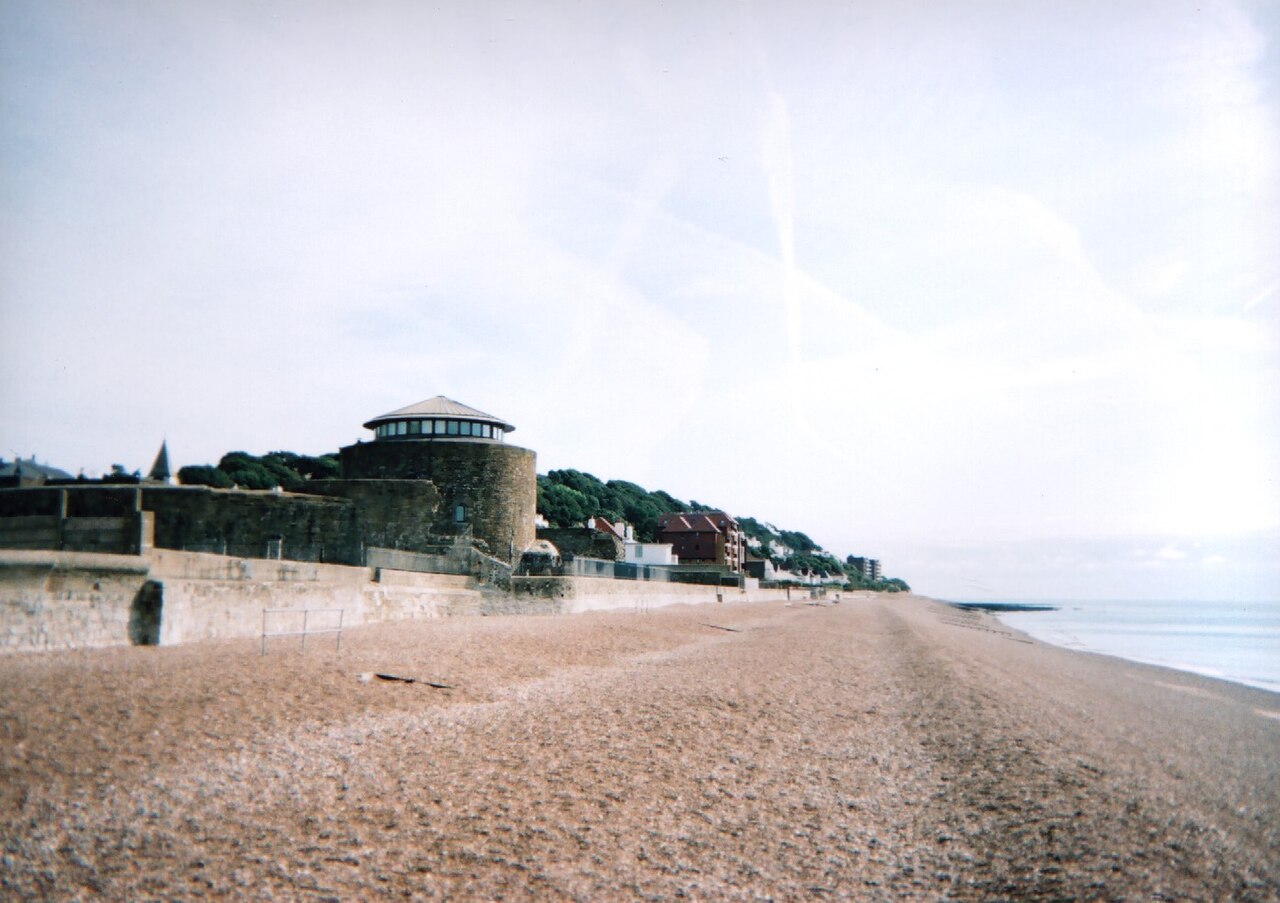
Martello Tower No. 4
Martello Tower No. 4 is located in the historic town of Folkestone, within the county of Kent in England. This tower is part of a series of coastal defenses constructed during the early 19th century as a response to fears of a French invasion under Napoleon Bonaparte. These towers were strategically placed along the southeastern coastline of England, particularly between Folkestone and Seaford, to serve as early warning and defensive structures.
Historical context and strategic purpose
Between 1805 and 1808, the British government commissioned the construction of 74 Martello towers along the Kent and Sussex coastlines. The primary objective was to create a line of defense against a potential French invasion during the Napoleonic Wars. Although none of these towers, including Martello Tower No. 4, were ever directly involved in combat, their presence represented a significant military deterrent during a period of heightened tension in Europe.
Architectural design and features
The design of Martello towers was inspired by a small round fortress located at Mortella Point in Corsica, completed in 1565. This fortress famously withstood a two-day assault by two British warships in 1794, impressing British military engineers who adapted its design for their own coastal defenses. The name "Martello" is a corruption of "Mortella," resulting from a misspelling.
A typical Martello tower, including Tower No. 4, follows a standard architectural plan characterized by a circular footprint approximately 13.7 meters in diameter at the base and rising up to 12 meters in height. The thick masonry walls, constructed primarily of brick, measure up to 2.5 meters thick, providing substantial protection against artillery fire.
Internally, these towers were organized into two main floors: the lower floor served as a storage area for supplies and a powder magazine, while the upper floor housed the garrison's living quarters. Typically, a Martello tower was manned by a garrison of 15 to 25 men, including one officer. The flat roof was designed to accommodate one or more cannons, offering a 360-degree field of fire against approaching enemy ships or troops.
The entrance to the tower was elevated about 3 meters above ground level, accessible only by a retractable ladder. This design feature enhanced the tower's defensibility by making it difficult for attackers to gain entry.
Current condition and preservation status
Today, Martello Tower No. 4 is completely overgrown with vegetation and is currently inaccessible to the public. While many Martello towers along the coast have been repurposed or fallen into ruin, only a select few remain in their original condition. Out of the original 74 towers, approximately 45 still stand, but only 9 retain their authentic structural integrity.
Significance of Martello towers in military architecture
The Martello towers represent an innovative adaptation of Renaissance-era fortification principles to the challenges of modern coastal defense in the early 19th century. Their compact, rounded design maximized defensive capability while minimizing the footprint and resource requirements. The thick walls and elevated gun platforms were specifically engineered to withstand naval bombardment and provide overlapping fields of fire along the coastline.
These towers also illustrate the evolution of British military strategy during the Napoleonic era, reflecting concerns about rapid invasion and the need for localized, self-sufficient defensive positions. Although they never engaged in battle, their construction contributed to the broader network of fortifications that protected the United Kingdom during a critical period of European conflict.
Legacy and cultural heritage
Martello Tower No. 4, along with its counterparts, remains a tangible reminder of Britain's defensive measures during the Napoleonic Wars. The towers have attracted interest from historians, military enthusiasts, and conservationists who seek to preserve these unique structures. While some towers have been restored or converted for modern use, many, including Tower No. 4, stand as silent monuments to a bygone era of military architecture.
Visitors to the region can explore several Martello towers that have been maintained or adapted, offering insights into early 19th-century military engineering. The towers also contribute to the coastal landscape, marking historical points of defense that shaped the development of Britain's maritime security.
Frequently asked questions (FAQ)
- When was Martello Tower No. 4 built?
- Martello Tower No. 4 was constructed in the early 19th century, between 1805 and 1808, as part of a series of coastal defenses against a potential French invasion.
- What was the purpose of Martello Tower No. 4?
- The tower was built to serve as a coastal defense fortification during the Napoleonic Wars, designed to deter or resist invasion by French forces.
- Can visitors access Martello Tower No. 4 today?
- Currently, Martello Tower No. 4 is overgrown and inaccessible to the public, with no established visitor facilities.
- How many Martello towers still exist along the Kent and Sussex coastlines?
- Out of the original 74 towers built, approximately 45 remain, but only 9 retain their original condition without significant alterations.
- What architectural features are typical of Martello towers?
- Martello towers typically have thick brick walls up to 2.5 meters thick, a circular design about 13.7 meters in diameter, two floors for storage and quarters, and a flat roof with cannons.
Information
Address
Next to 22 Cliff Rd, Folkestone, Kent, United Kingdom
Loading map...
Visitor reviews
No reviews yet. Been here? Write the first review and help other travelers!
Write the first reviewVisited this castle? Share your experience
Your review helps other travelers and adds first-hand knowledge to our encyclopedia.