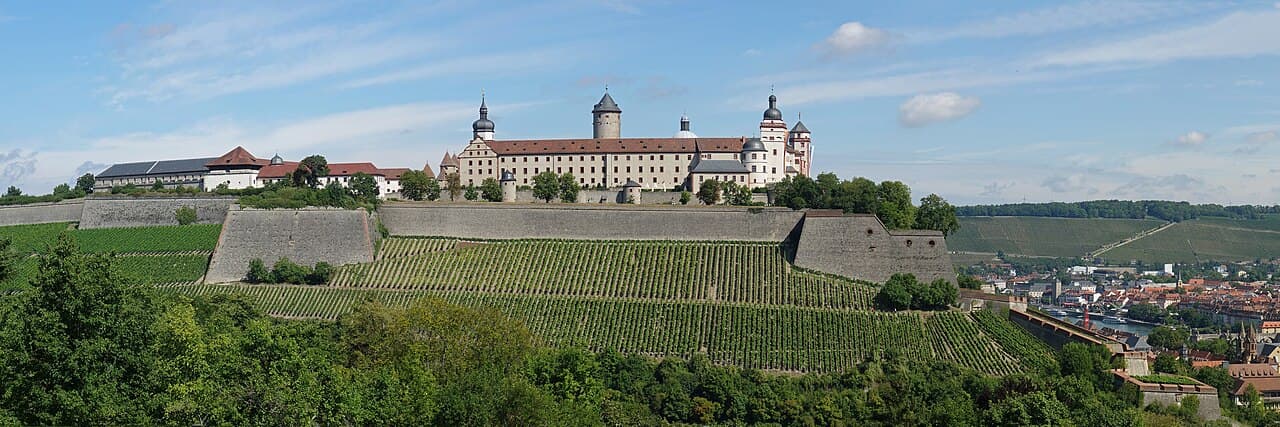
Marienberg Fortress
Marienberg Fortress stands as a commanding symbol of Würzburg, Germany, with a rich history spanning over a millennium. Perched on the 266-metre high Marienberg hill, the fortress overlooks the Main river and the city below, dominating the landscape with its imposing presence. Originally a fortified site since ancient times, it evolved into a grand residence for the prince-bishops of Würzburg over nearly five centuries, reflecting the political and religious power exerted in the region.
The fortress's origins trace back to the early medieval period, with the first fortifications likely established in the 8th century by the Franconian-Thuringian dukes. Archaeological evidence suggests that the hill was settled as early as the late Bronze Age, highlighting its longstanding strategic importance. The initial castle on the site was accompanied by a church founded in 741, which became the first episcopal church of Würzburg. This early fortification laid the groundwork for what would become a complex and architecturally diverse fortress.
Architectural evolution and styles
The fortress underwent significant expansions and reconstructions across the centuries, with the most notable developments occurring during the Renaissance and Baroque periods between the 16th and 18th centuries. These phases introduced elaborate bastions, residential buildings, and ornate decorative elements that transformed the fortress from a purely military stronghold into a palatial complex.
Renaissance and baroque influences
The Renaissance architecture is evident in the fortress's residential wings, which feature symmetrical layouts, classical proportions, and decorative stonework. The later Baroque renovations added grandeur and artistic flourish, including stucco work, ornate facades, and expansive gardens. The Princes' Garden, reconstructed in the 20th century based on early 18th-century plans, exemplifies the Baroque style's emphasis on order and beauty in landscape design.
Fortifications and bastions
Following the Thirty Years' War and the 1631 storming of the fortress by Swedish forces, a comprehensive defensive upgrade was undertaken by Prince-Bishop Johann Philipp von Schönborn. He commissioned a circle of massive bastions that enhanced the fortress's ability to withstand artillery sieges, reflecting the military architectural advancements of the early modern period. These bastions remain a prominent feature of the fortress's silhouette.
Historical significance and events
Marienberg Fortress served as the seat of the prince-bishops who ruled the Würzburg territory, combining both secular and ecclesiastical authority. Its strategic location and formidable defenses made it a key military and administrative center. The fortress witnessed several conflicts, including the Thirty Years' War and the Napoleonic Wars, which shaped the political landscape of Franconia and Bavaria.
In 1945, during the final stages of World War II, the fortress suffered extensive damage from bombing raids and subsequent fires, leaving much of the complex burned out. Restoration efforts were extensive and lasted until 1990, aiming to preserve the fortress's historical and architectural integrity.
Current use and visitor experience
Today, Festung Marienberg is largely accessible to the public and functions as a cultural and historical landmark. It houses two prominent museums: the Princes' Building Museum and the Main-Franconian Museum. The Princes' Building Museum showcases the Bibra Apartment with its valuable furnishings, tapestries, and paintings, alongside the Princes' Hall, which features early Gothic arcatures and a large Echtersche family tapestry. Visitors can also explore the fortress treasury and vestment chamber, which hold artifacts from the era of the prince-bishops.
The Main-Franconian Museum documents the history of the fortress and the surrounding region, providing rich insights into the cultural heritage of Franconia. The Princes' Garden, accessible from the castle courtyard, offers a serene environment reflecting the Baroque gardening traditions.
Würzburg cathedral and its connection
Located near the fortress, Würzburg Cathedral is an architectural masterpiece of the Salian period and one of the largest Romanesque churches in Germany. Built from 1040 onwards under Bishop Bruno of Würzburg, it has undergone multiple phases of construction, destruction, and restoration. The cathedral's proximity to Marienberg Fortress underscores the intertwined religious and political history of Würzburg.
The cathedral features notable artistic works, including a baptismal font by Meister Eckart of Worms and monumental effigies of prince-bishops such as Rudolf II von Scherenberg and Lorenz von Bibra. Its reconstruction after World War II involved a re-Romanisation approach, blending historical and modern elements that continue to spark scholarly interest.
Architectural details and layout
The fortress complex includes a variety of structures such as towers, gates, walls, and bastions that illustrate the evolution of military architecture. The Princes' Building is a highlight, with its richly decorated interiors and historical apartments. The defensive walls incorporate elements from different periods, showcasing adaptations to changing warfare technologies.
The castle's location on a steep hill provided natural defense advantages, complemented by man-made fortifications. The surrounding vineyards on the slopes add to the scenic beauty and cultural landscape of the site.
Cultural heritage and preservation
Marienberg Fortress is a protected heritage site that represents the historical depth of Franconia and Bavaria. Its preservation and restoration have been guided by a commitment to maintaining authenticity while adapting to contemporary museum standards. The fortress continues to attract scholars, tourists, and architecture enthusiasts interested in medieval and early modern fortifications.
The ongoing cultural activities and exhibitions held within the fortress contribute to the living history of Würzburg, making it a vibrant center for education and tourism.
Frequently asked questions (FAQ)
- How do I get to Marienberg Fortress from Würzburg city center?
- Marienberg Fortress is accessible by a short walk from Würzburg city center, crossing the Main river via the Alte Mainbrücke bridge, followed by a steep path or shuttle bus to the fortress entrance.
- What are the opening hours and ticket prices for visiting the fortress?
- The fortress is open daily from 10:00 to 17:00. Tickets cost €8 for adults and €4 for children, with discounts available for groups and families.
- Can I visit the museums inside Marienberg Fortress?
- Yes, the fortress houses the Princes' Building Museum and the Main-Franconian Museum, both open to the public and included with the entrance ticket.
- What architectural styles are represented in Marienberg Fortress?
- The fortress showcases a blend of <strong>Renaissance</strong>, <strong>Baroque</strong>, and <strong>medieval</strong> architectural elements, reflecting its long history and multiple phases of construction and renovation.
- Is Marienberg Fortress suitable for visitors with limited mobility?
- Due to its hilltop location and steep paths, access can be challenging for visitors with limited mobility. However, shuttle services and some accessible areas are available; it is recommended to check in advance for specific accommodations.
Photo gallery

Information
Opening hours
10:00-17:00, daily
Ticket prices
€8 adult, €4 child
Current owner
State museum
Website
Visit websiteSources & official resources
Verify the information above using these authoritative references.
Loading map...
Visitor reviews
No reviews yet. Been here? Write the first review and help other travelers!
Write the first reviewVisited this castle? Share your experience
Your review helps other travelers and adds first-hand knowledge to our encyclopedia.



