Majorie Castle
Majorie Castle in Sion, Switzerland, stands as a remarkable example of a late medieval hill castle with a rich history intertwined with the ecclesiastical and political power of the region. Originally constructed in the 13th century, the castle evolved significantly over the centuries, serving as the principal residence of the Prince-bishops of Sion from 1373 onward. Its elevated position on a hill provided strategic advantages for defense and governance, making it a focal point of authority in the canton of Valais.
The castle's origins trace back to the early mentions of the Vidomnat structure in 1179 and the Majorie tower in 1221, also known as the Tour de Sion. The presence of St Michel’s Chapel within the tower highlights the castle's religious significance alongside its defensive role. The acquisition by Bishop Guichard Tavelli in 1373 marked a turning point, as Majorie Castle became the main episcopal residence, preferred over the less accessible Tourbillon Castle. The castle's layout reflects its dual function as a residence and administrative center, with the Majorie tower likely serving as a reception and ceremonial space, while the bishop's living quarters, now lost, were situated nearby.
Architectural features and layout
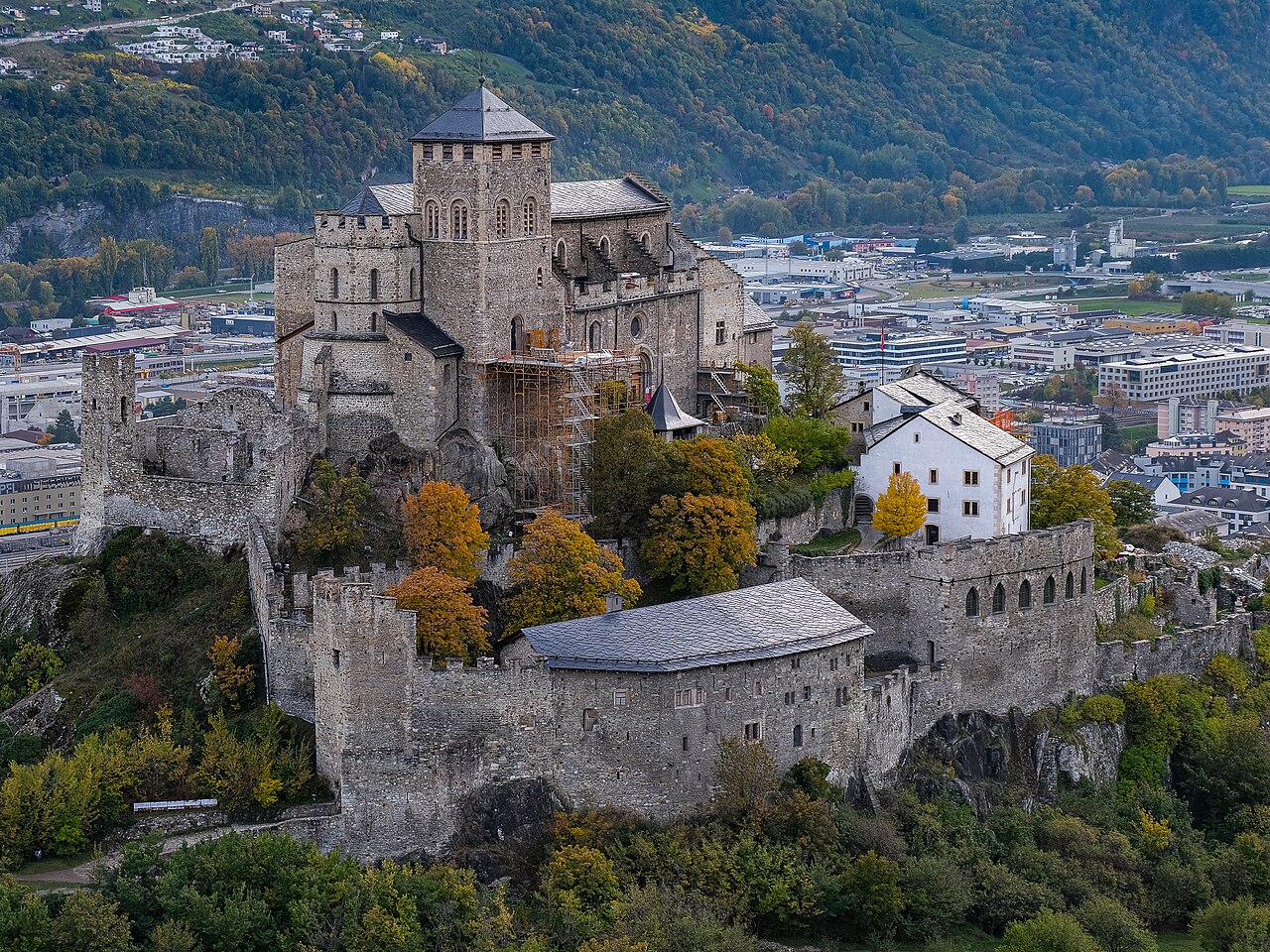
The castle complex is dominated by two principal structures: the imposing Majorie tower and the Vidomnat complex. The Majorie tower, a tall and fortified structure, is surrounded by terraced walls that enhanced its defensive capabilities. Its design suggests a focus on formal and official functions rather than residential comfort, emphasizing the castle's role as a seat of power.
Below and to the west lies the Vidomnat complex, consisting of two square towers originally built separately but later connected. Each tower rises three stories, reflecting architectural adaptations to meet evolving defensive and residential needs. This combination of structures illustrates the castle's layered development and its importance as a fortified episcopal seat.
The Grange-à-l’Évêque, formerly the castle stables, is another significant building within the site. Recently repurposed to house the Valais Nature Museum, it represents the castle's transition from a medieval fortress to a modern cultural institution.
Historical significance and events
Majorie Castle's history is marked by its role as the residence and administrative hub for the Prince-bishops of Sion. The castle's strategic and political importance grew after its acquisition in 1373, serving as the center of ecclesiastical and secular power in the region. It was favored over the nearby Tourbillon Castle due to its accessibility and suitability for governance.
The castle suffered two major fires, in 1529 and 1788, which caused significant damage. The first fire led to reconstruction efforts under Bishop Adrian I of Riedmatten in 1536, restoring the castle's functionality. The second fire destroyed the diocesan archives and left the castle largely unchanged afterward, as the bishops moved their residence closer to the Sion Cathedral in the early 19th century.
Following the bishops' departure around 1839–1840, the State of Valais took ownership and converted the castle into military barracks. This shift marked the beginning of the castle's transformation from a religious and political center to a site of civic and cultural importance.
Modern use and preservation
Since the mid-20th century, Majorie Castle has been repurposed as a cultural venue. In 1947, it became home to the Valais Museum of Fine Arts, showcasing the region's artistic heritage. The adaptation of the Grange-à-l’Évêque to house the Valais Nature Museum in 2013 further expanded the site's cultural offerings.
Despite the damage from historical fires, the castle's key structures, including the Majorie tower and Vidomnat complex, have been preserved. The site remains a testament to the architectural and historical legacy of the Prince-bishops of Sion and continues to attract visitors interested in medieval architecture, ecclesiastical history, and regional culture.
Architectural style and construction period
Majorie Castle exemplifies late medieval architecture with its robust defensive features and ecclesiastical influences. The castle's construction spans from the 12th to the 14th centuries, with significant modifications in the 16th and 17th centuries following fire damage. Its style is primarily functional, emphasizing fortification and administrative utility rather than ornate decoration, consistent with the needs of a hill castle serving as a bishop's stronghold.
Visitor information and cultural significance
Today, Majorie Castle stands as a prominent cultural landmark in Sion. Visitors can explore the preserved medieval structures and enjoy exhibitions at the Valais Museum of Fine Arts and the Valais Nature Museum. The castle's location offers panoramic views of the city and surrounding landscape, enhancing its appeal as a tourist destination.
The castle's layered history, from its medieval origins through its ecclesiastical prominence to its modern cultural role, makes it a valuable site for understanding the region's heritage. Its preservation and adaptive reuse demonstrate the importance of maintaining historical monuments within contemporary society.
Frequently asked questions (FAQ)
- What is the historical significance of Majorie Castle?
- Majorie Castle, located in Sion, Switzerland, dates back to the 13th century and is a remarkable example of medieval architecture. It played a crucial role in the defense of the region and has witnessed many historical events, reflecting the rich heritage of the area.
- When was Majorie Castle built?
- Majorie Castle was constructed in the early 13th century, with its foundation attributed to the Counts of Savoy. The castle has undergone various renovations over the centuries, preserving its historical essence while adapting to modern needs.
- Can I visit Majorie Castle?
- Yes, Majorie Castle is open to visitors year-round. Guided tours are available, allowing guests to explore its fascinating history and stunning architecture while learning about its significance in Swiss heritage.
- What are the opening hours for Majorie Castle?
- Majorie Castle is typically open from 10 AM to 5 PM, with extended hours during the summer months. It is advisable to check the official website for any seasonal changes or special events that may affect visiting hours.
- Is it possible to access Majorie Castle with limited mobility?
- While Majorie Castle is a historical site with some uneven surfaces, efforts have been made to improve accessibility for visitors with limited mobility. It is recommended to contact the castle administration beforehand to inquire about specific accommodations.
- What is the best time to visit Majorie Castle?
- The best time to visit Majorie Castle is during the spring and fall when the weather is mild and the surrounding landscape is particularly beautiful. Additionally, visiting during weekdays can help avoid larger crowds.
- Can I find nearby attractions when visiting Majorie Castle?
- Absolutely! Visitors to Majorie Castle can explore nearby attractions such as the historic old town of Sion, the Valère Basilica, and various hiking trails in the Swiss Alps. These sites complement the castle experience and offer a full day of exploration.
- What are the ticket prices for Majorie Castle?
- Ticket prices for Majorie Castle are generally affordable, with discounts available for students and seniors. Family tickets are also offered, making it a great outing for all ages.
Information
Website
Visit websiteSources & official resources
Verify the information above using these authoritative references.
Loading map...
Visitor reviews
No reviews yet. Been here? Write the first review and help other travelers!
Write the first reviewVisited this castle? Share your experience
Your review helps other travelers and adds first-hand knowledge to our encyclopedia.