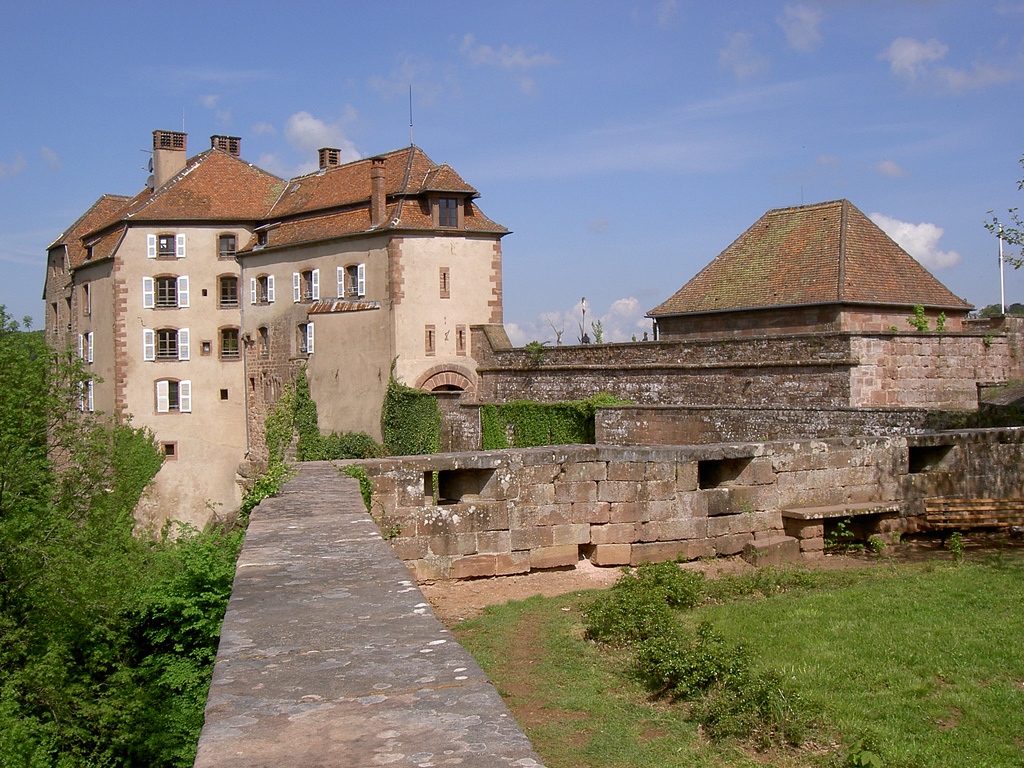
Lorentzen Castle
Lorentzen Castle, known locally as Château de Lorentzen, is a historic fortress located in the village of Lorentzen within the Bas-Rhin department of France. This late medieval castle dates back to the 14th century and stands as a notable example of border defense architecture from that period. It was originally constructed by Friedrich II, Count of Sarrewerden, who commissioned the fortress to protect the boundaries of his county.
Architectural design and fortifications
The castle was designed as a square stronghold featuring round corner towers, a common defensive layout in medieval fortifications intended to provide comprehensive coverage against attackers. The main entrance was secured by a gate flanked by two substantial round towers, enhancing its defensive capabilities. Originally, Lorentzen Castle had five towers in total, but today only the two gate towers, one corner tower, and the base of another corner tower remain intact.
Surrounding the castle was a moat fed by the nearby River Eichel, which added an additional layer of defense by making direct assaults more difficult. The moat and towers exemplify the strategic military architecture typical of the late medieval period in this region of France.
Historical evolution and ownership
In the 16th century, Lorentzen Castle underwent significant restoration and modernization efforts to maintain its defensive and residential functions. The castle later passed into the hands of the County of Nassau-Saarbrücken in 1683, after which it served as a dowager's residence, a common practice for noble widows to reside in such estates.
The turbulent period of the French Revolution at the end of the 18th century brought significant changes to the castle's status. It was divided into multiple residential lots and sold as National Property, reflecting the widespread redistribution of aristocratic lands during this era.
Current condition and usage
Today, Lorentzen Castle remains privately owned and its structures have been divided into several residences. Due to its private status, public access is limited to external viewing only. Despite this, the castle retains much of its rural charm and historical ambiance, making it a noteworthy landmark in the Bas-Rhin region.
Architectural significance and legacy
Lorentzen Castle represents a typical example of a late medieval fortress in northeastern France, combining military functionality with residential use. Its surviving towers and moat remnants offer valuable insights into medieval defensive architecture, particularly the use of round towers for better deflection of projectiles and improved fields of fire.
The castle's evolution from a defensive stronghold to a noble residence and finally to divided private property illustrates broader historical trends in the region, including the impact of political changes such as the French Revolution on aristocratic estates.
Frequently asked questions (FAQ)
- How do I visit Lorentzen Castle?
- Lorentzen Castle is privately owned and divided into residences, so visitors can only view the exterior from public areas around Place du Château.
- What is the historical significance of Lorentzen Castle?
- Built in the 14th century by Friedrich II, Count of Sarrewerden, Lorentzen Castle served as a border fortress and later a noble residence, reflecting regional medieval history.
- When was Lorentzen Castle built and by whom?
- The castle was constructed in the 14th century by Friedrich II, Count of Sarrewerden, to protect his county's border.
- Is the castle accessible for tours inside?
- No, the castle is currently private property with no public interior access; visitors can only explore the castle's exterior.
- Why does Lorentzen Castle have round towers?
- Round towers were a common defensive feature in medieval castles, designed to better deflect attacks and provide wider fields of fire compared to square towers.
Information
Current owner
Private owner
Address
Place du Château, Lorentzen, Bas-Rhin, France
Loading map...
Visitor reviews
No reviews yet. Been here? Write the first review and help other travelers!
Write the first reviewVisited this castle? Share your experience
Your review helps other travelers and adds first-hand knowledge to our encyclopedia.