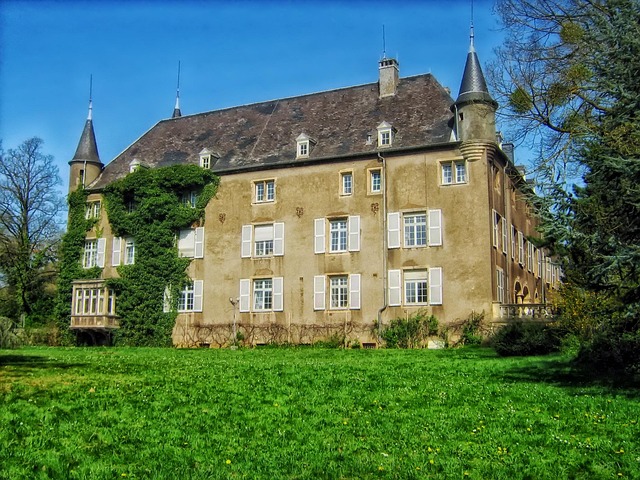
Longwy Castle
Longwy Castle, known locally as the Vieux Château, is located in the town of Longwy in the Meurthe-et-Moselle department of France. This historic site occupies an elongated rocky promontory overlooking the strategic confluence of the Chiers and Moulaine rivers. The location has been settled since at least the 6th century, making it an important early medieval stronghold in the region.
Archaeological and historical evidence suggests that by the 9th century, the site featured a fortified village complete with a church and a tower house belonging to the local lord. This early fortification served as a defensive and administrative center during the turbulent early medieval period in northeastern France.
Medieval history and ownership
Over the centuries, Longwy Castle changed hands multiple times, reflecting the shifting political landscape of the region. It was controlled by the House of Luxembourg and later by the Dukes of Bar. By the 16th century, the castle had expanded into a formidable stronghold under the ownership of the Dukes of Lorraine, who regarded it as their third most important fortress after their main residences.
The castle's strategic position near key waterways made it a valuable military asset. Its fortifications were enhanced over time to withstand the evolving nature of warfare during the late medieval and early modern periods.
Sieges and destruction in the 17th century
Longwy Castle played a role during the Thirty Years' War, a devastating conflict that engulfed much of Europe in the 17th century. In 1636, French forces captured the castle after a siege, asserting their influence in the region. Later, in 1670, troops under King Louis XIV of France seized the castle again.
Following this conquest, Louis XIV ordered the castle to be razed to its foundations. This decision was part of a strategic plan to build a new fortified town slightly to the north. The stones from the demolished castle were repurposed for the construction of the new citadel of Longwy, designed by the renowned military engineer Vauban. This marked the end of Longwy Castle as a medieval fortress.
Later fortifications and military use
In the 18th century, a redoubt was constructed on the site of the old castle, continuing the location's military significance. This redoubt was replaced in 1884 by a modern casemated redoubt built according to the Séré de Rivières system, a French method of fortification developed in response to advances in artillery technology.
The 19th-century redoubt was armed with four 90 mm cannons and played a defensive role during the early stages of World War I. In 1914, the redoubt was bombed and destroyed, marking the end of its active military use.
Archaeological discoveries and current remains
In the latter half of the 20th century, local volunteers conducted limited archaeological excavations at the site. These efforts uncovered and cleared the remains of the large tower, now believed to have been the Chapel Tower. Foundations of a second tower and the connecting curtain wall between the two towers were also revealed.
Today, the remains of Longwy Castle are scarce but significant. The site includes visible ruins of the medieval fortifications alongside the better-preserved remains of the 19th-century redoubt. Visitors can freely explore the area, gaining insight into the castle's layered history from early medieval times through to modern military architecture.
Architectural features and strategic location
The castle's position on a rocky promontory provided natural defensive advantages, overlooking the converging rivers which served as natural barriers. The original medieval fortifications included a tower house, defensive curtain walls, and a church within the fortified village.
The later addition of the 19th-century casemated redoubt reflects the evolution of military architecture, incorporating concrete and underground gun emplacements designed to withstand artillery bombardment.
Visiting longwy castle today
Visitors to Longwy Castle can explore the open site without an entrance fee. Although the medieval ruins are limited, the juxtaposition of the early medieval remains with the 19th-century redoubt offers a unique perspective on the site's military history across centuries.
The castle's location in Longwy also places it near other historical landmarks and the modern fortified town that succeeded it, providing a broader context for understanding the region's strategic importance.
Frequently asked questions (FAQ)
- What is the historical significance of Longwy Castle?
- Longwy Castle, originally built in the 17th century, played a crucial role in the defense of the region during various conflicts, including the Thirty Years' War. Its strategic location allowed it to serve as a military stronghold, and today it stands as a testament to the architectural and military history of France.
- When was Longwy Castle built?
- Construction of Longwy Castle began in 1687 under the direction of the renowned military engineer Vauban. The castle was completed in 1691 and has since undergone several restorations, preserving its historical and architectural integrity.
- How do I get to Longwy Castle?
- Longwy Castle is accessible by car and public transport, with the nearest train station located in the town of Longwy. From there, visitors can enjoy a short walk to the castle, which is situated on a hill offering stunning views of the surrounding area.
- What are the opening hours for Longwy Castle?
- Longwy Castle is open to visitors from April to October, typically from 10 AM to 6 PM daily. However, it is recommended to check the official website or local tourist information for any seasonal changes in opening hours.
- Can I take guided tours of Longwy Castle?
- Yes, guided tours of Longwy Castle are available and provide visitors with a deeper understanding of its history and architecture. Tours are typically conducted in French, but English-speaking guides may be available upon request.
- Is there an admission fee to visit Longwy Castle?
- Yes, there is a modest admission fee to enter Longwy Castle, which helps support its maintenance and preservation. Ticket prices vary for adults, children, and seniors, so it's best to check the official website for the most current pricing information.
- What is the best time to visit Longwy Castle?
- The best time to visit Longwy Castle is during the spring and early fall when the weather is mild, and the surrounding landscapes are particularly beautiful. Additionally, visiting during weekdays may help you avoid larger crowds.
- Are there any nearby attractions to visit while at Longwy Castle?
- Yes, visitors can explore the charming town of Longwy, known for its historic architecture and vibrant arts scene. Nearby attractions include the Longwy Museum and the beautiful landscapes of the Lorraine region, making it a perfect destination for a day trip.
- Is Longwy Castle accessible for visitors with disabilities?
- Longwy Castle has made efforts to improve accessibility for all visitors. While some areas may pose challenges, staff is available to assist and provide information on accessible routes and facilities to ensure a pleasant visit.
Information
Loading map...
Visitor reviews
No reviews yet. Been here? Write the first review and help other travelers!
Write the first reviewVisited this castle? Share your experience
Your review helps other travelers and adds first-hand knowledge to our encyclopedia.