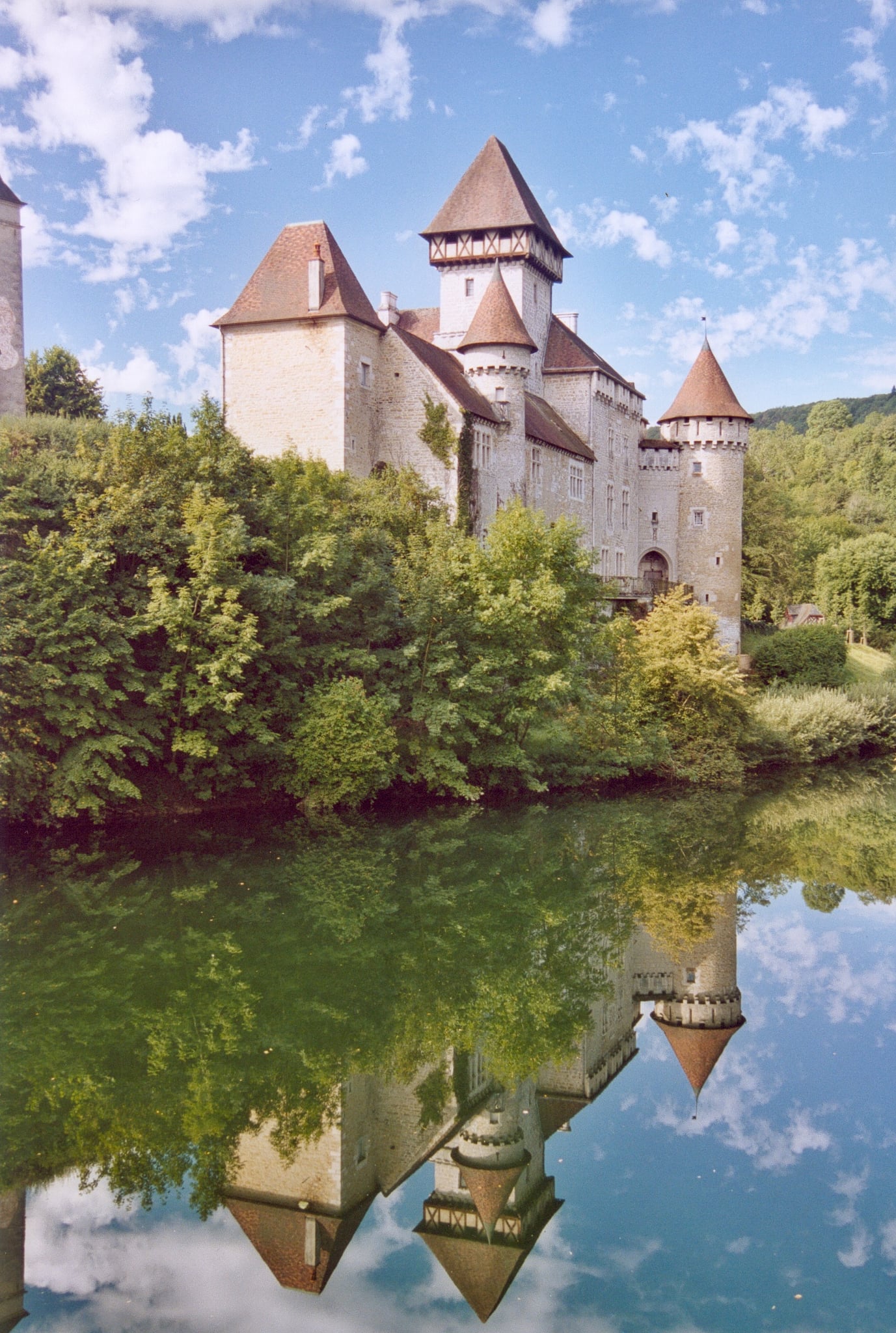
Lods Castle

Lods Castle in Bourgogne-Franche-Comté, France
Lods, Bourgogne-Franche-Comte, France
Late Medieval (14th–15th c.)
Restored

Lods Castle stands as a remarkable example of a late medieval hill castle nestled in the picturesque village of Lods, within the Bourgogne-Franche-Comté region of eastern France. Built between the 14th and 16th centuries, this castle reflects the architectural evolution and strategic military importance characteristic of that era. Its elevated position on a hill provided commanding views over the surrounding landscape, ensuring both defense and control of the nearby valley routes.

Historical significance and origins

The origins of Lods Castle trace back to the turbulent late medieval period, a time marked by frequent conflicts and territorial disputes in the region. Constructed initially in the 14th century, the castle was designed to serve as a fortified residence for local nobility and as a defensive stronghold against invasions. Over the centuries, its structure was expanded and reinforced, particularly during the 15th and 16th centuries, reflecting advances in military architecture and the need to adapt to evolving siege technologies.

Strategic location

Perched atop a hill, Lods Castle commanded strategic oversight of the Loue River valley, an important route for trade and military movements. This location not only provided natural defense advantages but also allowed the castle's occupants to monitor and control access to the region, solidifying their influence and power.

Architectural features and style

The castle exhibits typical late medieval architectural elements with a focus on fortification and functionality. Its construction features robust stone walls, battlements, and defensive towers designed to withstand attacks. The castle's layout includes a central courtyard, surrounded by residential quarters, storage facilities, and defensive structures such as curtain walls and gatehouses.

Defensive structures

Lods Castle's defensive system was comprehensive, incorporating thick curtain walls with crenellations for archers and artillery. The presence of towers at key points enhanced visibility and defense capabilities, allowing defenders to repel attackers effectively. The main gate was fortified and likely equipped with a portcullis and drawbridge, typical of castles from this period.

Residential and functional spaces

Within the castle walls, the residential areas were designed to accommodate the lord's family and retainers, featuring halls, chambers, and service rooms. The castle also included storage areas for provisions and armaments, essential for sustaining prolonged sieges. The integration of these spaces reflects the dual role of the castle as both a home and a military fortress.

Restoration and current condition

Lods Castle has undergone significant restoration efforts to preserve its structural integrity and historical character. The castle is currently classified as restored, with many of its original features carefully conserved or reconstructed to provide visitors with an authentic experience. These restorations have focused on stabilizing the stonework, restoring defensive elements, and maintaining the castle's historical ambiance.

Visitor experience

Today, Lods Castle serves as a cultural and historical landmark, attracting visitors interested in medieval architecture and history. The castle's elevated position offers stunning views of the surrounding countryside, enhancing its appeal. Interpretive signage and guided tours help visitors understand the castle's historical context, architectural features, and the lifestyle of its medieval inhabitants.

Cultural and heritage importance

As a well-preserved example of a late medieval hill castle, Lods Castle holds significant cultural value within the Bourgogne-Franche-Comté region. It represents the region's medieval heritage and contributes to the understanding of feudal society, military architecture, and regional history. The castle's preservation supports local tourism and educational initiatives, making it an important asset for cultural heritage.

Frequently asked questions (FAQ)

What are the opening hours of Lods Castle?
Lods Castle is open to visitors from 10 AM to 6 PM, Tuesday through Sunday. It is closed on Mondays and certain public holidays, so it's best to check the official website for any updates before planning your visit.
Can I purchase tickets online for Lods Castle?
Yes, you can purchase tickets online through the official Lods Castle website. Buying tickets in advance is recommended, especially during peak tourist seasons, to avoid long queues at the entrance.
When was Lods Castle built?
Lods Castle was built in the late 14th century and has undergone several renovations over the years. Its architecture reflects the medieval style that was prevalent during that period, making it a significant historical site in France.
Is it possible to access Lods Castle with a wheelchair?
Lods Castle is committed to accessibility, and while some areas may present challenges due to the historical structure, there are pathways designed for easier access. It's advisable to check with the staff upon arrival for assistance and guidance.
What is the historical significance of Lods Castle?
Lods Castle played a crucial role in the defense of the region during the Middle Ages and served as a residence for various noble families. Its well-preserved architecture and rich history make it a fascinating site for those interested in French heritage.
When is the best time to visit Lods Castle?
The best time to visit Lods Castle is during the spring and early autumn months when the weather is mild and the gardens are in full bloom. Additionally, these seasons tend to have fewer crowds, allowing for a more enjoyable experience.
What nearby attractions are there to explore after visiting Lods Castle?
After visiting Lods Castle, you can explore the charming village of Lods, known for its picturesque streets and local artisan shops. Additionally, the nearby Doubs River offers opportunities for scenic walks and boat rides, enhancing your visit to the area.
How do I get to Lods Castle using public transportation?
Lods Castle can be accessed via public transportation from major cities in the region. The nearest train station is in the town of Besançon, from where you can take a local bus or taxi to reach the castle.
Are there any guided tours available at Lods Castle?
Yes, guided tours are available at Lods Castle, providing visitors with in-depth knowledge about its history and architecture. These tours are conducted in multiple languages and are an excellent way to enhance your understanding of this remarkable site.

Information

Hill Castle

Loading map...

Visitor reviews

No reviews yet. Been here? Write the first review and help other travelers!

Write the first review

Visited this castle? Share your experience

Your review helps other travelers and adds first-hand knowledge to our encyclopedia.

Write a review

(5/5)

0/2000 characters

Your review will be visible after admin approval

Nearby castles

12.9 km

Castle of Montbeliard

Montbeliard, France

The Castle of Montbeliard, also known as the Chateau de Montbeliard or the Castle of the Dukes of Württemberg, is a prominent high medieval fortress situated on a commanding rocky outcrop overlooking the town of Montbeliard in eastern France. This imposing stronghold has played a significant role in the region's history and stands today as a testament to medieval military architecture and feudal power. Since 1996, it has been officially recognized as a monument historique by the French Ministry of Culture, underscoring its cultural and historical importance. The castle remains the property of the commune and is accessible to visitors, offering a rich glimpse into its storied past. Historical background and significance The origins of the Castle of Montbeliard date back to the 13th century, a period marked by the consolidation of feudal territories and the construction of formidable defensive structures across Europe. The castle was initially built as a strategic fortress to oversee and control the surrounding lands and trade routes. It became the residence of the Dukes of Württemberg, a noble family whose influence extended into this part of France, reflecting the complex political and territorial dynamics of the region during the high medieval period. Throughout its history, the castle has witnessed numerous conflicts, sieges, and political changes, adapting architecturally to meet evolving military needs. Its position on a rocky promontory provided natural defenses, which were enhanced by man-made fortifications, making it a formidable bastion in the region. Architectural features and layout The Castle of Montbeliard exemplifies the characteristics of a hill castle, utilizing the natural elevation of the rocky outcrop to maximize defense and visibility. The fortress is composed of multiple sections, including thick stone walls, towers, and a keep that served as the last line of defense and the residence of the ruling family. Key architectural elements include a gatehouse designed to control access, battlements for archers and defenders, and a series of courtyards that organized the internal space for both military and domestic functions. The castle's design reflects the transition from purely military fortifications to more comfortable noble residences, incorporating living quarters, chapels, and storerooms. Over the centuries, the castle underwent modifications and expansions, integrating elements from later architectural styles while preserving its medieval core. This layering of styles and functions illustrates the castle's continuous use and adaptation through the high medieval and subsequent periods. Cultural heritage and public access Today, the Castle of Montbeliard serves as a cultural landmark and a symbol of the town's rich heritage. Its classification as a monument historique ensures its protection and conservation, allowing visitors to explore its well-preserved structures and learn about its historical significance. The castle hosts various cultural events, exhibitions, and guided tours that highlight its architectural features and historical narratives. Visitors can appreciate panoramic views of Montbeliard and the surrounding landscape from the castle's elevated position, enhancing the experience of this medieval fortress. As a publicly owned site, the castle is maintained by the local commune, which facilitates educational programs and tourism activities to promote awareness and appreciation of this remarkable medieval monument.

High Medieval (11th–13th c.)
Details
14 km

Scey Castle

Chassagne-Saint-Denis, France

Scey Castle, also known as Château de Scey or Castel Saint-Denis, is a remarkable example of a medieval fortress that evolved into a noble residence, located on a commanding rocky spur above the Loue valley in the Doubs department of France. Founded around 1020, the castle's strategic position allowed it to control the surrounding valleys and served as a significant defensive stronghold throughout the High Medieval period and beyond. Its long history is marked by military conflicts, architectural transformations, and gradual decline, reflecting the turbulent history of the region. The earliest documented mention of the castle dates to 1083, with the oldest surviving structure being the Saint-Denis Tower, a keep built in 1166 by Pierre de Scey, a notable figure who served as guardian of the County of Burgundy under Emperor Frederick I. This tower exemplifies medieval military architecture, showcasing robust stone construction and defensive features typical of the period. A second keep, known as the Montsoufflot Tower, was constructed after 1179 at the far end of the spur but no longer survives. Medieval military significance and conflicts Throughout the 14th and 15th centuries, Scey Castle witnessed several episodes of military strife. In 1364, it was seized by mercenary troops during the upheavals of the Hundred Years' War, indicating its ongoing strategic importance. Later, around 1480, the castle suffered significant damage when it was sacked by the forces of King Louis XI of France. Although Emperor Maximilian I authorized its re-fortification in 1494, these plans were not executed, leaving the castle vulnerable to further decline. Renaissance transformation under the granvelle family The castle underwent a major transformation in the 16th century after being acquired in 1550 by Nicolas Perrenot de Granvelle, a prominent advisor to Emperor Charles V. Between 1565 and 1576, the Granvelle family, with architect Richard Maire, undertook extensive reconstruction and remodeling. This work incorporated Renaissance architectural elements into the medieval fabric, including the addition of a chapel attached to the Saint-Denis Tower and the refurbishment of the residential quarters. The residential logis was expanded and enhanced to serve as a noble residence, featuring the salle d’armes (great hall) for receptions and display of status, kitchens, and private chambers known as the "new chambers." The integration of Renaissance aesthetics with medieval defensive structures illustrates the castle's evolution from fortress to stately home. Sieges and final destruction During the Thirty Years’ War, Scey Castle was besieged by Swedish troops in 1639, demonstrating its continued military relevance. However, its role as a fortress effectively ended in 1674 when King Louis XIV ordered the destruction of its upper floors during the Franco-Dutch War, a common practice to prevent castles from being used in future conflicts. Architectural layout and surviving features The castle is situated at an elevation between 478 and 496 meters above sea level, perched on a rocky outcrop that rises more than 150 meters above the Loue valley. The complex is composed of several distinct areas: Basse-cour (lower courtyard): A trapezoidal enclosure approximately 110 meters long, housing essential service buildings such as a forge, stables, and a vaulted rainwater cistern. The presence of a sommellerie cellar highlights the castle's role in managing local wine production from nearby appellations like Pulsart, Arbois, and Savagnin. Avant-château (forecastle): A rectangular enclosure separated from the basse-cour by a defensive moat, containing part of the living quarters and a chapel begun around 1480 and completed during the 16th-century renovations. The chapel, attached to the Saint-Denis Tower, included a priest’s lodging above, underscoring the integration of religious functions within the castle. Residential logis: Located between the Saint-Denis and the former Montsoufflot towers, this area includes structures dating from the 12th and 13th centuries alongside Renaissance additions. Notable rooms include the Pallas, the oldest main residence from the 13th century, and the Treulle, adjacent to the Montsoufflot tower. The Saint-Denis Tower remains partially preserved, with medieval walls displaying local architectural styles. The tower was remodeled in the 16th century, blending medieval and Renaissance elements, illustrating the castle’s layered history. Modern preservation and restoration efforts Recognized for its historical and architectural significance, Scey Castle was designated a historic monument in 1934, with further protections added in 1987 covering the forecourt and basement areas. Since 1995, local associations have actively worked on stabilizing and restoring the site, focusing on the basse-cour walls, the Saint-Denis Tower, and key features such as the cistern and sommellerie. Restoration projects have included the repair of vaulted roofs, the creation of a viewing platform, and the preservation of the castle’s structural integrity to ensure its survival for future generations. Although partially in ruins, the castle remains a compelling testament to the region's medieval and Renaissance heritage. Visiting scey castle today While some areas of Scey Castle are currently under restoration and may be partially inaccessible, visitors can explore significant portions of the site, including the basse-cour and the chapel. The castle's dramatic location offers stunning views over the Loue valley, enhancing the visitor experience. Its rich history, architectural complexity, and scenic setting make Scey Castle a valuable destination for those interested in medieval fortifications and Renaissance architecture in the Bourgogne-Franche-Comté region of France.

High Medieval (11th–13th c.)
Details
15.4 km
Cléron Castle — France castle

Cléron Castle

4 Bas de Cléron, France

Cléron Castle, known locally as Château de Cléron, is a remarkable example of medieval fortification situated in the village of Cléron in the Doubs department of France. This hill castle occupies a strategic rocky promontory overlooking the Loue River, a location that has been of military and commercial importance since antiquity. Its origins trace back to a Gallo-Roman castrum, highlighting the site's longstanding defensive significance. The castle’s position guarded a vital river crossing that was part of the main salt route connecting Besançon and Salins-les-Bains, crucial for regional trade and prosperity during the Middle Ages. The current castle was constructed in 1320 by Humbert de Cléron, a vassal of the Count of Burgundy, replacing an earlier medieval fortification. This construction marks the castle’s transition into a significant medieval stronghold designed to protect the ford and later the wooden bridge built in 1384. The castle’s role as a guardian of the river crossing reflects the broader geopolitical importance of the region during the High Medieval period. Medieval origins and strategic importance The site of Cléron Castle was originally a Gallo-Roman military camp, or castrum, strategically placed on a rocky outcrop that commands views over the Loue River. This location was critical for controlling the river ford, a crossing point that formed part of the vital salt trade route. The Lords of Cléron inherited control of this crossing from the Lords of Scey before the 12th century, emphasizing the continuity of feudal authority and military oversight in the region. The salt route was a key economic artery in medieval Franche-Comté, facilitating the transport of salt, a valuable commodity, between Besançon and Salins-les-Bains. Control of the crossing not only brought economic benefits but also necessitated strong defensive measures to protect against banditry and military threats. Construction and architectural features The castle built by Humbert de Cléron in the early 14th century was designed with robust defensive features typical of the High Medieval period. Central to its fortifications is a tall keep, which served as both a last refuge and a symbol of lordly power. The keep was surrounded by machicolations, openings in the parapets allowing defenders to drop projectiles or boiling substances on attackers below, providing an effective means of vertical defense. The castle also features narrow arrowslits for archers to defend against invaders while remaining protected. Murder-holes located in gateways and passageways further enhanced the castle’s defensive capabilities, allowing defenders to target enemies attempting to breach the entrance. These architectural elements reflect the military technology and siege warfare tactics of the medieval period. In the 19th century, a distinctive square tower known as the Clock Tower was added, representing the architectural evolution of the castle while maintaining its medieval character. This tower adds a vertical emphasis to the castle’s silhouette and serves as a notable landmark. Historical events and legends Cléron Castle’s history is marked by episodes of conflict and resilience. In the mid-15th century, the nearby village was attacked by brigands who kidnapped a villager, leading to a dramatic punitive expedition led by Simon de Cléron. The tale of the mad woman locked in a tower and the fiery siege of 1480 during a French attack adds a layer of local legend to the castle’s history. The keep caught fire during this siege, and Simon’s escape involved a tense confrontation on a fragile wooden footbridge, culminating in the death of the brigand leader and the tragic demise of the mad woman. The castle and village also suffered during the Ten Years’ War (1634–1644), part of the broader Thirty Years’ War. In 1639, Swedish mercenaries allied with France under Cardinal Richelieu devastated the area, followed by further destruction by French troops in 1641. These events underscore the castle’s strategic importance and the turbulence of the early modern period in the region. 18th and 19th century modifications After being acquired by the Terrier family in 1691, the castle underwent significant remodeling in the 18th century. These modifications adapted the medieval fortress into a more comfortable residence, reflecting contemporary architectural and domestic trends while preserving key defensive features such as the keep, machicolations, and arrowslits. The French Revolution brought upheaval; the castle was confiscated and repurposed as a farm. However, the Terrier family regained ownership post-Revolution, aided by a marriage to a wealthy heiress, enabling restoration efforts. Following 1840, the castle was substantially rebuilt to emphasize its medieval appearance, a reflection of the 19th-century Romantic movement’s fascination with medieval architecture. In 1890, ownership passed to the Montrichard family through marriage. The castle remains their private residence today and has been listed as a monument historique since 1988 by the French Ministry of Culture, recognizing its cultural and architectural significance. Current status and visitor information Cléron Castle is a restored hill castle that retains much of its medieval defensive architecture alongside later modifications. While the interior remains private and is not open to the public, the castle’s gardens are accessible during the summer months for a fee. Visitors can enjoy the beautifully maintained grounds, which include decorative stone sculptures of lions, a latticework pavilion relocated from the Hôtel Terrier de Santans, and a charming dollhouse. The castle’s exterior, with its imposing keep and defensive features, offers a vivid glimpse into the medieval military architecture of the region. Its historical layers, from the Gallo-Roman castrum origins through medieval fortification to 18th and 19th-century renovations, make Cléron Castle a significant heritage site in the Doubs department.

High Medieval (11th–13th c.)
Details