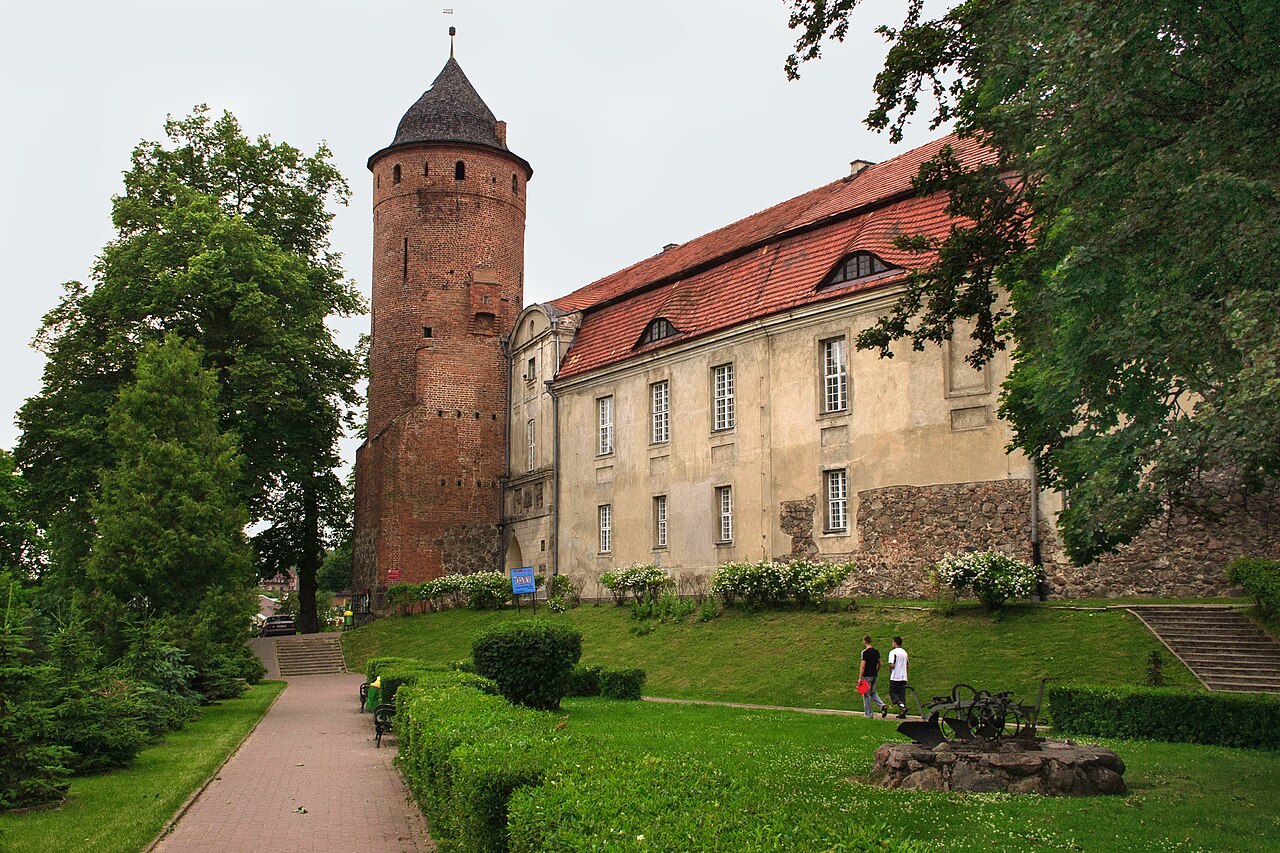
Lipie
Lipie castle stands as a remarkable example of a medieval bastioned fortress located in the village of Lipie, Poland. Its origins trace back to the late 13th century, a period marked by significant territorial and ecclesiastical power struggles in the region. The castle's strategic position atop a promontory with steep slopes encircled by the Mogilica river provided natural defense, making it a key stronghold in the High Medieval era.
Early history and strategic location
The site of Lipie castle was initially occupied in the early medieval period by a fortified settlement or gord, protected by a stone and earth rampart approximately 2.5 meters high. This early fortification exploited the natural defensive advantages of the terrain, situated on a peninsula of high ground with steep slopes reaching up to 25 meters. In 1277, the Pomeranian duke Barnim I sold Lipie, along with surrounding lands in the Kołobrzeg castellany, to the Bishop of Cammin, Herman von Gleichen. Recognizing the site's defensive potential, Bishop Herman likely initiated the construction of a castle, referred to in historical sources as "castrum Tharnhus."
Construction phases and architectural features
Archaeological investigations have not conclusively confirmed the initial castle structure, suggesting that the first fortification may have been primarily wooden. It is believed that the transition to a stone castle occurred in the mid-14th century. The earliest stone phase included a rectangular building measuring approximately 9.3 by 17.5 meters, constructed of stone and brick. This building likely functioned as a defensive residential tower, serving as a critical point of defense for the bishop's estates against Brandenburg incursions.
The castle was situated on a dry moat-cut promontory, with steep natural slopes providing formidable protection. In the early 16th century, during the tenure of Bishop Erasmus von Manteuffel, the castle underwent significant expansion. A surrounding curtain wall was added on the eastern side, enclosing a small courtyard measuring roughly 13.8 by 19.5 meters. The main gate was positioned in the southern wall, enhancing the fortress's defensive capabilities.
Historical significance and ownership changes
Throughout its history, Lipie castle was a focal point of regional power struggles. In 1387, the castle and town passed from the bishopric to the Pomeranian dukes as a result of conflict between Duke Bogusław VIII and the bishop. The castle's borderland location made it vulnerable to frequent attacks, including a devastating raid in 1444 by the Teutonic Knights from nearby Świdwin, who plundered both the town and castle.
In 1461, the fortress came under the control of Eggard von Manteuffel from Połczyn, and from 1521 to 1544, it served as the residence of Bishop Erasmus von Manteuffel. This period marked the castle's zenith, with renovations and fortifications reflecting its importance. Despite an attack in 1540 by forces led by the Bork family, the castle's defenses were quickly restored.
The decline began in 1572 when Lipie lost its town rights following a conflict involving the bishop's nephew, Kersten von Manteuffel. The castle and town gradually fell into decay, exacerbated by the Thirty Years' War (1618–1648), during which the settlement was destroyed and the population relocated to Połczyn.
Destruction and archaeological remains
By 1733, Lipie castle was completely demolished. In the mid-18th century, a palace was constructed approximately 150 meters east of the castle site, utilizing building materials salvaged from the castle ruins. Today, only scant archaeological remains survive, primarily the stone foundations of the defensive tower, located in the northwest part of Lipie village.
Archaeological research has been crucial in piecing together the castle's history, though the limited remains prevent a full reconstruction of its original appearance. Despite this, Lipie castle remains a significant example of a church feudal fortress from the late 13th century, illustrating the military and administrative strategies of ecclesiastical powers in medieval Pomerania.
Architectural and cultural importance
Lipie castle exemplifies the defensive architecture typical of High Medieval bastioned fortresses built by ecclesiastical authorities. Its location on a naturally fortified promontory, combined with man-made fortifications such as the dry moat and curtain walls, reflects sophisticated military engineering adapted to the landscape. The castle's role as a bishop's seat underscores the intertwining of religious and secular power during the Middle Ages.
Though now in ruins, the site offers valuable insights into the evolution of medieval fortifications and the regional history of Pomerania. The castle's connection to prominent historical figures and events enhances its cultural heritage significance, making it a subject of interest for historians, archaeologists, and visitors fascinated by medieval architecture and history.
Visiting and preservation
Currently, Lipie castle exists as an archaeological site with limited visible remains. Visitors interested in medieval architecture and history can explore the area to appreciate the natural defensive features and the archaeological foundations uncovered. Preservation efforts focus on protecting the site from further degradation, ensuring that this important cultural landmark endures for future study and appreciation.
Frequently asked questions (FAQ)
- When was Lipie castle originally built?
- Lipie castle was originally constructed in 1277, with initial wooden fortifications likely predating the stone structures built in the mid-14th century.
- What defensive features did Lipie castle have?
- The castle was strategically located on a promontory with steep slopes and surrounded by a dry moat, featuring stone and brick walls and a curtain wall enclosing a courtyard.
- Who owned Lipie castle during its peak?
- During its peak, Lipie castle was owned by the bishops of Cammin, notably Bishop Erasmus von Manteuffel in the early 16th century, who expanded and fortified the castle.
- What caused the decline of Lipie castle?
- The castle declined after losing town rights in 1572 due to local conflicts, and further suffered destruction during the Thirty Years' War, leading to its eventual demolition in 1733.
- Are there any remains of Lipie castle today?
- Today, only archaeological remains such as stone foundations of the defensive tower survive, located in the northwest part of Lipie village.
Information
Loading map...
Visitor reviews
No reviews yet. Been here? Write the first review and help other travelers!
Write the first reviewVisited this castle? Share your experience
Your review helps other travelers and adds first-hand knowledge to our encyclopedia.