Lewes Castle
Lewes Castle is a remarkable medieval fortress located in the historic town of Lewes, East Sussex, England. Known originally as Bray Castle, it occupies a commanding position on an artificial hill just north of the town’s main street. The castle overlooks the strategic passage through the South Downs, shaped by the course of the River Ouse and the nearby settlements of Lewes and Cliffe. Constructed primarily of local limestone and flint, the castle’s robust stonework reflects the regional building traditions and the evolution of medieval military architecture.
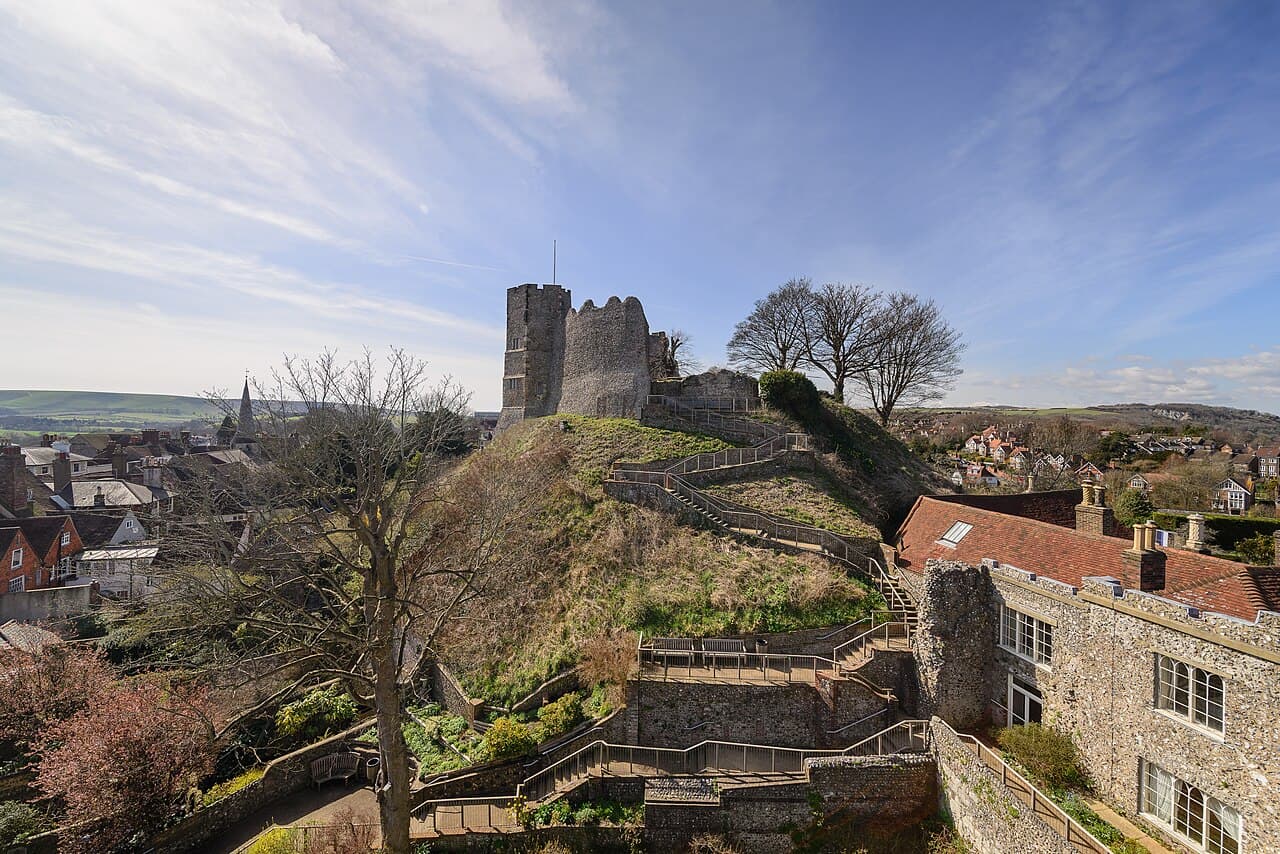
One of the most distinctive features of Lewes Castle is its dual-motte design, a rarity in England shared only with Lincoln Castle. The two mottes, known as Brack Mount and the Keep, were constructed shortly after the Norman Conquest of 1066 by William de Warenne, 1st Earl of Surrey. These earthwork mounds initially supported wooden palisades, which were soon replaced by stone shell keeps in the early 12th century. These circular stone walls enclosed the summits of each motte, creating formidable defensive strongholds.
Early construction and architectural evolution
The initial phase of construction began in the late 11th century, with the building of the two mottes to secure the strategic gap in the South Downs. The first motte, Brack Mount, was completed soon after 1066, followed by the second motte, the Keep, towards the end of the century. These mottes were originally protected by wooden palisades and timber structures, which were common in early Norman fortifications.
By the early 12th century, the wooden defenses were replaced by more durable stone structures. The stone shell keeps were built as circular curtain walls atop the mottes, providing a secure enclosure for defenders and enhancing the castle’s resilience against siege warfare. Simultaneously, the bailey—the enclosed courtyard area—was fortified with a stone curtain wall and equipped with defensive towers at intervals, reflecting advancements in castle design and the increasing importance of stone fortifications during the High Medieval period.
13th and 14th century enhancements
Throughout the 13th century, Lewes Castle underwent further military improvements. Additional defensive towers were added to one of the shell keeps, increasing its capacity for surveillance and defense. In the 14th century, a barbican gate was constructed, serving as an outer fortified gateway to enhance the security of the main entrance. These additions demonstrate the castle’s ongoing strategic relevance and adaptation to evolving military technologies and threats.
Historical significance and notable events
Lewes Castle played a prominent role in the political and military history of medieval England. Most notably, in 1264, troops stationed at the castle marched to join Simon de Montfort at the Battle of Lewes. This battle was a pivotal conflict during the Second Barons' War, resulting in the defeat and capture of King Henry III and his son Edward. The victory significantly influenced the development of parliamentary governance in England, marking Lewes Castle as a site of considerable historical importance.
Ownership of the castle passed through distinguished noble families over the centuries. The last de Warenne earl, John de Warenne, died without heirs in 1347. His title and estates, including Lewes Castle, were inherited by his nephew, Richard FitzAlan, 10th Earl of Arundel. John de Warenne was buried at the nearby Lewes Priory, underscoring the castle’s connection to regional religious institutions.
Later history and preservation efforts
By the 19th century, Lewes Castle’s military significance had diminished, and the fortress transitioned into a historic monument. In 1850, the Sussex Archaeological Society leased the castle, initiating efforts to preserve and study the site. Later, in 1922, Charles Thomas-Stanford, a local benefactor, purchased and donated the castle to the society, ensuring its protection and public accessibility.
Despite careful maintenance, the castle faced challenges in recent years. On 11 November 2019, a significant event occurred when a 10-by-10 meter section of the castle’s original stone curtain wall collapsed onto an adjacent house and garden. Weighing approximately 600 tonnes, this section was privately owned and separate from the areas managed by the Sussex Archaeological Society. Fortunately, no casualties resulted from the collapse. The incident highlighted the ongoing need for preservation and structural monitoring of historic castle remains.
Architectural features and surviving remains
Lewes Castle’s surviving structures offer a vivid illustration of Norman and medieval military architecture. The two mottes remain prominent features, with their circular stone shell keeps providing insight into early 12th-century defensive strategies. The surrounding stone curtain walls and defensive towers reveal the castle’s layered fortifications designed to withstand sieges and attacks.
The barbican gate added in the 14th century remains a significant architectural element, demonstrating the evolution of castle entrances from simple gateways to complex defensive structures. The use of local limestone and flint in construction not only provided strength but also linked the castle aesthetically to the surrounding landscape.
Today, Lewes Castle stands as a well-documented archaeological site and popular tourist attraction. The visible remains of the dual mottes, shell keeps, curtain walls, and barbican gate collectively narrate the castle’s story from its Norman origins through centuries of military and political change. The site offers visitors a tangible connection to England’s medieval past and the architectural ingenuity of Norman fortifications.
Visitor information and cultural significance
Lewes Castle is managed by the Sussex Archaeological Society and is open to the public, offering a unique opportunity to explore one of England’s rare dual-motte castles. Visitors can appreciate the castle’s strategic location overlooking the South Downs and learn about its role in significant historical events such as the Battle of Lewes.
The castle’s preservation as a heritage site underscores its importance in England’s cultural landscape. Educational programs and guided tours help contextualize the architectural features and historical narratives, making Lewes Castle a valuable resource for understanding medieval fortifications and regional history.
Frequently asked questions (FAQ)
- How do I get to Lewes Castle?
- Lewes Castle is located in the town of Lewes, East Sussex, easily accessible by car or public transport. The nearest train station is Lewes railway station, a short walk from the castle.
- What are the opening hours of Lewes Castle?
- Lewes Castle is generally open to visitors daily during the warmer months, typically from 10:00 to 17:00. It is advisable to check the Sussex Archaeological Society website for seasonal variations and special closures.
- Is there an admission fee to visit Lewes Castle?
- Admission fees apply to enter Lewes Castle, with discounts available for children, seniors, and groups. Tickets can be purchased on-site or online through the Sussex Archaeological Society.
- What makes Lewes Castle architecturally unique?
- Lewes Castle is architecturally unique due to its rare dual-motte design, a feature shared only with Lincoln Castle in England. This design includes two stone shell keeps atop separate mottes, surrounded by curtain walls and defensive towers.
- Can I explore the entire castle grounds?
- Visitors can explore the main areas of Lewes Castle, including the dual mottes, curtain walls, and barbican gate. Some areas may be restricted for safety reasons, especially following the 2019 wall collapse.
- What historical events is Lewes Castle known for?
- Lewes Castle is known for its role in the 1264 Battle of Lewes, where troops from the castle fought alongside Simon de Montfort, leading to a significant shift in English governance.
- Is Lewes Castle suitable for families and children?
- Yes, Lewes Castle is suitable for families, offering educational programs and safe pathways for children to explore the historic site while learning about medieval history.
Photo gallery

Information
Sources & official resources
Verify the information above using these authoritative references.
Loading map...
Visitor reviews
No reviews yet. Been here? Write the first review and help other travelers!
Write the first reviewVisited this castle? Share your experience
Your review helps other travelers and adds first-hand knowledge to our encyclopedia.