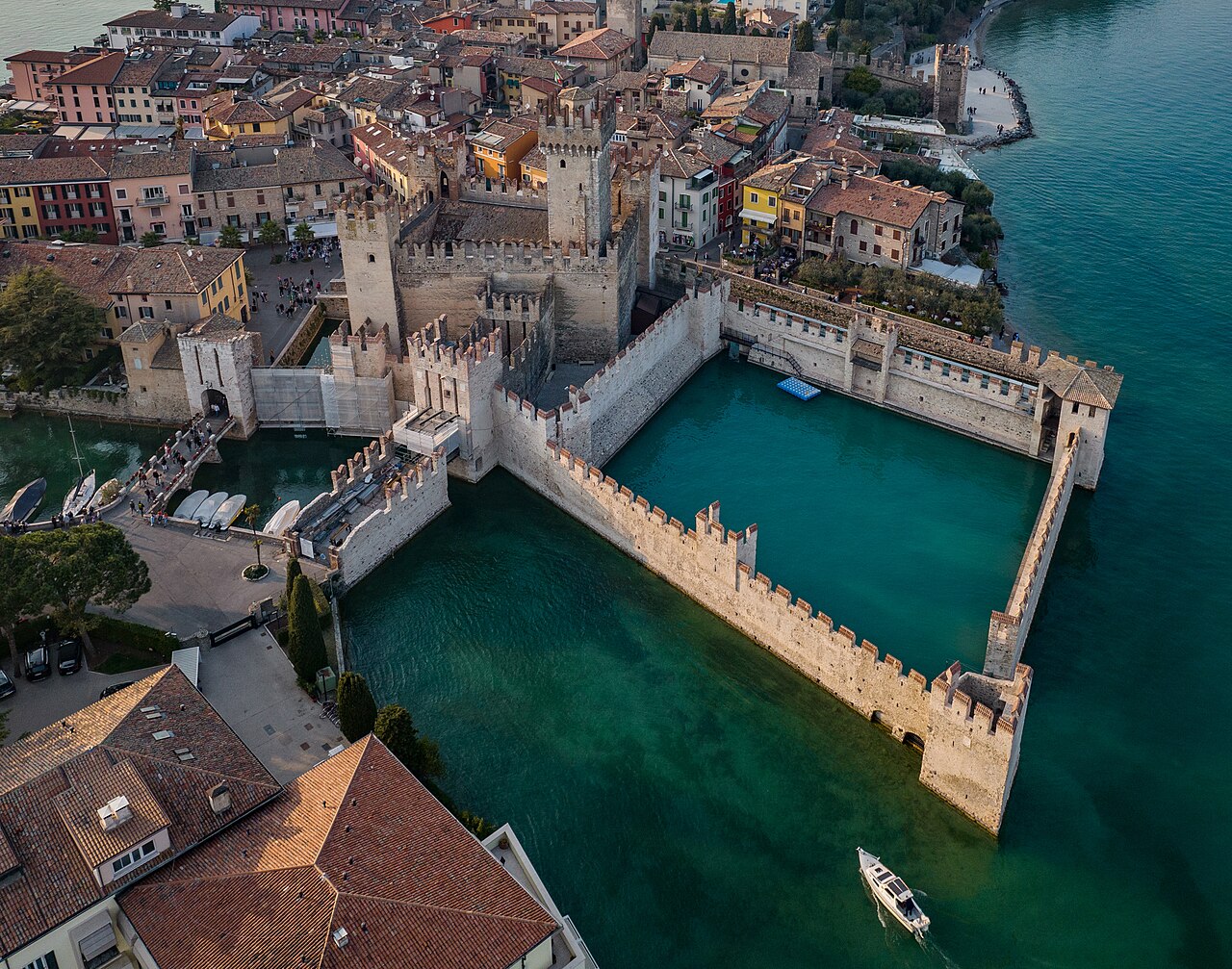
Lazise Castle
Lazise Castle, also known as Castello Scaligero di Lazise, is a striking medieval fortress located in the town of Lazise on the eastern shore of Lake Garda in the Veneto region of Italy. This castle, with its imposing walls and towers, stands as a testament to the military and political significance of the area during the Middle Ages. Its history spans from early medieval origins through the rule of the powerful Scaligeri family to its transformation in the 19th century into a romantic garden setting.
The earliest known references to Lazise date back to between 888 and 961 AD, when the settlement was recognized as a "free villa," meaning it was not subject to feudal control. During this early medieval period, the inhabitants constructed initial defensive works to protect against incursions, particularly from Hungarian invasions. A significant boost to Lazise’s fortifications came in 983 AD when Holy Roman Emperor Otto II granted privileges that allowed the community to complete its defenses.
By the late 12th century, Lazise and its castle came under the jurisdiction of the Comune of Verona. Shortly thereafter, control passed to the Scaligeri dynasty, also known as the Della Scala family, who ruled Verona and its territories from the 13th to 14th centuries. The Scaligeri were instrumental in strengthening the castle and town defenses, particularly under the leadership of Alberto II and Mastino II della Scala. Around 1329, they enhanced the fortifications by adding approximately twenty shielded towers, a formidable defensive feature for the period.
The Scaligeri fortification and architectural features
The most significant construction phase of Lazise Castle occurred between 1375 and 1381 under the direction of Cansignorio della Scala and his successors Antonio and Bartolomeo II della Scala. This phase transformed Lazise into a key fortified outpost within the western defensive network protecting Verona and its territories. The castle was integrated with the town walls, forming a unified defensive system.
The castle’s layout is characterized by two adjoining rectangular enclosures. The larger enclosure faced the lake and functioned as a military port, while the smaller inner courtyard served as the defensive core of the fortress. The walls were reinforced by six shielded towers—four at the corners and two along the longer sides—providing overlapping fields of fire and robust protection.
A prominent feature of the castle is the keep (mastio), a massive brick tower resting on a two-meter-high stone base. The upper section of the keep is crowned by a battlemented hanging structure with machicolations—openings through which defenders could drop projectiles or boiling liquids on attackers. This architectural detail is supported by three stone corbels. The keep’s entrance was accessible via a small drawbridge connected to the wall walk, leading to staircases and trapdoors that provided access to prison cells and upper floors. The base of the keep housed the residence of the castellan (castle governor) and militia barracks adjacent to the curtain wall.
The castle’s walls feature vaulted masonry supporting battlemented terraces, allowing soldiers to patrol and defend the fortress effectively. Wooden structures within the walls created intermediate floors for additional defensive positions and living quarters. Surrounding the castle is a wide water-filled moat reinforced by a stone counterscarp, adding another layer of defense. An additional moat with its counterscarp protected the inland side.
Town walls and gates
The town of Lazise was protected by substantial walls, mostly intact today except for some sections along the north and west. These walls included roughly twenty shielded towers and three main gates: Porta Nuova (Porta Cansignorio), built between 1375 and 1376; Porta Superiore (San Zeno), dating likely to the early medieval period; and Porta Lion at the southern edge, which bore the emblem of the Venetian Republic, the Serenissima. The gates were fortified with portcullises and drawbridges over the moats, although these features have mostly vanished today.
Historical significance and military role
During the 13th and 14th centuries, the Scaligeri family controlled Verona and sought to dominate Lake Garda and its trade routes. To this end, they rebuilt and constructed several castles around the lake, including Lazise, Malcesine, Torri del Benaco, Riva, and Sirmione. Lazise Castle was a vital part of this defensive network, ensuring control over the lake and providing protection for commerce and local populations.
The castle and town endured several notable sieges and conflicts. In 1387, it was attacked by the forces of Gian Galeazzo Visconti, Francesco I Gonzaga, and Francesco I da Carrara. Later, in 1439, Venetian troops led by Francesco Sforza and the condottiero Gattamelata besieged Lazise during campaigns against Visconti's forces. In 1528, the Duke of Brunswick assaulted the castle, targeting the Venetian captain Nicolò Barbaro stationed there.
After the fall of the Scaliger dynasty in 1387, Lazise passed to the Visconti of Milan and later, in 1405, to the Republic of Venice following the War of Padua. Under Venetian rule, Lazise became the most important village on the Veronese shore of Lake Garda. The castle was used as a residence for Venetian magistrates and hosted two fully armed galleons anchored at the military port, underscoring its strategic maritime role.
By the end of the 16th century, the castle’s military importance declined. Venice gradually handed over control of the fortress to Lazise and local noble families. During the Hapsburg occupation, the fortress was sold to private owners at a low price and was partially dismantled, with stones repurposed for local construction.
19th-century transformation and current status
In the 19th century, Count Giovanni Battista Buri acquired the castle and undertook significant restoration and landscaping efforts. He transformed the castle ruins and the surrounding area into a romantic garden known as Villa Buri Bernini. This garden combined medieval architectural charm with natural beauty, incorporating large trees such as sequoias, wellingtonias, and magnolias, and an artificial promontory called "la mara," made from stones salvaged from demolished walls and towers.
During these modifications, parts of the outer curtain wall and some lakeside towers were dismantled or buried, and the military dock was almost entirely filled in to create a park-like setting. The castle thus transitioned from a military fortress to a picturesque garden ornament.
Today, Lazise Castle is privately owned and not open to the public. However, its towering ruins and the remaining sections of the town walls can be viewed from various points in Lazise. The castle remains a prominent landmark on Lake Garda’s eastern shore, symbolizing the region’s rich medieval heritage and its evolution through centuries of political and military change.
Architectural style and condition
The castle exemplifies Gothic military architecture typical of the late medieval period, with its rectangular plan, fortified towers, battlements, and defensive moats. The integration of the castle with the town walls and the military port reflects the strategic importance of Lazise in controlling Lake Garda’s trade and defense.
Currently, the castle is in a partially preserved state, with significant portions of the walls, towers, and the keep surviving, though some sections have been altered or lost due to 19th-century landscaping and earlier dismantling. The romantic garden setting adds a unique layer to the castle’s historical narrative.
Visiting information
While the castle itself is not accessible to visitors due to private ownership, the town of Lazise offers many vantage points from which to admire the castle’s impressive silhouette against the backdrop of Lake Garda. The surrounding historic town center, with its medieval walls and gates, provides a rich cultural experience for visitors interested in the region’s history and architecture.
Frequently asked questions (FAQ)
- When was Lazise Castle built and by whom?
- Lazise Castle was primarily constructed between 1375 and 1381 by the Scaligeri family, who ruled Verona and sought to fortify Lake Garda's shores.
- Is Lazise Castle open to the public for visits?
- No, Lazise Castle is privately owned and not open to the public. However, it can be viewed from various points around the town.
- What architectural features characterize Lazise Castle?
- The castle features a rectangular plan with five square towers, a high slender keep with machicolations, battlemented terraces, and a moat with stone counterscarps.
- What was the strategic importance of Lazise Castle historically?
- Lazise Castle was a key defensive and trading port on Lake Garda, controlling trade routes and serving as a fortified outpost for the Scaligeri and later Venetian rule.
- How did the castle change during the 19th century?
- In the 19th century, Count Giovanni Battista Buri restored the castle ruins and transformed the grounds into a romantic garden, filling in the military dock and altering some medieval features.
Information
Current owner
Private owner
Address
Via Pra' del Principe 12, Lazise, Italy
Loading map...
Visitor reviews
No reviews yet. Been here? Write the first review and help other travelers!
Write the first reviewVisited this castle? Share your experience
Your review helps other travelers and adds first-hand knowledge to our encyclopedia.