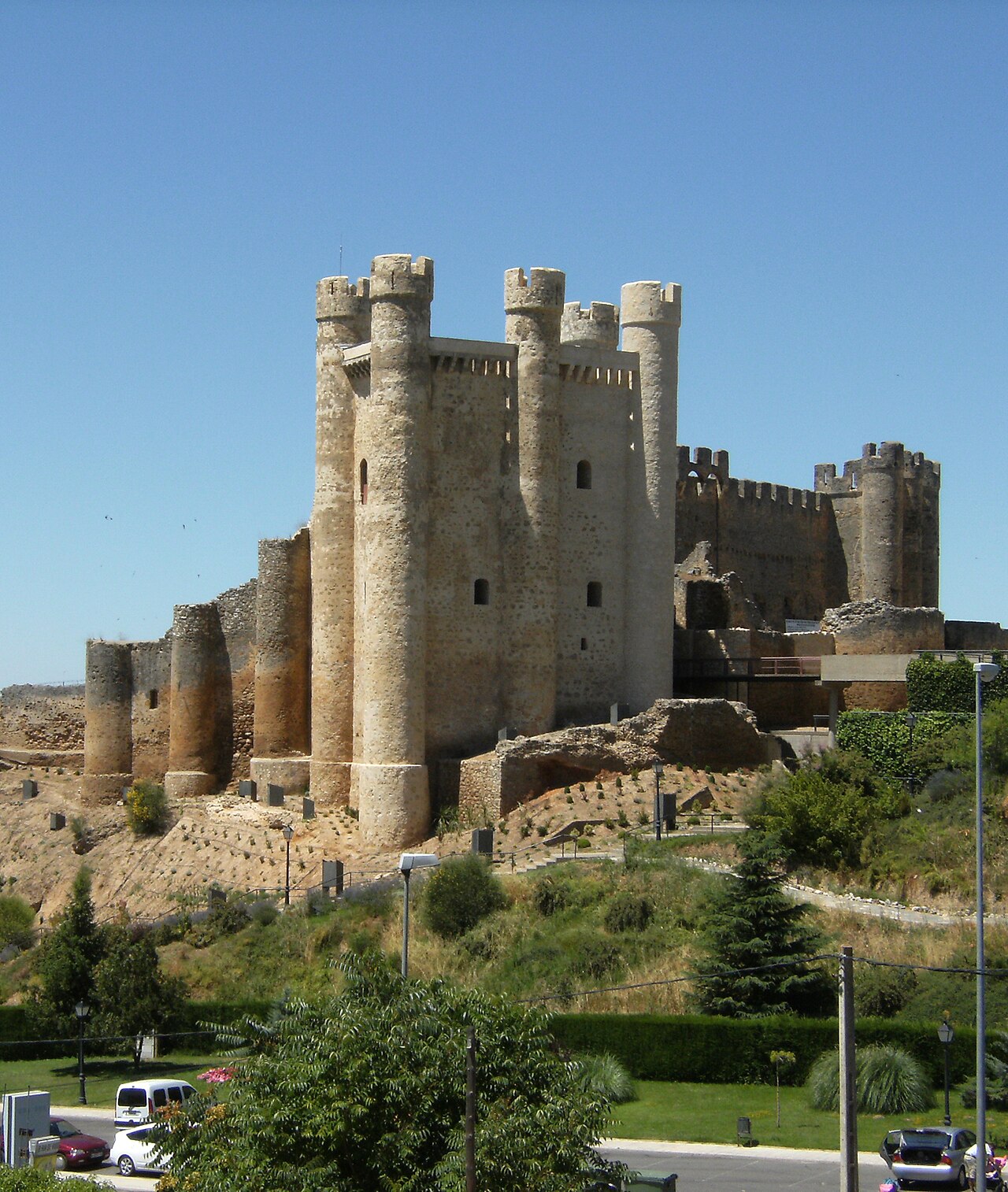
Laguna de Negrillos Castle
The Castle of Laguna de Negrillos stands as a significant medieval fortress located in the municipality of Laguna de Negrillos, Spain. This hill castle was originally constructed in the 13th century during the High Medieval period, serving both military and residential purposes. Strategically positioned near the important Vía de la Plata route, it played a crucial role in the Christian Kingdom of León's efforts to secure and expand its southern borders.
The fortress is notable for its square-trapezoidal layout, built primarily with masonry walls using lime mortar and river cobblestones, while the corners feature ashlar stone blocks that provide structural strength. The castle's most prominent architectural feature is its five-story keep tower, known as the torre del homenaje, which retains its original battlements and stands as the best-preserved element of the complex. Additional defensive structures include the queen's tower at the northeast corner and two round towers or cubos at the southeast and southwest corners, with the southwest tower referred to as the valley tower.
Historical context and significance
The castle was first documented in 1205 when King Alfonso IX of León granted the local community a charter, confirming the existence of the fortress and the town's defensive walls. Its location near the Vía de la Plata made it a vital military base for the king's campaigns, including attempts to extend influence into Castile after the death of King Enrique I. The fortress's strategic importance is further highlighted by its association with prominent nobles such as Nuño Froilaz and later the Quiñones family.
Following the unification of León and Castile in 1230, the castle's military role diminished, and it transitioned into private ownership. In the 14th century, it was held by Doña María Fernández, a caretaker to Queen María and the Infanta Isabel. By the late 14th century, ownership passed to the Quiñones family through a complex inheritance and financial arrangement documented in 1388.
Architectural evolution and noble residence
In the 15th century, the castle underwent significant transformation under Diego Fernández de Quiñones and María de Toledo, parents of the famed knight Suero de Quiñones. They remodeled the fortress into a castle-palace that balanced defensive features with residential comforts, reflecting the changing role of castles during the late medieval period. Suero de Quiñones famously used the castle as his residence after his celebrated Passo Honroso tournament before embarking on a pilgrimage to Santiago de Compostela.
The castle also became a center of noble resistance against royal authority during the mid-15th century, notably in 1448 when King Juan II of Castile intervened to quell uprisings. This period underscores the fortress's role not only as a military stronghold but also as a symbol of noble power and autonomy.
Structural features and defensive elements
The castle's defensive architecture includes crenellated walls, arrow slits (saeteras), and multiple flanking towers designed to provide overlapping fields of fire. The main entrance is positioned on the western side, elevated approximately 1.5 meters above the adjacent plaza level to control access effectively. A narrow adarve or wall-walk once allowed defenders to move along the curtain walls, with remnants still visible along the northern and western faces.
Sanitation was addressed through the inclusion of latrines integrated into the walls, a common feature in medieval fortifications. The castle's layout and fortifications reflect typical High Medieval military architecture in the Kingdom of León, combining robust defense with residential functionality.
Modern history and conservation efforts
Designated as a site of cultural interest on April 22, 1949, the Castle of Laguna de Negrillos has been recognized for its historical and architectural significance. Despite this status, the fortress suffered from neglect in the late 20th century, leading to structural deterioration and partial collapse of some sections.
In 2008, the castle was listed on Hispania Nostra's Red List of Heritage at Risk and included in the European Cultural Heritage Protection Inventory as number 26. Conservation efforts initiated in 2009 focused on stabilizing vulnerable structures, particularly the valley tower, and installing a Gothic arch door on the main facade to enhance both preservation and historical authenticity.
Today, the castle remains a visible testament to its dual role as a medieval fortress and noble residence. Its ruins continue to attract interest for their architectural features and historical associations, underscoring the importance of ongoing preservation to safeguard this cultural heritage site.
Visitor experience and significance
Visitors to Laguna de Negrillos Castle can explore the remains of the square-trapezoidal fortress, including the imposing keep tower and surviving sections of the defensive walls and towers. The castle's location on a hill overlooking the town and nearby stream offers scenic views and a tangible connection to the region's medieval past.
The site provides valuable insights into the military architecture of the Kingdom of León and the lifestyle of the noble families who inhabited the fortress. Despite its ruined condition, the castle's preserved elements and recent restoration work allow visitors to appreciate its historical context and architectural evolution.
Frequently asked questions (FAQ)
- What is the historical significance of Laguna de Negrillos Castle?
- Laguna de Negrillos Castle, dating back to the 15th century, played a crucial role in the defense of the region during the Reconquista. Its strategic location allowed it to serve as a lookout point against invasions and as a residence for local nobility, reflecting the architectural styles of its time.
- When is the best time to visit Laguna de Negrillos Castle?
- The best time to visit is during the spring and fall months when the weather is mild and pleasant for outdoor exploration. Additionally, these seasons offer fewer crowds, allowing for a more intimate experience of the castle and its surroundings.
- Can I access Laguna de Negrillos Castle with a wheelchair?
- While efforts have been made to improve accessibility at Laguna de Negrillos Castle, some areas may still pose challenges for wheelchair users due to the historical nature of the site. It is advisable to contact the castle’s management ahead of your visit to inquire about specific accessibility options.
- What are the opening hours for Laguna de Negrillos Castle?
- Laguna de Negrillos Castle is typically open to visitors from 10 AM to 6 PM, Tuesday through Sunday. However, it is recommended to check the official website or contact the castle directly for any seasonal variations or holiday closures.
- Is it possible to take guided tours of the castle?
- Yes, guided tours are available at Laguna de Negrillos Castle, providing visitors with in-depth knowledge of its history and architecture. These tours often include access to areas that may not be open to the general public, enhancing the overall experience.
- What are the ticket prices for Laguna de Negrillos Castle?
- Ticket prices for Laguna de Negrillos Castle are generally affordable, with discounts available for students and seniors. Family packages may also be offered, making it an economical choice for visitors looking to explore this historical site.
- Are there any nearby attractions to visit after touring the castle?
- Yes, after visiting Laguna de Negrillos Castle, you can explore several nearby attractions, including local museums and picturesque parks. The area also offers charming restaurants and shops where you can experience the local culture and cuisine.
Information
Loading map...
Visitor reviews
No reviews yet. Been here? Write the first review and help other travelers!
Write the first reviewVisited this castle? Share your experience
Your review helps other travelers and adds first-hand knowledge to our encyclopedia.