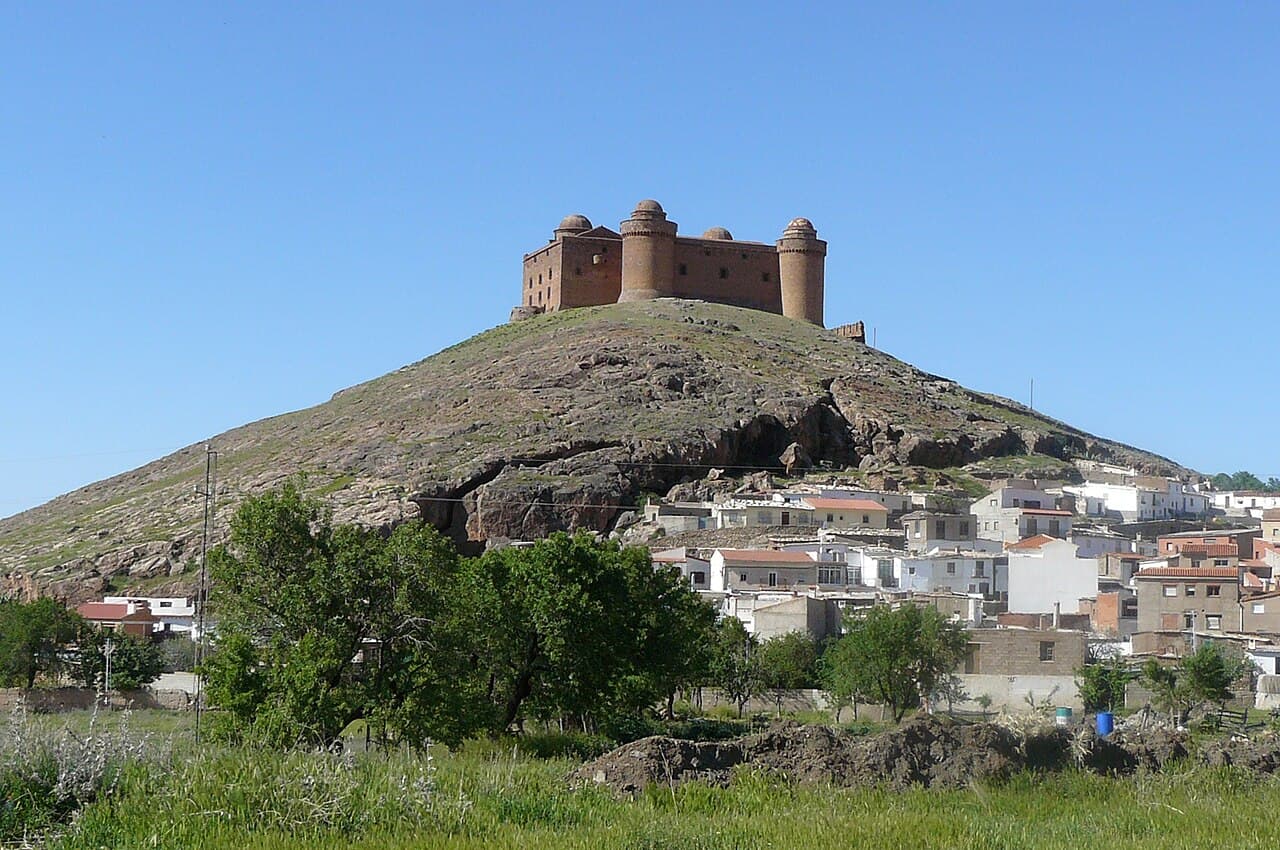
La Calahorra Castle
La Calahorra Castle, also known as Castillo de La Calahorra, stands prominently on a hill near the village of La Calahorra in the province of Granada, Andalucia, Spain. This imposing hill castle is a remarkable example of the transition from medieval fortress to Renaissance palace, reflecting the turbulent history and cultural shifts of the Iberian Peninsula during the late 15th and early 16th centuries.
The site originally hosted a medieval fortress of Moorish origin, which was later integrated into the Christian domains following the Reconquista. The castle's early history is intertwined with the complex social and political changes of the period, including the conversion of local Moors to Christianity and the redistribution of lands and fortifications by the Catholic Monarchs. In 1490, Queen Isabella I and King Ferdinand II granted the castle to Grand Cardinal Pedro González de Mendoza as a reward for his loyal service, marking the beginning of a significant transformation of the structure.
Historical evolution and ownership
After the cardinal's death in 1495, his son, Don Rodrigo Díaz de Vivar y Mendoza, the Marquess of Cenete, inherited La Calahorra Castle. Don Rodrigo's colorful life, including his travels to Italy and controversial marriages, influenced the castle's development. His relationship with Maria de Fonseca led to the castle's conversion from a fortress into a luxurious Renaissance residence between 1509 and 1512. This transformation was overseen by the architects Lorenzo Vázquez from Segovia and Michele Carlone, a Genoese architect, who introduced Italian Renaissance elements and imported Carrara marble, making La Calahorra one of the earliest examples of Renaissance architecture on the Iberian Peninsula.
Architectural features and Renaissance influence
The castle's design reflects a blend of medieval military architecture and Renaissance aesthetics. It has a rectangular ground plan with four large cylindrical towers at each corner, some measuring up to 13 meters in diameter, capped with domes. The walls are constructed from local stone ashlar, featuring few openings for defense. The main entrance, located at the northeast corner, retains its original wooden door reinforced with iron, adorned with the coats of arms of the Fonseca and Mendoza families, and bears a Latin inscription highlighting the castle's guardianship role.
Inside, the castle centers around a spacious courtyard with two levels of open galleries supported by Corinthian columns and decorated with intricate rib vaults and floral carvings. The galleries feature heraldic reliefs and Latin inscriptions that celebrate the castle's patron and his ideals. The use of iron tie rods from Valencia to counteract structural pressures was innovative for its time in Spain.
The interior rooms are richly ornamented, with doorways and halls displaying a variety of Renaissance motifs, including mythological figures, grotesques, and classical iconography. Notable rooms include the Sala de la Justicia, Salón de Occidente, and Salón de los Marqueses, each showcasing elaborate decorations that blend artistic techniques such as chiaroscuro and horror vacui.
Role during the Morisco Revolt and later history
During the Morisco Revolt (1568-1571), La Calahorra Castle served as a refuge for local Christians and a military garrison, underscoring its strategic importance in the border region of the Marquesado del Cenete. After this turbulent period, the castle was largely abandoned for centuries, reflecting the decline of feudal fortresses in Spain.
In the early 20th century, the castle was nearly dismantled and transported to the United States but was instead acquired by Spanish nobility, preserving its structure. Currently, it remains in private hands, with controlled access for visitors. Since April 2025, ownership has been transferred to the Diputación de Granada, ensuring its conservation and public engagement.
Significance and cultural heritage
La Calahorra Castle is significant as one of the earliest manifestations of Italian Renaissance architecture outside Italy, blending military and residential functions. Its preservation offers insight into the cultural exchanges between Spain and Italy during the Renaissance and the socio-political dynamics of post-Reconquista Spain. The castle's use as a filming location for productions such as "La casa del dragón" attests to its striking appearance and historical ambiance.
The castle's architectural innovations, including circular bastions, the integration of Renaissance decorative arts, and advanced structural techniques, mark it as a landmark in Spanish architectural history. Its survival despite royal decrees aimed at dismantling feudal strongholds highlights the influence of the Mendoza family and the castle's enduring legacy.
Architectural details and layout
- The fortress measures approximately 46.5 by 32 meters, with walls constructed from local stone ashlar.
- Four cylindrical towers at the corners provide defensive strength, with two southern towers about 10 meters in diameter and two northern towers about 13 meters.
- A rectangular wing along the west facade houses a circular artillery tower containing the main staircase, reflecting a shift toward residential comfort.
- The courtyard measures roughly 20 meters square, surrounded by two levels of arcaded galleries with Corinthian columns and rib-vaulted ceilings.
- Decorative elements include heraldic shields, Latin inscriptions, floral and mythological motifs, and finely carved stonework.
Visiting information
The exterior of La Calahorra Castle is freely accessible, offering visitors panoramic views of the surrounding Sierra Nevada mountains and the valley of the Marquesado del Cenete. Interior visits are limited and require prior arrangement with the current owners or their representatives. The castle's remote location and private ownership mean that opening hours and ticketing information may vary.
Visitors interested in Renaissance architecture, Spanish history, and military fortifications will find La Calahorra Castle a compelling destination. Nearby attractions include the historic town of Guadix and the natural beauty of the Sierra Nevada National Park.
Frequently asked questions (FAQ)
- How do I get to La Calahorra Castle?
- La Calahorra Castle is located near Calle Mirador de la Sierra in Spain. The nearest major city is Granada, and you can reach the castle by car in about an hour. Public transport options may be limited, so renting a vehicle is recommended for convenience.
- What is the historical significance of La Calahorra Castle?
- La Calahorra Castle, built in the 16th century, is an important example of Renaissance military architecture in Spain. It played a crucial role in the defense against pirates and invasions during its time. The castle also reflects the strategic importance of the region in the history of the Spanish Kingdom.
- When was La Calahorra Castle built?
- Construction of La Calahorra Castle began in 1509 and was completed in 1512. It was commissioned by the Spanish nobleman, Don Juan de Austria, to serve as a defensive stronghold. The castle's design showcases the military architectural trends of the early 16th century.
- Can I visit La Calahorra Castle?
- Yes, La Calahorra Castle is open to visitors throughout the year. Guided tours are available, allowing guests to explore its impressive architecture and learn about its history. It’s advisable to check the official website for any seasonal variations in visiting hours.
- Why is La Calahorra Castle famous for its architecture?
- La Calahorra Castle is renowned for its unique blend of Renaissance and Moorish architectural styles. The castle features a robust design with thick walls, angular towers, and stunning views of the surrounding landscape. Its architectural significance lies in its adaptation to the geographical and historical context of the region.
- Is it possible to access La Calahorra Castle for people with disabilities?
- La Calahorra Castle has made efforts to improve accessibility for visitors with disabilities. However, due to its historical structure, some areas may have limited access. It is recommended to contact the castle administration beforehand to inquire about specific accommodations.
- What are the opening hours for La Calahorra Castle?
- La Calahorra Castle typically opens from 10 AM to 6 PM, but hours may vary based on the season. It is closed on certain holidays, so it's best to check the official website for the most current information before planning your visit. Arriving early can enhance your experience by allowing you to enjoy the castle with fewer crowds.
- What are the ticket prices for La Calahorra Castle?
- Ticket prices for La Calahorra Castle are generally affordable, with discounts available for students and seniors. A typical adult ticket costs around €5, while children may enter for free or at a reduced rate. Keep an eye on special events, as they may offer unique pricing or free entry days.
- What nearby attractions can I visit after La Calahorra Castle?
- After visiting La Calahorra Castle, consider exploring the natural beauty of Sierra de Baza Natural Park, which is nearby. The charming village of La Calahorra also offers quaint cafes and local shops. Additionally, the city of Granada, with its stunning Alhambra, is just a short drive away and makes for an excellent day trip.
Photo gallery

Information
Website
Visit websiteSources & official resources
Verify the information above using these authoritative references.
Loading map...
Visitor reviews
No reviews yet. Been here? Write the first review and help other travelers!
Write the first reviewVisited this castle? Share your experience
Your review helps other travelers and adds first-hand knowledge to our encyclopedia.



