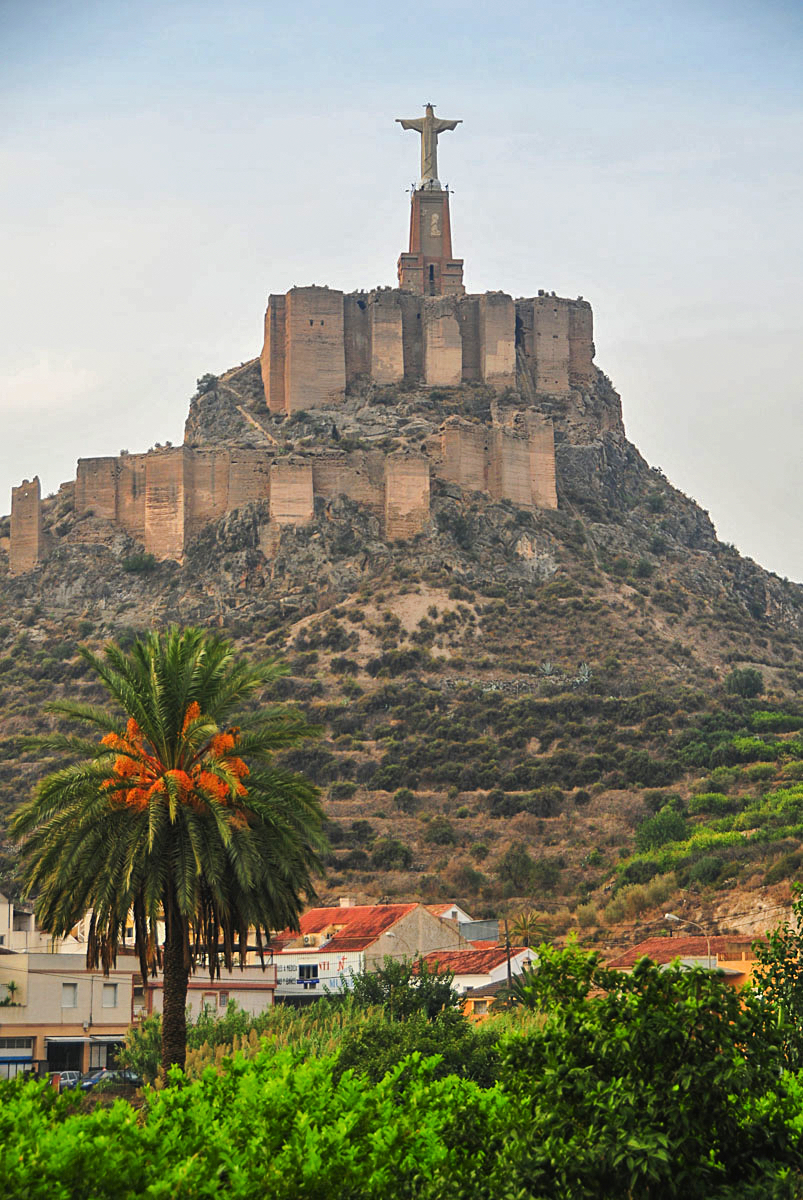
La Asomada Castle
La Asomada Castle, also known locally as Castillo de la Asomada, Castillo del Puerto de la Cadena, or Castillo del Morrón, is a significant medieval fortress perched atop a mountain overlooking the La Cadena pass, south of the city of Murcia in the Region of Murcia, Spain. This hill castle is an outstanding example of Muslim military architecture from the 12th century, embodying the strategic importance of controlling vital communication routes between the Mediterranean coast and the interior plains.
The castle was founded in the mid-12th century during the high medieval period, most likely under the auspices of Abu ʿAbd Allāh Muḥammad ibn Mardanis, known as the Wolf King, who was the Emir of the Taifa of Murcia. His reign marked the zenith of Muslim power in the region before the advancing Christian Reconquista. The fortress was built on a mountain approximately 532 meters above sea level, strategically positioned to guard the La Cadena pass, a crucial route connecting the cities of Murcia and Cartagena, thus enabling control over movement and trade.
Strategic location and historical significance
The castle's location atop the Cabezo del Puerto hill provided commanding views over the Segura valley and the surrounding terrain, making it an essential lookout point from the Mediterranean coast inland towards Murcia. Its elevated position allowed early detection of enemy movements and served as a defensive bastion during a turbulent period of fragmented Muslim rule known as the taifa era.
La Asomada was part of a broader defensive network that included nearby fortifications such as Castillo del Portazgo Inferior and Castillo del Portazgo Superior. These castles shared architectural characteristics and ceramic materials, indicating they were constructed simultaneously to secure the region and protect key communication corridors. This network was vital for maintaining Muslim control and resisting Christian advances.
Architectural features and construction details
The castle features a rectangular layout measuring approximately 65 by 48 meters, adapted to the mountain's topography. It was constructed primarily using tapia (rammed earth), a common building technique in Islamic architecture of the period, which involved compacting layers of earth to create thick, sturdy walls. The walls are reinforced by six rectangular towers, three on each of the longer sides, with turrets at the corners, providing both structural support and defensive capabilities.
Inside the enclosure lies a spacious square courtyard flanked by two rectangular wings divided into compartments, possibly intended as longitudinal rooms. However, the exact function of these rooms remains uncertain due to the castle's unfinished state. The main entrance is believed to have been located on the eastern side, adjacent to one of the towers, though no detailed doorway structures have survived.
Archaeological investigations have revealed that the castle was never completed, as evidenced by the absence of vaulted ceilings and the presence of only foundational elements such as leveling bases or plinths. This unfinished state is attributed to the Almohad invasion of Murcia in 1176, which interrupted construction and altered the region's political landscape.
Building materials and techniques
The use of argamassa, a compacted mixture applied directly to the foundation, was typical of Muslim fortifications in the Iberian Peninsula. This technique provided solid defensive walls that were both durable and economical. The castle's design reflects the "corner tower" concept, replacing singular square towers at each corner with paired rectangular towers at the ends of the curtain walls, enhancing defensive coverage.
Historical context and cultural importance
La Asomada Castle was constructed during the taifa period of Murcia, a time characterized by the fragmentation of former Caliphate territories into smaller Muslim principalities. The castle's builder, Ibn Mardanish, was a prominent figure who resisted Christian forces and sought to consolidate his power through fortifications like La Asomada.
Medieval texts from 1266, associated with the reign of Jaime I of Aragón, suggest that the castle may have served as a mausoleum for the emirs of Murcia. While archaeological excavations have not uncovered burial remains, this possibility underscores the castle's symbolic significance beyond its military role. It may have been intended as a royal pantheon, reflecting the status and prestige of the Murcian rulers.
Throughout its history, La Asomada has remained a cultural landmark and a symbol of Murcia's Islamic heritage. Its walls have witnessed centuries of political change, from Muslim rule to Christian conquest, and it continues to represent the region's layered past.
Current state and visitor experience
Today, La Asomada Castle is classified as a partially preserved fortress, with only foundational walls and some standing masonry remaining. The site is freely accessible to visitors, who can reach it via a dirt road leading up the mountain, followed by a short hike to the summit. The castle's remote location within the Carrascoy – El Valle natural park ensures a well-preserved natural setting, with Aleppo pine forests surrounding the ruins.
Although the castle lacks extensive architectural details due to its unfinished nature, its spectacular panoramic views over the Segura valley and the Mediterranean coast make it a popular destination for hikers and history enthusiasts. Trails through the pine forests offer opportunities to explore the natural environment alongside the historical site.
La Asomada Castle was declared a Site of Cultural Interest in 1985, reflecting its importance as a heritage monument. Preservation efforts focus on maintaining the archaeological integrity of the ruins while allowing public access. The limited restoration work respects the castle's incomplete state and the challenges posed by its hillside location.
Accessibility and visitor tips
- Visitors should be prepared for a moderate hike from the parking area, as the final approach involves walking on uneven terrain.
- There are no facilities on-site, so bringing water and sun protection is advisable, especially during summer months.
- The best time to visit is during spring or autumn when the weather is mild and the surrounding landscape is lush and green.
- Photography enthusiasts will appreciate the castle's elevated vantage point, which offers sweeping views ideal for landscape shots.
Archaeological research and ongoing studies
Archaeological investigations at La Asomada have provided valuable insights into Muslim fortification techniques and the historical context of the Taifa of Murcia. Excavations have helped clarify the castle's layout, construction methods, and unfinished state. However, the absence of burial remains leaves questions about the castle's possible role as a royal pantheon unresolved.
Research continues to explore the relationship between La Asomada and neighboring fortresses, aiming to better understand the defensive network that once protected the region. These studies contribute to a broader understanding of medieval Islamic architecture in Spain and the socio-political dynamics of the period.
In summary, La Asomada Castle stands as a remarkable testament to the high medieval Islamic military architecture in the Region of Murcia. Its strategic position, distinctive construction, and rich historical associations make it a valuable cultural and archaeological site, attracting visitors interested in history, architecture, and natural beauty.
Frequently asked questions (FAQ)
- What is the historical significance of La Asomada Castle?
- La Asomada Castle, located in Murcia, Spain, dates back to the 13th century and is a remarkable example of Moorish military architecture. It played a crucial role in the region's defense during the Reconquista and offers insight into the historical conflicts between Christian and Muslim kingdoms.
- When was La Asomada Castle built?
- La Asomada Castle was constructed in the late 1200s, primarily during the period of Muslim rule in Spain. Its strategic location was chosen for its commanding views over the surrounding landscape, making it a significant fortification of its time.
- Can I visit La Asomada Castle year-round?
- Yes, La Asomada Castle is open to visitors throughout the year. However, it is advisable to check specific opening hours and any seasonal variations before planning your visit to ensure a smooth experience.
- What are the opening hours for La Asomada Castle?
- The opening hours for La Asomada Castle vary by season, generally opening from 10 AM to 6 PM. During the summer months, the hours may extend, so it is best to verify the current schedule before your visit.
- Is La Asomada Castle accessible for visitors with disabilities?
- The accessibility of La Asomada Castle may be limited due to its historical structure and natural terrain. Visitors with mobility challenges are encouraged to contact the castle management in advance to inquire about available accommodations.
- What are the ticket prices for visiting La Asomada Castle?
- Admission to La Asomada Castle is typically very affordable, with a nominal fee for adults and discounts available for seniors and children. It is recommended to check the official website for the most current pricing and any special offers.
- When is the best time to visit La Asomada Castle?
- The best time to visit La Asomada Castle is during the spring and fall when temperatures are mild and pleasant for outdoor exploration. Additionally, these seasons often feature fewer crowds, allowing for a more enjoyable experience.
- Are there any nearby attractions to visit after La Asomada Castle?
- Yes, after visiting La Asomada Castle, you can explore nearby attractions such as the historic city of Murcia, known for its stunning cathedral and vibrant culture. The scenic landscapes of the surrounding countryside also offer opportunities for hiking and photography.
Information
Loading map...
Visitor reviews
No reviews yet. Been here? Write the first review and help other travelers!
Write the first reviewVisited this castle? Share your experience
Your review helps other travelers and adds first-hand knowledge to our encyclopedia.