Krasiczyn
Krasiczyn Castle stands as one of Poland's most remarkable examples of Renaissance defensive and residential architecture. Located in the village of Krasiczyn, this castle was built between 1594 and 1614 and reflects the grandeur and sophistication of Polish noble residences of the period. The castle's design harmoniously blends military fortification with elegant manor house features, making it a unique palazzo in fortezza that has survived centuries of turmoil and restoration.
The origins of Krasiczyn Castle date back to around 1540 when Jakub z Siecina, a nobleman from Mazovia, established a fortified manor near the village of Śliwnica. This early stronghold consisted of a wooden manor, defensive earthworks, and a moat, strategically situated on a small hill overlooking the San River valley. Jakub's descendants adopted the surname Krasicki, derived from the nearby village Krasice, and continued to develop the estate.
The renaissance transformation under the Krasicki family
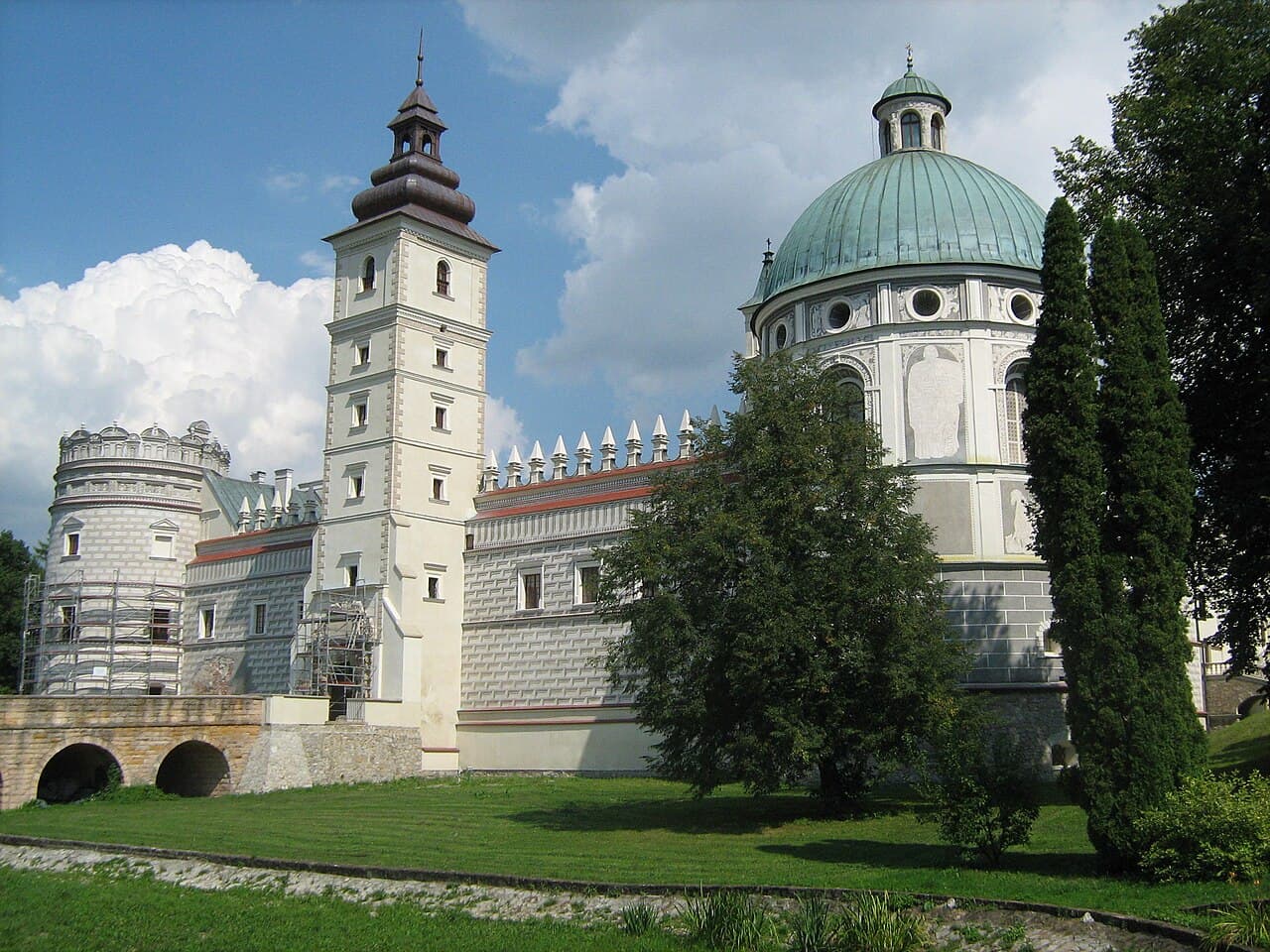
At the close of the 16th century, Stanisław Krasicki, son of Jakub and a marshal at the court of Queen Anna Jagiellonka, initiated a significant expansion of the family seat. The castle was transformed into a square-shaped fortress with four corner bastion towers, each equipped with artillery embrasures to defend the surrounding lands effectively. The northern and eastern walls incorporated residential wings, including a prominent new two-story eastern wing featuring the grand "Izba Stołowa Wielka Królewska" (Great Royal Dining Room).
The four corner towers were named to symbolize the eternal order of Church, Pope, King, and nobility: the Boska (Divine) tower to the southwest, the Papieska (Papal) tower to the northwest, the Królewska (Royal) tower to the northeast, and the Szlachecka (Noble) tower to the southeast. These towers were crowned with distinctive attics and decorative elements that reflected their symbolic roles. The Boska tower was later converted into a chapel, consecrated in 1618, and became a family crypt for the Sapieha family in the 19th century.
Architectural details and fortifications
The castle was surrounded by a wide moat and earth ramparts, with natural wetlands enhancing its defenses on the north and west sides. The main entrance was accessed via a drawbridge over the moat on the northern side, leading through a fortified gatehouse topped by a clock tower added in the early 17th century. This clock tower served as both a defensive structure and ceremonial gateway, featuring a richly decorated portal with the Rogala coat of arms and sculptural elements including volutes and carved heads.
The inner courtyard is enclosed by arcaded galleries (krużganki) and loggias, which added elegance and provided sheltered walkways. The castle's walls are famously adorned with extensive sgraffito decorations covering about 7,000 square meters. These artworks depict a wide array of subjects such as Roman emperors, Polish kings, Krasicki family members, hunting scenes, and Roman Catholic saints. The sgraffito technique involves scratching layers of plaster to reveal contrasting colors beneath, creating intricate and durable murals that are a highlight of the castle's artistic heritage.
Later history and challenges
After the death of Stanisław Krasicki, the castle was inherited by his son Marcin Krasicki, who completed the Renaissance transformation and solidified Krasiczyn as a magnificent magnate residence. However, the castle's fortunes fluctuated in subsequent centuries. In 1726, during political conflicts, it was attacked and heavily damaged by Russian and Cossack forces, resulting in the loss of interior furnishings and the destruction of the Papieska tower.
In the 18th century, ownership passed through various noble families, including the Modrzejewski and Tarło families, and later the Sapieha family, who acquired it in 1834. A devastating fire in 1852 destroyed much of the interior, sparing only the chapel in the Boska tower. Restoration efforts altered some architectural elements, such as the addition of a new gate passage and partial draining of the moat. The surrounding grounds were transformed into a landscaped park featuring rare tree species, with a tradition of planting oaks and lindens to commemorate family births.
20th-century events and preservation efforts
The castle suffered further damage during both World Wars, particularly during the Soviet occupation in World War II, when much of the interior decoration, including altars and sculptures, was destroyed. Post-war, the castle was nationalized and repurposed as a forestry school, and later came under the ownership of the Warsaw Automobile Factory in the 1970s.
Since the 1990s, the Industrial Development Agency of Warsaw has managed Krasiczyn Castle, undertaking extensive conservation and restoration projects to revive its historical character and architectural integrity. These efforts have included uncovering and preserving the sgraffito decorations, restoring the chapel, and maintaining the parklands. In 2018, Krasiczyn Castle was officially designated a Historic Monument of Poland, recognizing its cultural and architectural significance.
Architectural significance and visitor experience
Krasiczyn Castle exemplifies the Renaissance-Mannerist style with its harmonious blend of fortification and residential elegance. The castle's four bastion towers each carry symbolic meaning and architectural individuality, making it a rare example of a fortress designed to embody the social and religious order of its time.
The Boska tower, with its dome and chapel, is often compared to Kraków's Sigismund Chapel for its artistic value. The Papieska tower features elaborate sgraffito and was historically used to host high-ranking church dignitaries. The Królewska tower and Szlachecka tower housed royal and noble apartments, respectively, each crowned with decorative attics and symbolic crowns.
The castle's courtyard offers visitors a glimpse into Renaissance architectural design with its arcades, loggias, and richly decorated walls. The surrounding park, one of Poland's most valuable landscape parks, invites leisurely exploration among ancient trees and rare plant species. Nearby, the Swiss Pavilion connected by a secret passage and the Hunter’s Pavilion add to the estate's historical charm.
Today, Krasiczyn Castle is a popular tourist destination, offering guided tours that highlight its architectural splendor, historical narratives, and artistic treasures. Its well-preserved exterior and restored interiors provide an immersive experience into Poland's noble heritage and Renaissance artistry.
Frequently asked questions (FAQ)
- How do I get to Krasiczyn Castle?
- Krasiczyn Castle is located in the village of Krasiczyn in the Subcarpathian Voivodeship of Poland. It is accessible by car and local buses from nearby Przemyśl, which has train connections to major cities.
- What are the opening hours for visiting Krasiczyn Castle?
- The castle is generally open to visitors daily during the tourist season, with typical hours from 10:00 AM to 4:00 PM. It is advisable to check the official website or local tourist information for seasonal variations.
- Is there an admission fee to enter Krasiczyn Castle?
- Yes, there is a ticket fee for guided tours. Prices vary depending on age and group size, with discounts available for children, students, and seniors. Some special events may have separate pricing.
- What architectural style is Krasiczyn Castle built in?
- Krasiczyn Castle is a prime example of Renaissance-Mannerist architecture, featuring richly decorated sgraffito walls, bastion towers, and arcaded courtyards.
- Can I explore the castle grounds and park?
- Visitors are welcome to explore the extensive landscaped park surrounding the castle, which features rare tree species and historic pavilions such as the Swiss Pavilion and Hunter’s Pavilion.
- Why are the four towers named Boska, Papieska, Królewska, and Szlachecka?
- The towers are named to symbolize the eternal social and religious order: Boska (Divine) represents God, Papieska (Papal) the Pope, Królewska (Royal) the King, and Szlachecka (Noble) the nobility, reflecting the hierarchical structure of the time.
Photo gallery

Information
Sources & official resources
Verify the information above using these authoritative references.
Loading map...
Visitor reviews
No reviews yet. Been here? Write the first review and help other travelers!
Write the first reviewVisited this castle? Share your experience
Your review helps other travelers and adds first-hand knowledge to our encyclopedia.