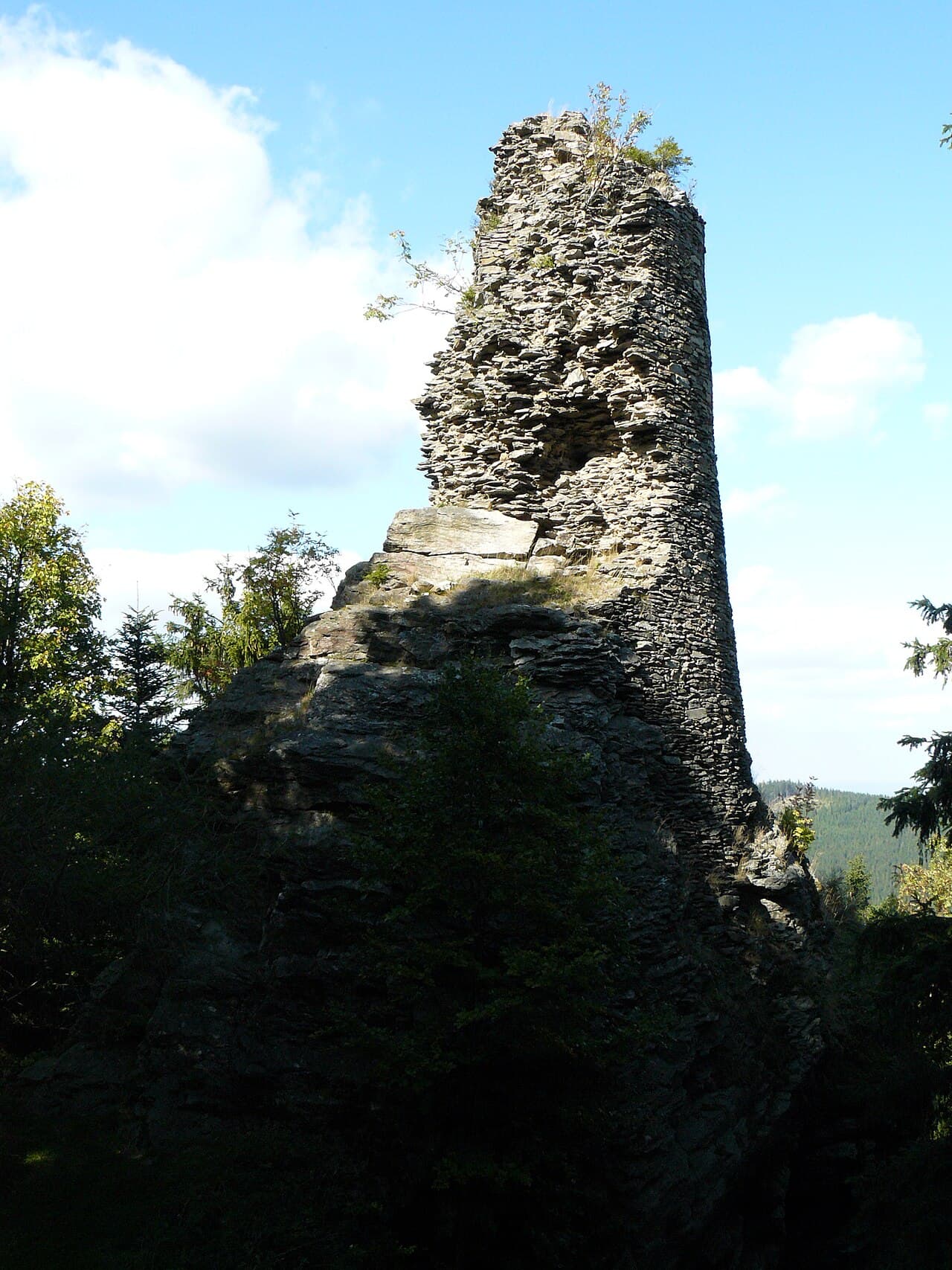
Korybut Castle
Korybut Castle stands as a historic hill castle ruin near the village of Rejvíz in the municipality of Zlaté Hory, Czechia. Constructed in the late 13th century, this fortress was originally established by a Silesian ruling family to secure a vital land passage between Zlaté Hory and Vrbno. The castle's strategic position on the slope of Zámecký vrch at approximately 912 meters above sea level allowed it to oversee the important merchant route running through the valley of the Černá Opava river. It also served a defensive role balancing the nearby fortress of Quinburk in Moravia and protecting the southern border of the Nisa principality.
Founding and early history
The castle was likely founded by Prince Bolek Svídnický at the end of the 13th century as a fortified stronghold. Its initial purpose was to control and defend key regional routes, reflecting the turbulent political landscape of the time. The castle's location on slate bedrock with quartz veins rising up to 25 meters provided natural defensive advantages that were integrated into its design.
Architectural development and modifications
Original construction features
The core of Korybut Castle was a large stone tower approximately 9 meters tall and 10 meters in diameter. The tower's interior was quadrilateral, an uncommon layout that distinguished it architecturally. It likely contained three levels, with a ground-level passageway that was unusual given the surrounding terrain. Access to the tower was primarily from its first floor, enhancing its defensibility.
The tower was surrounded by a courtyard enclosed by a stone curtain wall. This square courtyard initially housed a residential palace, indicating the castle's dual function as both a military stronghold and noble residence. The castle was protected by a double moat; the first moat ranged from 13 to 28 meters wide and 4 to 10 meters deep, likely supporting a wooden palisade as part of the early defensive system.
14th-century renovations under Mikuláš II Opavský
In the early 14th century, ownership transferred to the princes of Opava. Under Mikuláš II Opavský, the castle underwent significant rebuilding. A stairway annex was added to the main tower to improve vertical access. The outer defensive enclosure was renovated, including the construction of a new stone wall featuring a rounded bastion tower and a gate on the second earthwork. The residential palace was likely heightened during this period, and additional service buildings were added to the courtyard, expanding the castle's functionality.
Decline and later history
Sometime after 1400 and no later than the mid-15th century, Korybut Castle was abandoned. This decline coincided with regional conflicts, including the military campaigns of Matthias Corvinus, King of Hungary, which affected many castles in the region. By the 16th to mid-17th centuries, the deserted castle became a refuge for raubritters or robber knights, who exploited its isolated and fortified location.
The first written record mentioning the castle dates from 1687, describing it as deserted. No detailed chronicles or inscriptions survive to shed light on the castle's original inhabitants, leaving much of its history to archaeological interpretation.
Current remains and natural setting
Today, the ruins of Korybut Castle cover an area roughly 85 by 100 meters. The most prominent surviving feature is the substantial stone tower torso, which still conveys the castle's original scale and defensive strength. Nearby, a stone lookout point offers panoramic views of the village of Starý Rejvíz, the surrounding mountain landscapes, and on clear days, vistas extending into Poland.
The castle's setting on prominent slate bedrock with quartz veins has made it a favored site for modern rock climbers. Secured climbing routes and a summit register known as “Arbara viro” or “Lesní muž” are located on the tower remains, linking the medieval fortress to contemporary outdoor pursuits.
Architectural significance and heritage value
Korybut Castle exemplifies a hill castle typical of the late 13th century in the Silesian region, combining military fortification with residential elements. Its quadrilateral tower, double moat defenses, and subsequent 14th-century enhancements demonstrate evolving medieval castle architecture responding to changing military and domestic needs.
Though now in ruins, the site remains an important cultural landmark reflecting the complex history of borderland territories between Silesia, Moravia, and the Nisa principality. Its ruins offer valuable insight into medieval fortification strategies and regional power dynamics during the High medieval period.
Frequently asked questions (FAQ)
- How do I get to Korybut Castle?
- Korybut Castle is located near the village of Rejvíz in the municipality of Zlaté Hory. Visitors can reach the site by local roads and hiking trails from Zlaté Hory or nearby villages.
- What is the historical significance of Korybut Castle?
- Korybut Castle was a strategic fortress built in the late 13th century to protect key trade routes and regional borders. It played a defensive role during the High medieval period and reflects the architectural evolution of hill castles in Silesia.
- Can I visit the ruins of Korybut Castle?
- Yes, the ruins are accessible to the public. Visitors can explore the remains of the stone tower and curtain walls, as well as enjoy panoramic views from the nearby lookout point.
- When was Korybut Castle abandoned?
- The castle was abandoned sometime after 1400 and no later than the mid-15th century, likely due to regional conflicts and changing political circumstances.
- Is there any climbing activity at Korybut Castle?
- Yes, the castle's natural slate bedrock with quartz veins is popular among rock climbers. Secured climbing routes and a summit register are located on the tower remains.
Photo gallery

Information
Website
Visit websiteSources & official resources
Verify the information above using these authoritative references.
Loading map...
Visitor reviews
No reviews yet. Been here? Write the first review and help other travelers!
Write the first reviewVisited this castle? Share your experience
Your review helps other travelers and adds first-hand knowledge to our encyclopedia.


