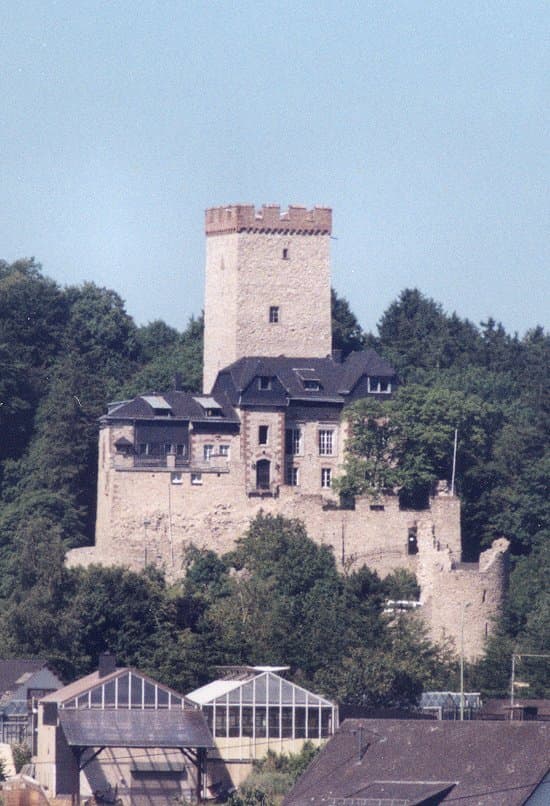
Kerpen Castle
Kerpen Castle, located in the village of Illingen in the Saarland region of Germany, is a striking example of a Renaissance hill castle with roots tracing back to the 12th century. Known locally as Burg Kerpen, the castle's documented history begins in 1359 when it was recorded as an old property of the Count of Saarwerden and held as a fief by Dietrich V von Kerpen. However, the origins of the castle are older, likely founded by members of the von Kerpen family, possibly Sigibertus de Kerpene or his son Heinrich I, in the latter half of the 12th century. This lineage originally centered around another Kerpen Castle located further north in Germany.
Early history and medieval significance
Kerpen Castle was an important feudal seat for the von Kerpen family, who held it as a Ganerbenburg—a castle jointly owned by several family branches—until the mid-15th century. In 1448, Wilhelm II von Sombreff consolidated ownership by buying out other family members. Through marriage alliances, the castle later passed to the von Manderscheid-Schleiden family. The castle's strategic location on a hill spur overlooking the village provided natural defense, enhanced by a moat fed by the Ill river and a neck ditch guarding the northern approach.
Architectural features and expansions
The castle's original layout was a square ground plan surrounded by a moat. It was built on a triple-terraced hill spur, with the highest terrace featuring a 23-meter-high bergfried (main tower) that contained a dungeon on its top floor. The middle terrace housed domestic and outbuildings, now lost, while the lowest terrace was enclosed by an enceinte supported by heavy pillars. A notable medieval feature that remains is the 35-meter-deep castle well, located within a roundel.
In the early 16th century, a castle chapel was constructed in the Gothic style under Dietrich IV of Manderscheid-Schleiden, reflecting the castle's evolving architectural character. Around 1620, an outer bailey was added, expanding the castle's defensive and residential capacity.
Destruction and restoration through conflict
The castle endured significant damage during the Thirty Years' War (1618-1648), when it was destroyed but subsequently restored by Johan Daniel von Kerpen. However, in 1677, French troops set fire to the castle and the adjacent town of Illingen during the Franco-Dutch conflicts, leading to another phase of destruction.
Reconstruction efforts extended well into the 18th century, reflecting the castle's importance to the von Kerpen family, who had been elevated to baronial rank and were members of the Imperial Knights. Despite these efforts, the family vacated the castle in 1748, appointing a bailiff to manage the estate.
Ownership changes and decline
The castle's fortunes declined following the French Revolutionary invasions of 1794, which stripped the von Kerpens of their feudal sovereignty. Napoleon Bonaparte restored ownership to Franz Georg von Kerpen in 1806, but after his death in 1825 without male heirs, the castle was sold in 1830 to Bergrat Leopold Sello. Subsequently, the castle fell into ruin, with locals using its stones as quarry material.
In the 19th century, the castle was partially cleared of debris and consolidated. The bergfried was fitted with new crenelations, and a residential house was constructed on the site. Despite these efforts, the castle remained largely a ruin.
Modern preservation and current status
Today, Kerpen Castle is part of a public park and is freely accessible to visitors, offering a picturesque ruin that reflects its layered history. The castle's remains, including the bergfried and portions of the enceinte, stand as testament to its medieval and Renaissance heritage.
The castle is an important cultural landmark in the Saarland region, illustrating the architectural evolution from medieval fortifications to Renaissance residences. Its history encapsulates the turbulent military and political changes in western Germany from the Middle Ages through the modern era.
Historical context and regional significance
Kerpen Castle's history is intertwined with the broader history of the Saarland and Rhineland regions, areas marked by shifting allegiances and frequent conflict. Its successive owners, from the Counts of Saarwerden to the Nassau-Saarbrücken counts, reflect the complex feudal landscape of the Holy Roman Empire. The castle's destruction during the Thirty Years' War and later French military actions exemplify the vulnerability of such fortifications during Europe's early modern conflicts.
The castle's survival as a ruin and its partial restoration highlight the importance of heritage preservation in Germany. It serves as a tangible link to the region's feudal past and the architectural styles that dominated castle construction from the medieval period through the Renaissance.
Visitor information and cultural use
Kerpen Castle is accessible to the public year-round as part of a recreational park area in Illingen. Visitors can explore the castle grounds, view the remaining defensive structures, and appreciate the scenic views from the hill spur. The site hosts occasional cultural events and serves as a local landmark celebrating Illingen's historical identity.
The castle's modest size and ruinous condition provide an intimate experience of medieval architecture, contrasting with larger, more fully preserved castles. Its setting along the Ill river and the surrounding landscape enhance its appeal to history enthusiasts and tourists alike.
Frequently asked questions (FAQ)
- How do I visit Kerpen Castle?
- Kerpen Castle is located in Illingen, Saarland, and is freely accessible as part of a public park. Visitors can explore the castle ruins year-round during daylight hours.
- What is the historical significance of Kerpen Castle?
- Kerpen Castle dates back to the 12th century and was a feudal seat for the von Kerpen family. It played a role in regional conflicts including the Thirty Years' War and French invasions.
- Can I see original medieval architecture at Kerpen Castle?
- Yes, the castle retains its 23-meter-high bergfried tower, parts of the enceinte, and a deep medieval well, showcasing typical medieval defensive features.
- Is there an admission fee to visit Kerpen Castle?
- No, Kerpen Castle is open to the public free of charge as it is part of a municipal park.
- When was the castle last restored?
- Significant restoration occurred in the 19th century with consolidation of ruins and crenelations added to the bergfried. Preservation efforts continue to maintain the site.
Photo gallery

Information
Current owner
Municipality
Address
Burgweg, Illingen, Saarland, Germany
Loading map...
Visitor reviews
No reviews yet. Been here? Write the first review and help other travelers!
Write the first reviewVisited this castle? Share your experience
Your review helps other travelers and adds first-hand knowledge to our encyclopedia.



