Karpień Castle
Karpień Castle, also known by its German name Burg Karpenstein, is a medieval hill fortress located near the town of Lądek-Zdrój in Kłodzko County, within the scenic Golden Mountains of southwestern Poland. Perched atop Karpiak hill at an elevation between 776 and 782 meters, the castle occupies a naturally defensible promontory with steep slopes on three sides, a typical strategic choice for medieval fortifications aimed at controlling vital routes and borderlands.
Originally constructed in the 14th century by the Bohemian kingdom, Karpień Castle served as a crucial stronghold near the border with the Duchy of Neisse. It guarded an important trade route passing through the Platzenberger Pass into the Glatzer Land, a region within the Kingdom of Bohemia. The fortress first appears in historical records dating from 1346, marking its significance in regional defense and administration during the High medieval period.
Historical significance and ownership
The castle was the administrative center of the Karpenstein lordship, named after the noble Glubos family who initially owned the estate until 1351. Their coat of arms, featuring a golden carp on a blue field, inspired the original name "Karpenstein." After the Glubos tenure, ownership passed through various hands, including the Bohemian kings John of Luxembourg and Charles IV. Notably, Charles IV reacquired the castle in 1353 and declared it a hereditary fief inseparable from the Bohemian crown, underscoring its strategic and political importance.
Throughout the late medieval period, Karpień Castle was held by prominent nobles such as Jan of Moravia and Jobst of Moravia. It later came under the possession of local families including the Nymancz brothers and the Schaffgotsch lineage. The castle's military role was highlighted during the Hussite Wars, when it sustained damage from Hussite forces in 1428. Its ultimate destruction occurred in June 1443 when combined forces led by the Bishop of Breslau (Wrocław) and allied Silesian princes captured and demolished the fortress. This was a punitive action against its last lord, Hynek Kruschina of Lichtenburg, who had used the castle as a base for raids and hostage-taking, activities that disrupted regional stability.
Architectural features and layout
Karpień Castle exemplifies typical medieval hill castle architecture, utilizing the natural topography for defense. The fortress extended approximately 70 meters in length and 30 meters in width, with its main entrance oriented toward the north. A deep defensive ditch on the western side enhanced protection against attackers.
The castle's core consisted of an inner ward featuring a central courtyard and a tower, surrounded by an outer defensive wall. This wall separated the inner ward from the outer bailey, known locally as a "podgrodzie," which housed service buildings such as stables and garrison quarters. These facilities indicate the castle's capacity for self-sufficiency and accommodation of its inhabitants and defenders.
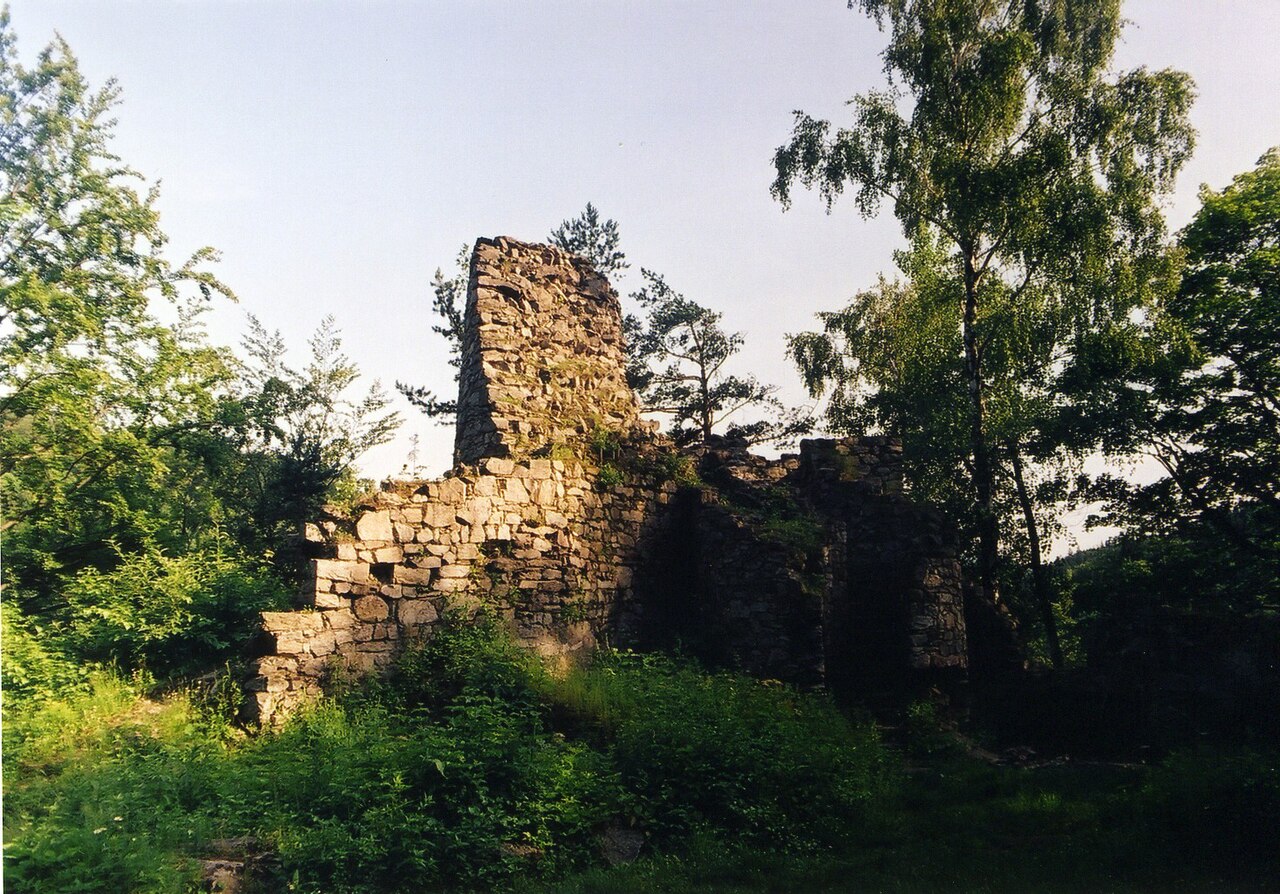
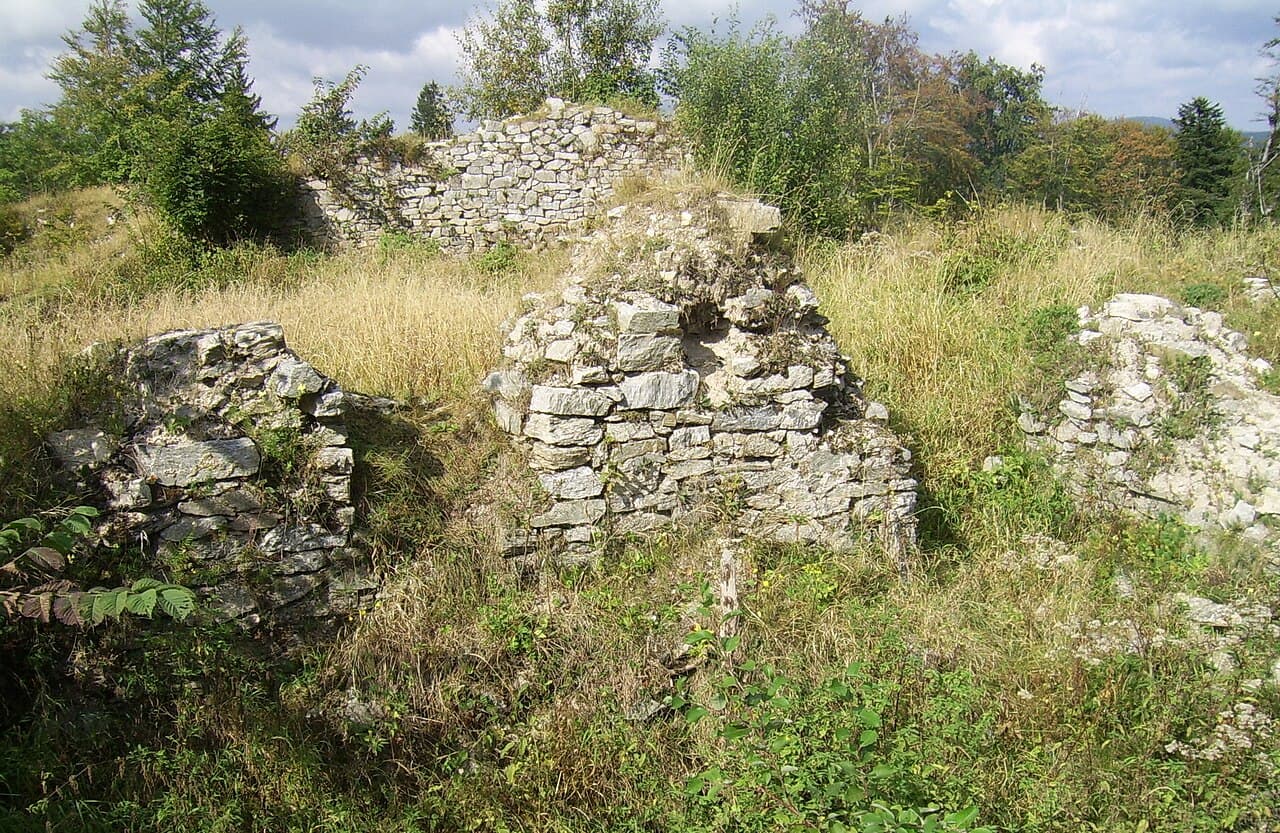
Construction primarily employed stone masonry, a common medieval technique aimed at durability and resistance to siege. Although today only foundational outlines and scattered stones remain, the castle's footprint is still discernible. Notably, in 1883, a large stone slab was carved with a detailed plan of the castle layout to inform visitors, and a stone bench from before World War II also survives on site.
Ruins and archaeological research
The ruins of Karpień Castle remain unprotected and are subject to natural decay, though local groups have made occasional efforts to preserve the site. Access to the ruins is available via two marked hiking trails: a blue trail coinciding with the European long-distance path E3, and a green trail, both connecting the castle with surrounding mountain passes and nearby towns. These routes highlight the castle's integration into the regional landscape and its continued appeal for visitors and hikers.
Archaeological excavations conducted in 1847, 1882, and more recently in 2009–2010 have uncovered sections of walls, passageways, and doorways, as well as artifacts including coins, daggers, and horseshoes. These findings provide valuable insights into the castle's medieval occupants, their daily life, and the military functions of the fortress.
Historical context and legacy
Following its destruction in the mid-15th century, Karpień Castle was never rebuilt. The estate eventually passed to the nearby town of Landeck in 1684, by which time the Karpenstein lordship had dissolved. The surrounding villages became crown lands before being sold individually. Despite its ruined state, the castle remains a significant historical site that reflects the complex feudal and military history of the Bohemian borderlands.
Karpień Castle's story illustrates the strategic importance of border fortresses in medieval Central Europe, particularly in the context of Bohemian-Silesian relations. Its ruins continue to attract historians, archaeologists, and visitors interested in medieval architecture and history, contributing to the cultural heritage of the Golden Mountains region.
Frequently asked questions (FAQ)
- How do I get to Karpień Castle?
- Karpień Castle is located in Poland and can be accessed by car or public transportation. The nearest major city is Wrocław, from where you can take a bus or drive for approximately two hours to reach the castle.
- What is the historical significance of Karpień Castle?
- Karpień Castle dates back to the 13th century and has played an important role in the region's history. It served as a defensive fortress and has witnessed various historical events, making it a valuable site for understanding medieval Polish architecture and culture.
- When was Karpień Castle built?
- Karpień Castle was constructed in the early 13th century, during a time when many fortifications were established in Poland. Over the centuries, it has undergone several renovations and restorations, reflecting changes in architectural styles and purposes.
- Can I take guided tours of Karpień Castle?
- Yes, guided tours are available for visitors to Karpień Castle. These tours provide insights into the castle's history, architecture, and the surrounding landscape, enhancing your experience while exploring this historic site.
- Why is Karpień Castle considered an architectural gem?
- Karpień Castle is renowned for its unique blend of medieval and Renaissance architectural styles. Its well-preserved structures, including towers and defensive walls, showcase the ingenuity of its builders and provide a glimpse into the past.
- Is it possible to visit Karpień Castle year-round?
- Yes, Karpień Castle is open to visitors throughout the year, although opening hours may vary by season. It's advisable to check the official website for the most current information on visiting hours and any seasonal events.
- What are the ticket prices for Karpień Castle?
- Ticket prices for Karpień Castle are generally affordable, with discounts available for students and seniors. Prices may vary for special events or guided tours, so it's best to check the official website for the latest information.
- What is the best time to visit Karpień Castle?
- The best time to visit Karpień Castle is during the spring and summer months when the weather is pleasant and outdoor exploration is enjoyable. Additionally, many cultural events and festivals take place during this time, adding to the experience.
- Are there any nearby attractions to Karpień Castle?
- Yes, there are several attractions near Karpień Castle, including picturesque villages, hiking trails, and other historical sites. Exploring the surrounding area can enhance your visit, offering a deeper appreciation of the region's culture and natural beauty.
Photo gallery

Information
Loading map...
Visitor reviews
No reviews yet. Been here? Write the first review and help other travelers!
Write the first reviewVisited this castle? Share your experience
Your review helps other travelers and adds first-hand knowledge to our encyclopedia.