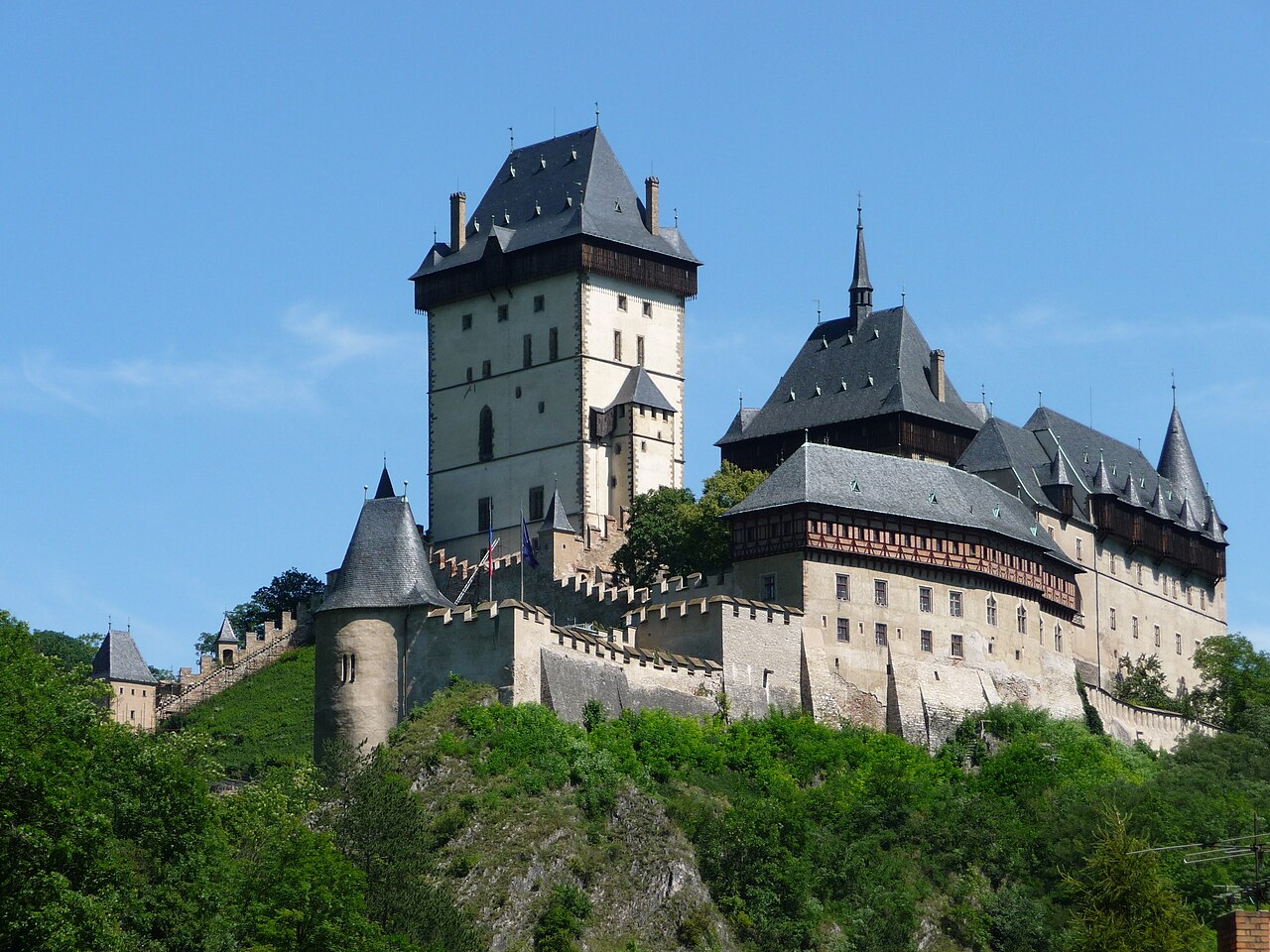
Karlík Castle
Karlík Castle is a medieval fortress ruin located in the municipality of Mořinka in the Czech Republic. Constructed in the mid-14th century, the castle occupies a naturally defensible promontory known as Hrádek, overlooking the Karlík Valley. Its strategic position along an important medieval route between Prague and Dobříš underscores its historical role in regional oversight and control.
The origins and historical context of Karlík Castle
The castle's foundation is believed to date back to around 1358, during the reign of Charles IV, King of Bohemia and Holy Roman Emperor. Although direct documentary evidence is scarce, historian Miloslav Bělohlávek suggests that Charles IV initiated the construction to strengthen territorial defenses and secure vital communication routes. The earliest confirmed mention of Karlík Castle appears in 1400, when King Wenceslaus IV pledged the fortress and allocated funds for its maintenance, indicating its established military and administrative function by that time.
By the mid-16th century, references to Karlík Castle diminish, with a 1544 record noting only a nearby pond and mill, implying that the castle had fallen into disuse or abandonment. Scholars Pavel Bolina and Tomáš Klimek have theorized that the castle's primary purpose was to monitor and control the long-distance trade and travel route connecting Prague with the southwestern regions, highlighting its strategic importance during the High and Late Medieval periods.
Architectural features and layout
Location and defensive structures
Situated on the hilltop promontory called Hrádek, Karlík Castle takes advantage of natural topography for defense. The site overlooks the Karlík Valley, providing clear views of the surrounding landscape and approach routes. The castle's position on a raised plateau made it difficult to assault, with steep slopes acting as natural barriers.
Castle design and fortifications
The castle's layout was compact and functional, dominated by a small polygonal building that likely served as the keep or main tower. This central structure was positioned near the edge of the promontory, maximizing its vantage point for surveillance and defense. Access was restricted to a single entrance on the northern side, which was protected by a neck ditch—a defensive trench cutting across the approach—and an earthen rampart. These earthworks were designed to slow and expose attackers, enhancing the castle's defensive capabilities.
Adjacent to the southwestern curtain wall, archaeological excavations have revealed another building whose interior was partially divided by a surviving fragment of a partition wall. This suggests the presence of functional spaces possibly used for residential quarters, storage, or administrative purposes within the castle complex.
Construction materials and current remains
The ruins primarily consist of fragmented masonry and earthworks, with no detailed records of decorative elements or inscriptions. The surviving walls and foundations reveal the castle's basic construction techniques typical of 14th-century Bohemian hill castles. The modest scale and simplicity of the ruins suggest Karlík was a smaller fortress, focused on military utility rather than grandeur.
Legends and cultural significance
The castle is enveloped in local legend, notably recorded by the chronicler Václav Hájek of Libočany, who claimed that Charles IV built Karlík Castle as a residence for the queen and her court. According to this account, women were forbidden at nearby Karlštejn Castle, prompting the establishment of Karlík as a complementary royal dwelling. This story inspired the famous Czech play Noc na Karlštejně by Jaroslav Vrchlický, embedding the castle in national cultural memory.
Today, Karlík Castle and its surroundings are protected as a cultural monument and form part of the Karlík Valley nature reserve. The site attracts visitors interested in medieval history, archaeology, and Czech folklore, offering a glimpse into the region's medieval defensive network and royal associations.
Preservation and archaeological research
The castle remains are classified as ruins, with limited above-ground structures surviving. Archaeological investigations have focused on mapping the site layout, identifying defensive features, and uncovering structural foundations. Despite the scarcity of artifacts or inscriptions, the site provides valuable insight into the construction and strategic planning of smaller medieval hill castles in Bohemia.
Efforts to preserve the ruins emphasize maintaining the earthworks and masonry fragments against further decay, while promoting responsible tourism within the protected natural reserve. The castle's modest remains serve as a tangible connection to the medieval Czech civilization and its complex network of fortifications.
Visiting Karlík Castle today
Visitors to Karlík Castle can explore the ruins situated on the Hrádek promontory, enjoying panoramic views of the surrounding Karlík Valley. The site is accessible via hiking trails within the Karlík Valley nature reserve, offering a combination of natural beauty and historical intrigue. While the castle itself is in ruins, interpretive signage and local guides provide context about its history and architectural features.
The castle's location and historical background make it a point of interest for enthusiasts of medieval architecture, Czech history, and folklore. Its proximity to other notable sites, including Karlštejn Castle, allows for a broader exploration of the region's medieval heritage.
Information
Loading map...
Visitor reviews
No reviews yet. Been here? Write the first review and help other travelers!
Write the first reviewVisited this castle? Share your experience
Your review helps other travelers and adds first-hand knowledge to our encyclopedia.