Jezeří Castle
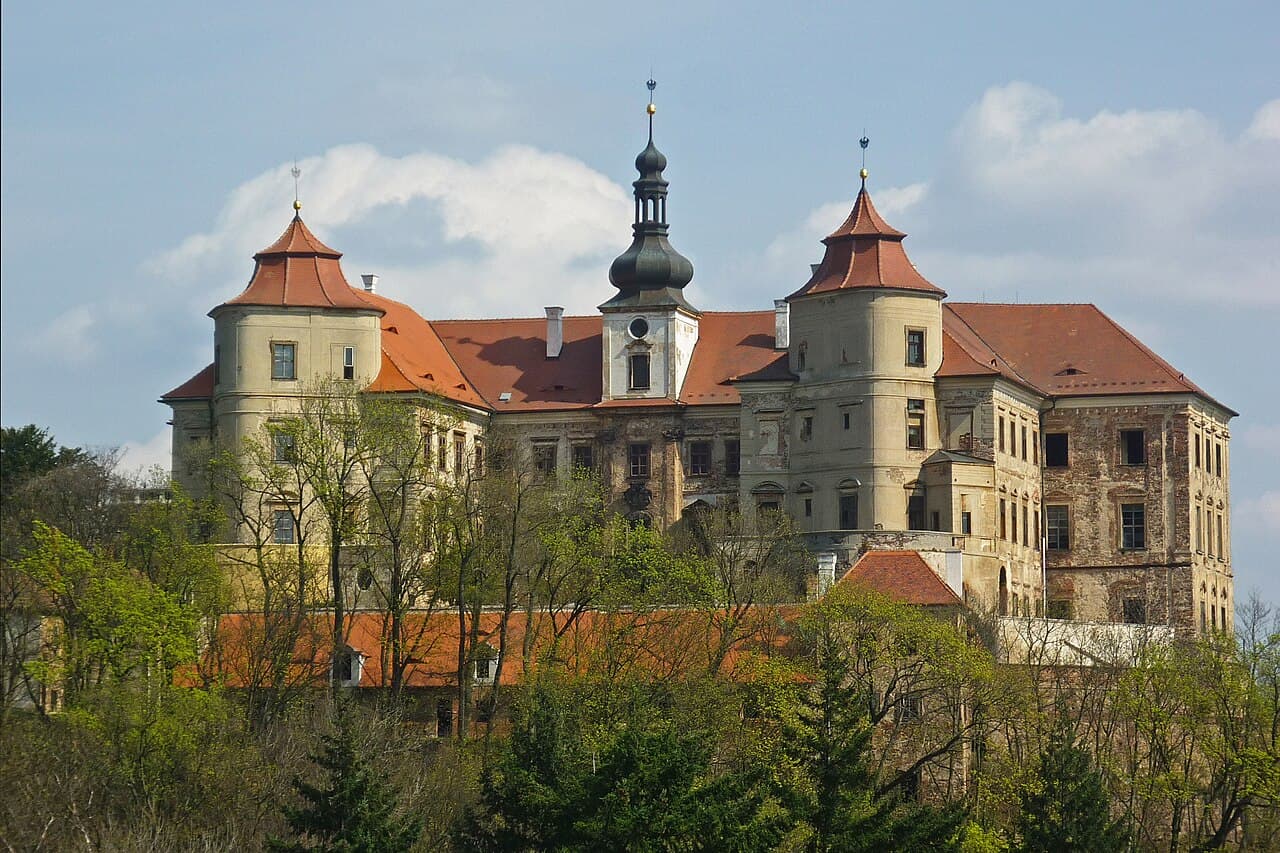
Jezeří Castle stands as a remarkable example of a historic hill castle in the Czech Republic, embodying centuries of architectural evolution and rich cultural heritage. Originally constructed as a Gothic fortress in the mid-14th century, the castle has witnessed significant transformations through the Renaissance and Baroque periods, reflecting the changing tastes and political fortunes of its noble owners.
Located on a rocky outcrop overlooking the southeastern slopes of the Erzgebirge mountains (locally known as Krušné hory), Jezeří Castle occupies a strategic position that influenced its historical importance. The castle's foundation rests on a stable crystalline rock formation of orthogneiss, which played a crucial role in its preservation despite nearby lignite mining activities threatening the region in the late 20th century.
Medieval origins and gothic fortress architecture
The castle's genesis dates back to between 1363 and 1365, when the noble family of Pány ze Rvenic (also known as de Lacu or de Aysemberg) established it as a fortified stronghold. The earliest documented owner, Nevlas de Lacu, appears in records from 1365, shortly after the castle's initial construction. The original fortress was designed primarily for defense, featuring thick stone walls, a moat, and strategically placed towers to guard the surrounding landscape.
Though much of the original medieval fortifications have not survived intact, archaeological evidence reveals the presence of a single moat and remnants of terraces that likely supported artillery bastions. These features indicate adaptations to evolving military technologies during the late medieval period, as castles transitioned from purely defensive structures to more complex fortifications.
Ownership transitions and renaissance transformation
Throughout the late medieval era, Jezeří Castle changed hands among several noble families, including the Smolík ze Slavic and Kunz von Kauffungen. The latter is historically notable for the 1450 abduction of Saxon princes, a politically charged event that underscored the castle's regional significance. In 1459, King George of Poděbrady seized the castle, emphasizing its strategic value amid the turbulent power struggles of the time.
The early 16th century marked a pivotal moment when the castle passed to Nikolaus Hochhauser following the death of Sigmund Smolík without heirs in 1513. Hochhauser initiated a comprehensive transformation of the medieval fortress into a Renaissance chateau in 1549. This renovation introduced architectural elements characteristic of the Renaissance, such as more elegant facades, larger windows, and a layout favoring residential comfort alongside defense.
Baroque remodeling and cultural flourishing under the lobkowicz family
The castle's history in the 17th and 18th centuries is closely linked to the Lobkowicz family, who acquired the estate after it was confiscated from Nikolaus Hochhauser in 1623 due to his involvement in the Bohemian Revolt. Wilhelm Popel von Lobkowicz spearheaded a Baroque remodeling beginning in 1627, which included rebuilding after devastating fires in 1646 and 1713. The Baroque style brought grandeur and decorative richness to the castle, evident in its vaulted chambers, stucco mirrors, and the polygonal great hall.
From 1722 onwards, Jezeří Castle primarily served as a hunting retreat for the Lobkowicz princes, who expanded their holdings to include towns, forests, breweries, and industrial enterprises such as lime kilns and lignite mines. The estate's economic diversity underpinned the family's wealth and influence in the region.
Cultural highlights and artistic patronage
The late 18th and early 19th centuries marked a cultural zenith for Jezeří Castle under the Lobkowicz family. The establishment of a castle theater in 1802, along with a hunting music band and choir, transformed the castle into a vibrant cultural hub. It attracted illustrious figures such as Johann Wolfgang von Goethe, Ludwig van Beethoven, Joseph Haydn, Christoph Willibald Gluck, and the Wranitzky brothers.
Notably, the castle hosted private premieres of Beethoven's Symphony No. 3, "Eroica", and Haydn's oratorio The Creation, underscoring its significance as a center of musical innovation and aristocratic patronage during this period.
20th-century challenges and preservation efforts
During the Second World War, Jezeří Castle was seized by Nazi forces while its owner, Max Lobkowicz, was in exile. The castle served as a special internment camp for high-ranking Allied officers and French hostages, and functioned as a satellite labor camp linked to the Flossenbürg concentration camp. This dark chapter left the castle's interior vulnerable to damage and neglect.
Following the war, the communist regime nationalized the estate in 1948, repurposing the castle for military use. This period saw significant interior destruction and deterioration. In the 1980s, plans to expand the nearby ČSA open-pit lignite mine posed a threat to the castle and adjacent settlements. However, geological studies revealed the castle's foundation on a stable crystalline rock, distinct from the coal basin, allowing for protective measures to be implemented.
After the fall of communism, the castle was restituted to the Lobkowicz family in 1991. Due to the high costs of restoration, the family donated Jezeří Castle to the Czech state in 1996. Since then, it has been managed by the National Heritage Institute. In 2020, Jezeří Castle was recognized by Europa Nostra as one of Europe’s most endangered heritage sites, highlighting the urgent need for conservation.
Architectural features and castle layout
Jezeří Castle's complex architectural layout reflects its layered history. The surviving structure incorporates parts of the original medieval fortress, especially in the basement and western wings. The eastern wings represent later Renaissance and Baroque expansions, extending beyond the initial castle boundaries.
The castle's defensive features survive only in fragments, with archaeological findings confirming the location of a moat and terraces that likely supported artillery bastions. The present Baroque chateau is arranged in an H-shaped floor plan with four wings enclosing three sides of a courtyard, creating a protected, inward-facing space.
A prominent architectural highlight is the southern risalit featuring a large domed hall supported by heavy consoles. This hall originally housed the early 19th-century castle theater, a centerpiece of the estate's cultural life. The main western façade is marked by a subtle risalit topped by a square tower above the main entrance portal, flanked by two atlantes sculptures attributed to the artist Johann Adam Dietz.
Inside, the castle boasts richly decorated rooms including vaulted chambers with stucco mirrors, a polygonal great hall, a gilded cabinet, audience and mirror halls, a banquet room, the princely chamber, the castle library, and the theater space. These interiors illustrate the Baroque emphasis on grandeur, light, and decorative detail.
Grounds, parkland, and auxiliary structures
The castle is surrounded by remnants of a once extensive English landscape park dating to the 1820s. Today, this area survives primarily as the Eisenberg Arboretum, which preserves ancient oak, linden, and beech trees, relics of the historic parkland integral to the estate's aesthetic and ecological heritage.
Within the park are the remains of a family mausoleum constructed after 1753, likely designed by the noted artist Andreas Altomonte. The castle chapel, dedicated to Our Lady of Sorrows and built in 1805, also stands on the grounds, emphasizing the estate’s religious and commemorative significance.
Geological context and structural stability
Jezeří Castle's location on the southeastern slope of the Erzgebirge mountains places it atop a crystalline rock formation known as orthogneiss. This bedrock, formed during the ancient Variscan orogeny, provides a stable foundation that has been critical in preserving the structure through centuries of natural and human-induced challenges, including nearby lignite mining operations.
Tectonic faults in the region separate this crystalline block from the adjacent coal basin, a geological feature that has allowed the castle to avoid subsidence and structural damage despite extensive mining activities in the surrounding area.
Today, Jezeří Castle remains a poignant symbol of the layered history of Czechia, reflecting the architectural, cultural, and political transformations of the region from the medieval period through the modern era. Its preservation and ongoing restoration efforts continue to safeguard this unique heritage site for future generations.
Frequently asked questions (FAQ)
- How do I get to Jezeří Castle?
- Jezeří Castle is located in Horní Jiřetín, Ústí nad Labem Region, Czechia. It is accessible by car and local public transport; the nearest major city is Ústí nad Labem.
- What is the historical significance of Jezeří Castle?
- Jezeří Castle dates back to the mid-14th century and has been a Gothic fortress, Renaissance chateau, and Baroque residence. It played roles in regional politics, cultural patronage, and wartime history.
- Can I visit the interior of Jezeří Castle?
- The castle is partially preserved and undergoing restoration. Some interiors, including the Baroque halls and theater space, may be accessible during guided tours, but access can be limited due to preservation efforts.
- When is the best time to visit Jezeří Castle?
- The best time to visit is during the warmer months from late spring to early autumn when the surrounding park and arboretum are most vibrant and accessible.
- Are there any notable architectural features to see at Jezeří Castle?
- Visitors can admire the castle's H-shaped Baroque layout, the southern risalit with its domed hall, the western façade with atlantes sculptures, and remnants of the medieval fortress foundations.
Photo gallery

Information
Sources & official resources
Verify the information above using these authoritative references.
Loading map...
Visitor reviews
No reviews yet. Been here? Write the first review and help other travelers!
Write the first reviewVisited this castle? Share your experience
Your review helps other travelers and adds first-hand knowledge to our encyclopedia.