Jędrzychów
Jędrzychów Castle, located at the crossroads of medieval trade routes leading to Chocianów, Lubin, and Polkowice in Poland, stands as a significant historical site embodying centuries of architectural evolution and turbulent history. Originally constructed in 1295 by Henryk III, Duke of Głogów, this fortress was strategically positioned amidst marshlands and wetlands, providing natural defenses against invaders. Although the original medieval castle was largely destroyed and altered over time, its remnants and subsequent structures offer a fascinating glimpse into the region's past.
Medieval origins and early history
The castle's foundation dates back to the late 13th century, when Henryk III erected a fortified stronghold to control the vital trade routes intersecting the area. The castle's position near swampy terrain was a deliberate choice to enhance its defensive capabilities. In 1331, the property was briefly transferred to Zygmunt Krzysztof von Rottenberg, reflecting the shifting allegiances and ownership typical of Silesian territories during the Middle Ages. Later, in 1361, Henryk V, Duke of Żagań, sold the castle along with the nearby towns of Polkowice and Chobienia, indicating its regional importance.
Destruction during the Hussite wars
The fortress suffered significant damage in 1419 when it was destroyed by the Hussites, a militant religious group whose campaigns ravaged many parts of Central Europe. This event marked a turning point in the castle's history, leading to periods of decline and reconstruction attempts. Despite these efforts, the castle never fully regained its former strength.
Early modern conflicts and decline
The 17th century brought further devastation during the Thirty Years' War, a destructive conflict that engulfed much of Europe. The castle was twice damaged: first, on 12 September 1642, when Austrian troops set it ablaze, and later by Swedish forces who compounded the destruction. These assaults left the fortress in ruins, and it was never rebuilt as a defensive stronghold thereafter.
Rebirth as an evangelical church and neogothic additions
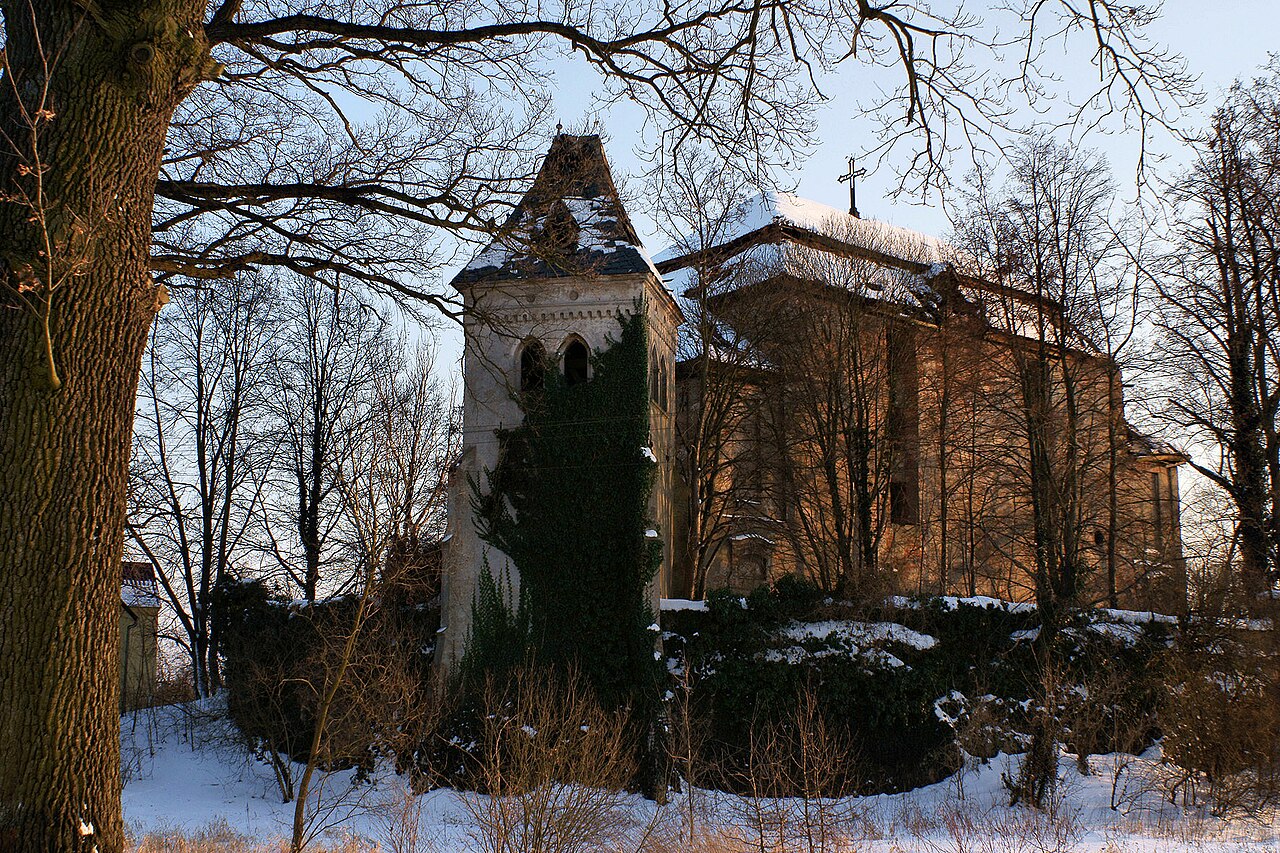
In 1744, the castle ruins and surrounding estates became the property of Christian von Busse. Around 1750, he repurposed the remnants of the medieval fortress to construct an evangelical church, blending the site's rich history with new religious functions. This three-story building, rectangular in plan and topped with a distinctive broken hip roof, incorporated lower annexes and preserved parts of the original structure.
Architectural features of the church
The church's crypt in the basement served as a burial chamber for local nobility, featuring Gothic vaults that hark back to the medieval past. The preservation of these vaults provides a tangible connection to the castle's original defensive and ceremonial purposes.
Neogothic tower and restoration efforts
In 1884, a free-standing neogothic tower was added to the church complex, serving as a bell tower and enhancing the site's architectural prominence. This stylistic addition reflected the 19th-century revivalist trends that sought to celebrate medieval forms with romanticized aesthetics. The church underwent restoration in 1903, which aimed to preserve its structural integrity and historical character.
20th-century damage and current condition
Unfortunately, the site suffered severe damage during the final stages of World War II, leaving it in a state of ruin. Today, the remains of Jędrzychów Castle and the evangelical church stand as evocative ruins surrounded by an oval stone wall, offering visitors a poignant glimpse into the layered history of Silesia. The site is notable for its blend of post-medieval fortress elements and neogothic architectural features, making it a unique cultural and historical landmark.
Architectural and historical significance
The complex exemplifies the transformation of a medieval defensive structure into a religious building, illustrating adaptive reuse across centuries. The juxtaposition of the original Gothic vaults with the later neogothic tower highlights the evolving architectural tastes and functional needs of the region's inhabitants. Despite its ruined state, the site preserves critical elements that allow historians and visitors to trace the narrative of warfare, religion, and heritage in Lower Silesia.
Site layout and defensive features
The original castle was surrounded by marshy land that served as a natural moat, enhancing its defensive capacity. The surviving oval stone wall encloses the site, reinforcing the fortress character even in its ruined form. The church's rectangular plan and multi-story construction reflect the practical adaptation of the medieval foundations to new uses.
Cultural heritage and tourism
Today, Jędrzychów Castle ruins attract visitors interested in medieval history, architectural evolution, and Silesian culture. The evocative ruins, combined with the neogothic church tower, create a compelling destination for heritage tourism. Efforts to preserve and interpret the site contribute to understanding the region's complex past and architectural legacy.
Frequently asked questions (FAQ)
- How do I get to Jędrzychów Castle?
- Jędrzychów Castle is easily accessible by car, located just off the main road connecting major cities in Poland. If you're using public transport, you can take a train or bus to the nearest town and then use a taxi or ride-sharing service to reach the castle.
- What is the historical significance of Jędrzychów Castle?
- Jędrzychów Castle dates back to the 15th century and has played a vital role in the region's history. It was originally built for defensive purposes and has witnessed numerous historical events, making it an important landmark in Polish heritage.
- When was Jędrzychów Castle built?
- Construction of Jędrzychów Castle began in the late 1400s, with various renovations and expansions occurring over the centuries. Its architectural style reflects the transition from medieval fortifications to more modern designs by the 17th century.
- Can I visit Jędrzychów Castle year-round?
- Yes, Jędrzychów Castle is open to visitors throughout the year, though some areas may be closed during the winter months for maintenance. It's advisable to check the castle's official website for any seasonal changes in visitor access.
- Why is Jędrzychów Castle a popular tourist destination?
- Jędrzychów Castle attracts visitors due to its rich history, stunning architecture, and scenic surroundings. It offers guided tours that delve into its past, making it a fascinating destination for history enthusiasts and families alike.
- Is it possible to tour the inside of Jędrzychów Castle?
- Yes, guided tours are available that allow visitors to explore the interior of Jędrzychów Castle. These tours provide insights into the castle's history, architecture, and the lives of those who once lived there.
- What are the opening hours for Jędrzychów Castle?
- Jędrzychów Castle typically opens at 10 AM and closes at 6 PM during the peak tourist season. However, it’s recommended to check the specific opening hours on the official website prior to your visit, as they may vary seasonally.
- What are the ticket prices for visiting Jędrzychów Castle?
- Ticket prices for Jędrzychów Castle are generally affordable, with discounts available for students and seniors. Children under a certain age may enter for free, so be sure to inquire about the latest pricing details on the castle's official site.
- What are some nearby attractions to Jędrzychów Castle?
- In addition to Jędrzychów Castle, visitors can explore the beautiful surrounding countryside and nearby historical sites. Popular attractions include local museums, parks, and other castles in the region, making it a perfect day trip for history lovers.
Information
Loading map...
Visitor reviews
No reviews yet. Been here? Write the first review and help other travelers!
Write the first reviewVisited this castle? Share your experience
Your review helps other travelers and adds first-hand knowledge to our encyclopedia.