Jawor
Jawor Castle in Poland stands as a remarkable example of a Renaissance hill castle with deep roots tracing back to the early medieval period. The site originally hosted a wooden stronghold, believed to have been established as early as the 8th century according to legend, with a fortified settlement built by the legendary figure Jawor. This early stronghold evolved through the centuries, becoming a significant administrative center for the Trzebowian tribe during the formation of the Polish state under Mieszko I. The castle’s strategic location on a hill overlooking the surrounding region made it a vital defensive and administrative site.
Medieval origins and early fortifications
By the 11th century, the original stronghold underwent expansion, including the construction of a suburb (podgrodzie). In the 12th century, the first stone castle keep was erected in the Romanesque style, marking the transition from wooden fortifications to more durable stone structures. This early castle featured a roughly triangular courtyard surrounded by a palisade and a branch of the Nysa Szalona river to the southwest, along with a moat to the northeast. The main residential and administrative building, located on the western side, was a rectangular stone structure approximately 20 by 10 meters, with walls up to 2.5 meters thick. This building likely had two floors and served as the residence of the castellan, the local governor.
The castle also included a southern building used for economic purposes and as quarters for servants and soldiers. The entrance was positioned on the side facing the suburb. The first recorded mention of the castellan of Jawor dates to 1224, indicating the castle’s early administrative significance.
Destruction and gothic reconstruction
The original castle was probably destroyed during the Mongol invasion in 1241, when Mongol forces retreated after the Battle of Legnica. Reconstruction began shortly afterward under the direction of Duke Henryk V, son of Bolesław Rogatka, as part of plans to establish the Duchy of Jawor from the Legnica district. Work continued after 1278 under Duke Bolko I, who integrated the castle into the town’s defensive system.
Unfortunately, the exact appearance of the Gothic castle is not well documented due to numerous later modifications. However, from 1273 to 1392, the castle served as the seat of the dukes of Jawor or their deputies, cementing its role as a political and military center.
Renaissance transformation and military modernization
After the death of Duchess Agnes in 1392, Jawor became the residence of governors of the newly formed Czech province comprising the duchies of Jawor and Świdnica. In the early 15th century, King Wenceslaus IV of Bohemia ordered significant reconstruction. This included adding an additional floor to the southern wing, expanding the eastern wing, and rebuilding the gatehouse.
Between 1510 and 1538, the castle’s defenses were modernized to accommodate the increasing use of firearms. A two-story horseshoe-shaped bastion equipped with gun ports was constructed at the western wing’s extension, enhancing the castle’s artillery capabilities.
The most notable Renaissance renovation began in 1568, transforming the Gothic fortress into a Renaissance residence. A tower was built at the southwest corner, enclosing the inner courtyard, and a second floor was added to the western wing. The eastern wing was also enlarged and given a Renaissance facade facing the courtyard. These changes resulted in a compact, two-story building embodying Renaissance architectural principles.
Damage, restoration, and changing functions in the early modern period
During the Thirty Years' War, Jawor Castle was occupied by Swedish forces. On July 25, 1648, imperial troops under Colonel Villani captured the castle after an artillery bombardment and fire caused significant damage. Restoration efforts led by Count Otto von Nostitz between 1656 and 1665 repaired the castle, culminating in the installation of a bell in the castle tower that remains to this day.
Further renovations included the addition of a Mannerist portal to the southern wing in 1673 and repairs to the clock tower in 1705, which was fitted with clocks. These improvements reflected the castle’s continued importance as a regional administrative center.
Prison conversion and 19th-century modifications
The geopolitical shifts caused by the Silesian Wars (1740-1745) resulted in Prussia acquiring Silesia from Austria. The royal estates office in Głogów took over administrative control of the Jawor-Świdnica province. In 1746, King Frederick II of Prussia ordered the castle’s conversion into a facility for mentally ill patients and a prison.
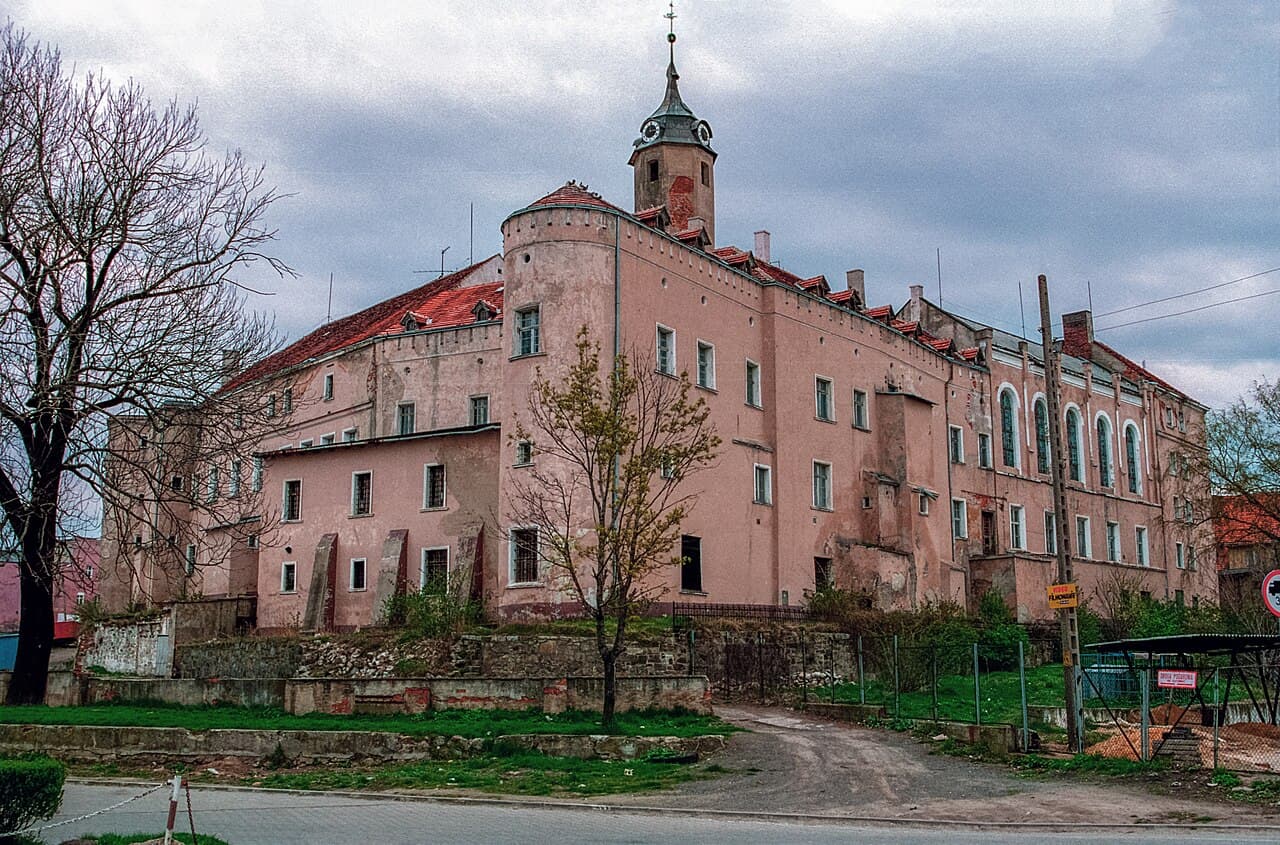
Extensive adaptations followed, significantly altering the castle’s interior and layout to isolate inmates. The gatehouse was expanded with a third floor and a single-story annex with a ceremonial gate. The courtyard was accessible through two gates and a long gate hall. The western wing was raised by an additional floor to accommodate prison functions.
In 1821, the asylum was closed, and from 1888 to 1955, the castle functioned as a women's prison. The southern wing underwent substantial reconstruction in the mid-19th century, enclosing the courtyard with a continuous three-story structure. Additional annexes were added to the side facades through the early 20th century.
20th-century history and current status
During World War II, the castle continued as a women's prison under German occupation, detaining several French women among others. A memorial in the courtyard honors these prisoners. After 1945, the castle housed political prisoners and former Home Army soldiers.
Today, Jawor Castle is used by various institutions and awaits comprehensive archaeological and architectural research. Such studies could reveal more about the castle’s oldest structures and enrich understanding of its complex history.
Frequently asked questions (FAQ)
- What is the historical significance of Jawor Castle?
- Jawor Castle, built in the late 13th century, is an important example of medieval architecture in Poland. It served as a residence for various noble families and played a crucial role in the region's political history, especially during the Silesian Wars.
- When was Jawor Castle constructed?
- Jawor Castle was originally constructed in the late 1200s, with significant modifications made over the centuries. Its construction reflects the transition from Romanesque to Gothic architectural styles, showcasing the evolving design preferences of the time.
- What are the opening hours for Jawor Castle?
- Jawor Castle is typically open to visitors from Tuesday to Sunday, with varying hours depending on the season. It is advisable to check the official website for the most current information on opening times and any special events.
- Can I take guided tours of Jawor Castle?
- Yes, guided tours of Jawor Castle are available and are highly recommended for a deeper understanding of its history and architecture. Tours often include access to the castle's key areas, such as the main hall and defensive towers, providing insights into its fascinating past.
- Is it possible to visit Jawor Castle with limited mobility?
- Jawor Castle has made efforts to improve accessibility for visitors with limited mobility. While some areas may pose challenges due to their historical nature, there are accessible routes available, and staff are generally willing to assist when needed.
- What is the best time to visit Jawor Castle?
- The best time to visit Jawor Castle is during the spring and early autumn when the weather is mild, and the surrounding gardens are in full bloom. Additionally, these seasons often see fewer tourists, allowing for a more enjoyable experience.
- Are there any nearby attractions to Jawor Castle?
- Yes, there are several nearby attractions, including the beautiful Jawor Market Square and the picturesque St. Martin's Church. Visitors can also explore the local museums that showcase the region's rich history and culture.
- How much are the ticket prices for Jawor Castle?
- Ticket prices for Jawor Castle vary based on age and group status, with discounts available for students and seniors. Generally, the entrance fee is quite reasonable, making it an accessible option for families and history enthusiasts alike.
Photo gallery

Information
Loading map...
Visitor reviews
No reviews yet. Been here? Write the first review and help other travelers!
Write the first reviewVisited this castle? Share your experience
Your review helps other travelers and adds first-hand knowledge to our encyclopedia.