Jadraque Castle
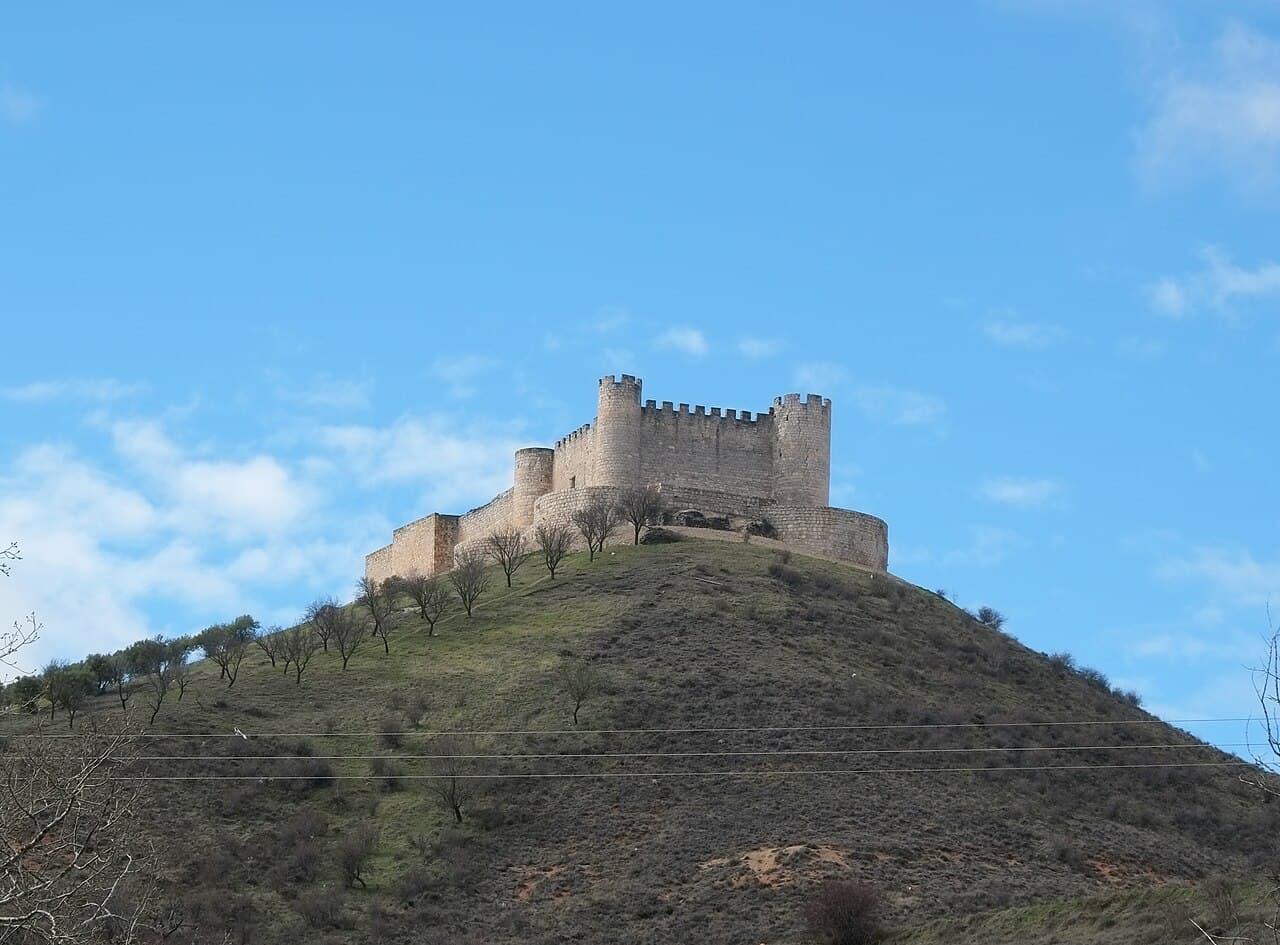
Jadraque Castle stands prominently on a steep hilltop overlooking the valley of the river Henares in the province of Guadalajara, Spain. This imposing fortress, often referred to as the Castle of El Cid, though without direct ties to the legendary knight, is a remarkable example of a hill castle with a complex history spanning from the Early Medieval period through the Renaissance. Its strategic location along the ancient Roman Via Augusta road and commanding views of the surrounding landscape underscore its military and administrative importance over centuries.
Originally constructed in the 10th century by the Moors, who named it Xaradraq, the castle likely replaced earlier fortifications dating back to Roman times, given the area's significance as a transit and defensive corridor. The castle's early history is intertwined with the Christian Reconquista, as it was captured by Christian forces in 1085 during King Alfonso VI's campaigns. Subsequently, it became part of the Villa y Tierra de Atienza jurisdiction before evolving into an independent municipality in the early 15th century.
Historical evolution and ownership
Early origins and moorish construction
The fortress' origins trace to the Andalusian Arabs who established the initial stronghold around 801 AD to secure the territory. The site had prehistoric and Roman antecedents, reflecting a long history of human occupation and strategic use. The castle's name, Xaradraq, is rooted in its Moorish foundation, and its construction employed typical Islamic military architectural principles suited to the rugged terrain.
Christian reconquest and medieval lordship
After its capture by Christian forces in 1085, the castle entered the domain of the Lords of Atienza. This period marked a transition from Islamic to Christian control, with modifications likely made to adapt the fortress to new defensive needs. By the 15th century, the castle had gained prominence as a noble seat, culminating in its cession in 1434 by King Juan II to Doña María de Castilla, granddaughter of King Pedro I "the Cruel." Her marriage to Gómez Carrillo established a lordship that passed through the Carrillo family.
Renaissance transformation under the mendoza family
In 1469, the castle was acquired by Cardinal Pedro González de Mendoza, a powerful Castilian noble and churchman. Under his patronage, the fortress underwent significant reconstruction, transforming it into a palace-fortress that blended military functionality with Renaissance aesthetics. The renovations, overseen by Alberto de Caravajal and supported by skilled masons from northern Spain, introduced Italianate elements and refined stonework, reflecting contemporary architectural trends.
The castle became the residence of Pedro González's son, Rodrigo Díaz de Vivar y Mendoza, the first Count of the Cid, who lived there with his wives, including Leonor de la Cerda and María de Fonseca. Their daughter, Mencía de Mendoza, was born at Jadraque and later became a notable patron of the arts, further enhancing the castle's cultural significance.
Architectural features and layout
Site and defensive structures
Jadraque Castle occupies a narrow, elongated plateau approximately 70 meters long and 18 meters wide, extending to nearly 100 meters with an added southern bailey. Its perimeter is enclosed by defensive walls stretching about 240 meters, constructed from pale white stone blocks arranged in courses that combine roughly hewn and finely dressed masonry.
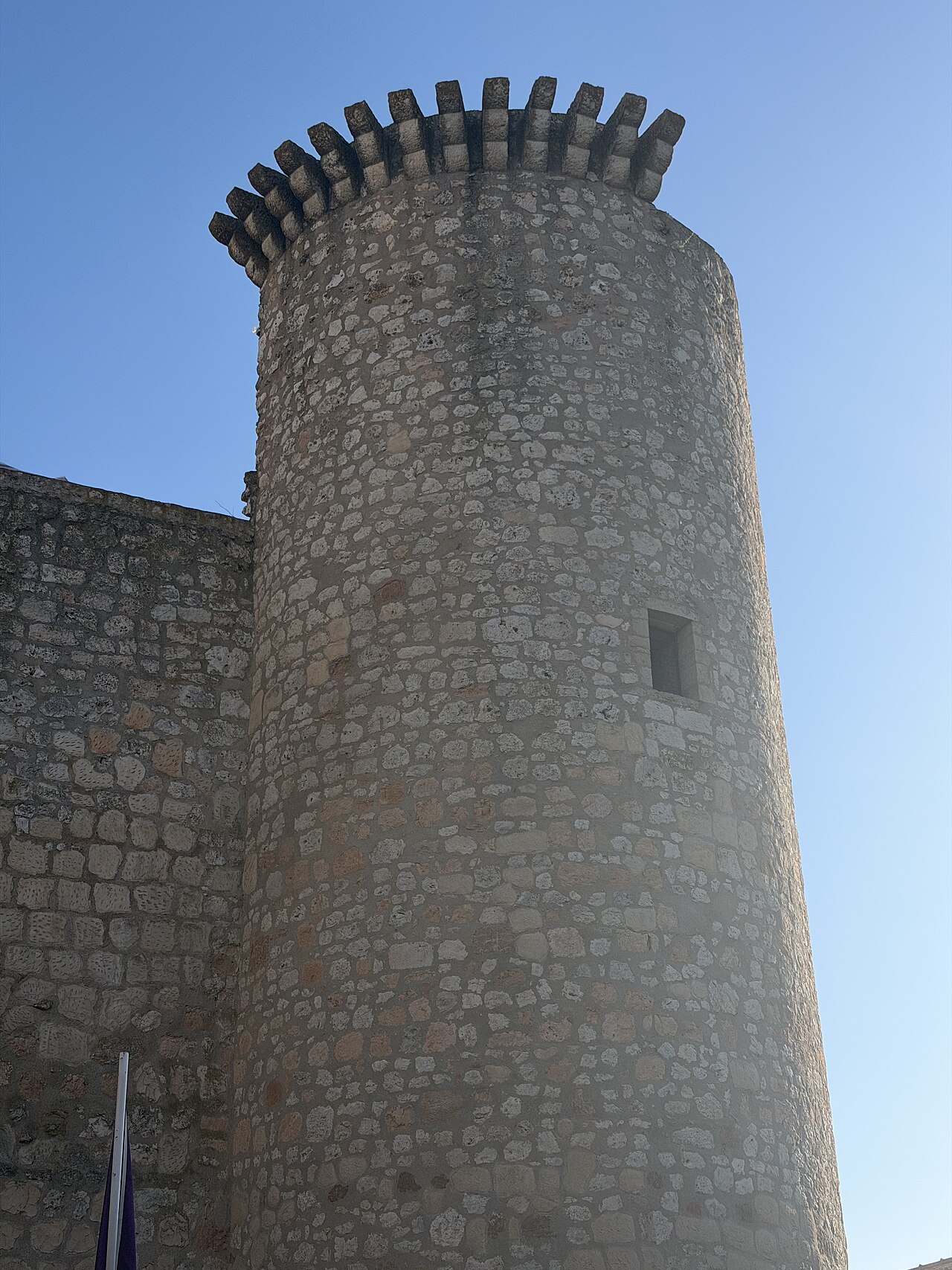
The castle's main entrance is located on the southern side, accessed via a steep, narrow path through an olive grove. This gateway is flanked by two large semicircular towers designed to repel attackers. The outer defenses include four circular towers and one rectangular tower with a robust base, strategically positioned to cover all approaches except the southeast corner, which notably lacks a corner tower.
The battlements crowning the walls and towers feature crenellations, alternating raised merlons and gaps, providing defenders with protection and firing positions. The towers are equipped with terraces and narrow arrow slits, enabling archers to observe and target enemies while remaining shielded. The walls themselves are solid, lacking firing embrasures, emphasizing a defensive strategy based on height and visibility.
Interior spaces and residential quarters
Within the castle, the interior is largely empty except for the southern bailey, which contains a large square pit covered with wooden planks, likely serving as a cellar or storage area. A passageway along the northern wall provides access to the ramparts, allowing defenders to patrol the full length of the walls.
The main rectangular tower on the southern wall houses a small chapel dedicated to Our Lady of Castejón, the patroness of the town of Jadraque. This religious space reflects the castle's dual role as a fortress and noble residence, integrating spiritual functions into its design.
The northern sector contains the former residential quarters, which incorporate elements of Renaissance Italianate design. These living spaces were carefully integrated with defensive features, balancing comfort with security. The absence of a moat is compensated by the castle's elevated position and clear sightlines over the surrounding landscape.
Decline, restoration, and current status
Following the death of Rodrigo Díaz de Vivar y Mendoza, the castle passed to the Dukes of Infantado. Over time, its strategic and residential importance waned, leading to gradual abandonment. It briefly regained military significance during the War of Spanish Succession in the early 18th century but never fully recovered its former status.
By the 19th century, the castle belonged to the House of Osuna. Its dilapidated state led to its sale in 1889 to the municipality of Jadraque for a nominal sum. Subsequently, a restoration effort lasting approximately 30 years sought to stabilize and preserve the structure, although weathering continues to challenge its walls. Notably, one of the entrance towers collapsed in recent decades due to deterioration.
Today, Jadraque Castle is freely accessible to visitors, with an empty interior that allows exploration of its ramparts and courtyards. It is protected as a historic monument under Spanish heritage laws enacted in 1949 and 1985. Ongoing conservation and archaeological research aim to safeguard its legacy and enhance understanding of its layered history.
Cultural significance and visitor experience
The castle's association with the legendary El Cid—though historically unconfirmed—adds to its cultural allure. Its architectural evolution from a Moorish fortress to a Renaissance palace-fortress encapsulates key moments in Spanish history, reflecting shifts in military technology, noble power, and artistic influence.
Visitors today can appreciate the castle's commanding views over the Henares valley, the craftsmanship of its stone walls and towers, and the peaceful atmosphere of its hilltop setting. The site offers insights into medieval military architecture, Renaissance residential design, and the complex history of Castilian nobility.
While the castle lacks extensive interior furnishings or exhibitions, its open access and dramatic location make it a compelling destination for history enthusiasts, architecture scholars, and travelers seeking to connect with Spain's rich medieval heritage.
Access and amenities
The castle is reached by a steep path through olive groves, requiring a moderate level of physical fitness. There are no visitor facilities within the castle itself, so visitors are advised to prepare accordingly. The municipality of Jadraque manages the site and provides information for tourists interested in exploring the castle and the surrounding historic town.
Frequently asked questions (FAQ)
- What is the historical significance of Jadraque Castle?
- Jadraque Castle, a remarkable example of medieval military architecture, dates back to the 15th century. It served as a strategic fortress during the Reconquista, playing a vital role in the defense against Moorish forces in Spain.
- When was Jadraque Castle built?
- Construction of Jadraque Castle began in the late 15th century, with significant modifications made over the years. Its design reflects the transition from Gothic to Renaissance styles, showcasing the architectural evolution of the period.
- How do I get to Jadraque Castle?
- Jadraque Castle is located just off the CM-1000 road in the province of Guadalajara, Spain. Visitors can reach it by car or public transport, with parking available nearby for convenience.
- What are the opening hours for Jadraque Castle?
- Jadraque Castle is typically open to visitors from 10 AM to 6 PM during the peak season, with shorter hours in the off-season. It is advisable to check the official website or local tourist information for any seasonal changes in opening times.
- Can I take guided tours of Jadraque Castle?
- Yes, guided tours are available and provide an in-depth look at the history and architecture of Jadraque Castle. These tours are led by knowledgeable guides who share fascinating stories and insights about the castle's past.
- Is it possible to access Jadraque Castle with limited mobility?
- While Jadraque Castle has some paths and areas that can be accessed with limited mobility, the castle's terrain and historic structure present challenges. Visitors with mobility concerns are encouraged to contact the site in advance to discuss accessibility options.
- When is the best time to visit Jadraque Castle?
- The best time to visit Jadraque Castle is during the spring and fall months when the weather is mild and ideal for sightseeing. Additionally, visiting during local festivals can enhance your experience with cultural events and activities.
- What are the ticket prices for Jadraque Castle?
- Ticket prices for Jadraque Castle are generally affordable, with discounts available for students, seniors, and children. It's advisable to check the official website for the most current pricing and any available promotions.
- Are there any nearby attractions to visit alongside Jadraque Castle?
- Yes, nearby attractions include the charming town of Jadraque itself, which features picturesque streets and local eateries. Additionally, visitors can explore other historical sites and natural parks in the Guadalajara region, making for a full day of exploration.
Photo gallery

Information
Loading map...
Visitor reviews
No reviews yet. Been here? Write the first review and help other travelers!
Write the first reviewVisited this castle? Share your experience
Your review helps other travelers and adds first-hand knowledge to our encyclopedia.